

News leaders share strategies for avoiding churn, even at the moment of cancellation
Readers First Initiative Blog | 22 June 2026




What are the warning signs a subscriber is going to churn? And how can publishers respond?
Often, proactive measures are in place to engage users in the product and reinforce its value, but some publishers are even viewing the moment of cancellation as an opportunity to strengthen the relationship.
During the recent INMA Subscriber Retention Master Class, researchers and media leaders discussed strategies for recognising and addressing customer disengagement to improve retention.
Sleeping beauties and sleeping dogs
Today’s subscription executives are haunted by a variety of unsavoury characters, including zombies, ghosts, and even angry dogs.
But Greg Piechota, INMA researcher-in-residence and lead of the Readers First Initiative, reframed the notion of subscription zombies, referring to them instead as sleeping beauties because “it’s much better to kiss a sleeping beauty than a zombie.”
Regardless what you call them, they pose a threat to news media organisations.
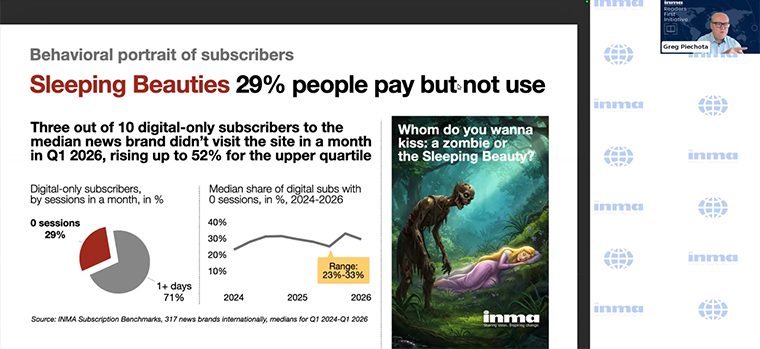
Based on INMA Benchmark research, 29% of paying subscribers for median news brands failed to visit the news Web site even once a month. And the news was even worse for the upper quartile of news brands, where that number jumped to 52%.
These “sleeping beauties” present a significant challenge because “they are all subscribers potentially at risk,” Piechota explained.
Also of concern is that numbers haven’t moved much since 2024, which means the situation isn’t getting better: “It’s ... a big problem,” Piechota said. “When we compare the proportion of those sleeping beauties with the churn rates, we clearly see that news brands that see a higher proportion of sleeping subscribers also see higher churn rates.”
On the flip side, by engaging users just a little — as infrequently as two visits per month — companies can see their churn rates decline.
In many cases, subscribers may have mentally churned but are still paying for the news. The question Piechota posed was whether to wake these “sleeping dogs” or let them lie.
“Of course, the common wisdom would tell you, ‘Beware of poking a sleeping dog because they can actually bite you.’ Sometimes …when we see people completely disengaged and we try to do something about it, we can actually trigger cancellation.”
That’s because they might not be aware that they were still paying for something they aren’t using.
Research from Professor Eva Ascarza at the Harvard Business School reinforces this idea, and her work suggests trying different re-engagement actions on a small section of disengaged users to see what is most successful. Then, scale those actions to users who “look likely to respond well rather than cancelling.”
The Philadelphia Inquirer shifts from reactive to proactive
Instead of relying on last-minute save offers, the team at The Philadelphia Inquirer focused on identifying subscriber needs earlier and improving the overall customer experience. One of the most interesting elements of the strategy is a programme known as “Future Stops.”
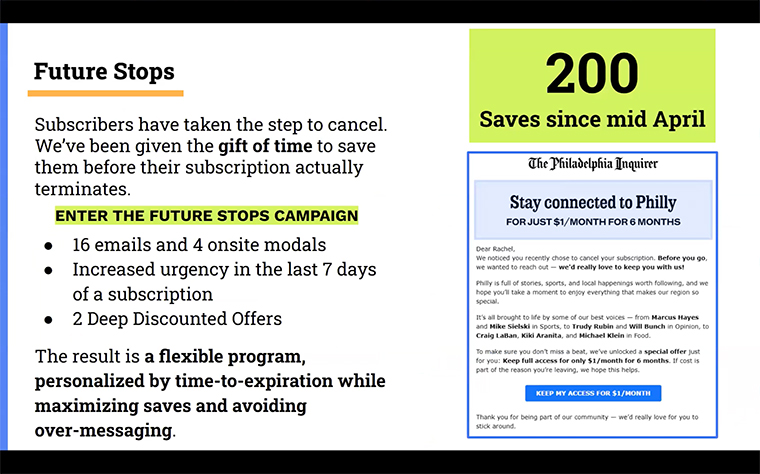
The initiative focuses on subscribers who have already submitted cancellation requests but still retain access to their subscriptions until the end of their billing period. Rather than viewing those subscribers as already lost, The Philadelphia Inquirer sees an additional opportunity to strengthen the relationship.
“That gap between the cancel request and the actual stop date is a gift, a gift of time,” Rachel Ciampaglia, senior director of subscriber service and retention, said.
The programme uses personalised e-mail sequences and on-site messaging to keep subscribers engaged throughout the remaining access period. Communications are adjusted according to how much time remains before expiration, ensuring subscribers receive relevant outreach without being overwhelmed.
The strategy focuses on reminding readers of the value they receive before emphasising promotional offers.
“We remind them what they’re walking away from before we even talk price,” Ciampaglia said.
The Philadelphia Inquirer's transformation ultimately extends beyond customer service, cancellation flows, or AI. At its core, the strategy reflects a broader evolution in how organisations think about subscriber relationships. The results suggest that approach is paying off.
Since implementing its proactive retention framework, The Philadelphia Inquirer has increased its save rate by 20 percentage points and now retains 60% of subscribers who reach out to cancel. Future Stops in particular has already saved roughly 200 subscribers who had previously chosen to leave.
For Ciampaglia, however, the most important takeaway is not a specific metric but a shift in philosophy: “We’ve moved from reactive to proactive. That shift is the whole story. And the numbers say it’s working.”
Research: Auto renewal locks in disengaged subscribers
About 35% fewer readers start a trial subscription when the offer comes with auto renewal rather than auto cancellation.
Professor Klaus Miller, a professor of marketing at HEC Paris who previously worked in the news industry, presented findings from a large-scale field experiment that he conducted alongside co-authors Navdeep Sahni from Stanford University and Avner Strulov-Shlain from the University of Chicago Booth School of Business.
The experiment, which ran from 2018 to 2020, tested auto renewal against auto cancellation with 1.4 million readers of a leading European premium newspaper, one that Miller described as comparable to The New York Times or The Guardian in Europe, with a strict paywall and about 10 free articles per week.
The central question the research set out to answer was whether auto renewal grows a business or simply locks in disengaged subscribers. The first finding concerned what Miller called the “take-up rate,” meaning how many readers chose to start a trial in the first place.

“Users actually anticipate their future inertia, so their fear of getting stuck in a subscription which they will be unable to cancel,” he said.
The result was about 35% fewer readers starting any subscription when the offer was auto renewing, in line with a 40%-41% drop in promotional period subscription take-up.
The more striking finding was on engagement. Auto renewal subscribers used the product significantly less.
“All else being equal, auto-renewal users use or generate about 62% fewer pages if they are in the auto renewal condition,” Miller said. “That does mean that the auto renewal users are not necessarily valuing the service very much. Essentially, they are stuck in a contract they are not using, and they are failing to cancel their contract.”
Miller acknowledged auto-renewal may be appropriate for some users, specifically heavy users who genuinely value the product and benefit from not having to resubscribe each month. But for the others, an auto canceling contract would be much better.
“The best long-term strategy isn’t to trap consumers,” Miller said, “but to give them a reason to stay.”
Spotting disengagement: Behavioural drift
Tom Burrell, retention consultant and author of The Retention Blueprint, said sometimes the “moments of truth” create an immediate churn trigger, and they almost always create behavioural drift. Eventually, this change in behaviour leads to the customer feeling like:
- “I don’t feel value fast enough.”
- “I feel guilty because I’m paying but not using it or don’t have time.”
- “This is not exciting anymore.”
- “I don’t feel valued.”
Burrell said that while immediate churn triggers can be identified in the data and corrected, behavioural drift is harder to identify and address.

“Behavioural drift is where you move away from value,” Burrell said. “Your normal relationship with the brand is shifting away from what you’d expect it to be.”
This results in the decision to leave. Before a customer makes that conscious decision to cancel, however, there are ways that publishers can track that behavioural drift, even though it might not be as obvious in churn risk models.
Churn models are based on hard signals — but behavioural drift happens before these signals show up.
Burrell shared some examples:
- The user first opens the app four times a week, then it falls to two times.
- The user goes from reading 45 minutes a week to reading 20 minutes.
- The user begins by exploring new content, then shifts to reading in the same category.
- The user goes from raising support tickets to ignoring messages about engagement.
“Churn signals occur when customers become conscious that they want to leave,” he said.
Related Articles
-

Bundling is a pricing decision, rebundling is an organisational...
18 October 2026 -

7 themes from Madrid show publishers trading traffic for relati...
28 September 2026 -

AI’s effect on super user math
15 September 2026 -

What I told 40 CEOs (and won’t gatekeep from you)
30 August 2026 -

Economist launches subscription tier targeting younger audience...
20 July 2026 -

Inside Denník N’s successful subscription strategy
15 July 2026 -

News media companies create strong foundations for long-term su...
21 June 2026 -

Bonnier News Local, Gota Media strike gold with their Core Mode...
21 June 2026
Upcoming Events
-

Subscriber Acquisition Master Class
10-17 November 2026
-

Media Advertising Summit
New York, United States
07-10 December 2026
-

AI-Native News Product Master Class
18-25 February 2027
-

Media Subscriptions Summit
Oslo, Norway
08-12 March 2027
-

World Congress of News Media
New York, United States
25-30 April 2027
-

Branded Content & Partnerships Master Class
20-27 May 2027
-

Subscriber Retention Master Class
17-24 June 2027
-

Conferencia Latinoamericana
15-16 July 2027
-

South Asia News Media Festival
New Delhi, India
19-22 July 2027
-

Asia/Pacific News Media Summit
19-20 August 2027
-

CEO Roundtable at Kilkenny
Kilkenny, Ireland
24-26 August 2027
-

Media Innovation Week
Amsterdam, The Netherlands
27 September - 01 October 2027








