

Preparing for an inflation shock: how to absorb a likely spike in churn?
Readers First Initiative Blog | 15 June 2026

The end of war in Iran still feels unpredictable and threatens an inflation shock across the world. “If the market does take a dip, and your customers en masse begin to re-evaluate their spending habits, are you prepared?”
Jonathan Gupta-Buckley, founder of The Twenty One and formerly with Dow Jones, called to action in his opening lecture at this month’s INMA Subscriber Retention Master Class.
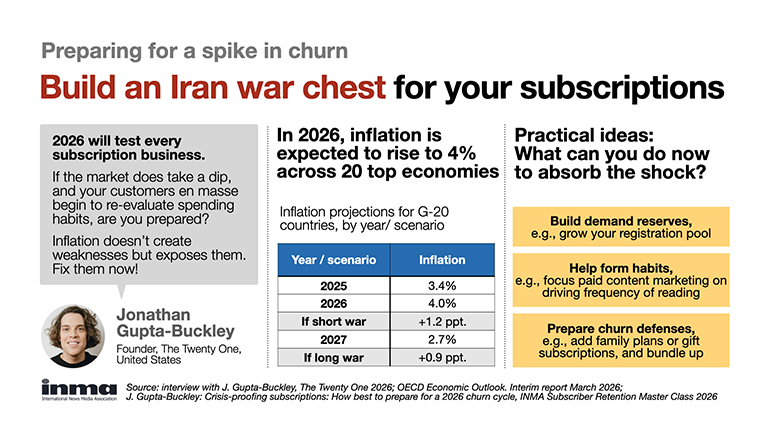
In his opinion, inflation doesn’t create weaknesses but rather exposes them. And the time to fix them is before subscribers start looking for cuts.
His advice is to build these as soon as possible:
Demand reserves, e.g., through registrations.
Habits, e.g., with paid content marketing.
Churn defenses, e.g., shared subscriptions.
Beware the churn bubble
We’ve seen this movie before. After Russia’s invasion of Ukraine in 2022, inflation across the G-20 nearly doubled by autumn. According to INMA Subscription Benchmarks, median subscription churn rates rose sharply and peaked one quarter later.
In April, a month after the Iran war started, INMA warned publishers, asking: Should we raise prices? Can we raise prices? What pricing tactics can help?
For Gupta-Buckley, the biggest risk is not mispricing the product but rather discovering your paying subscribers don’t use it in the first place.
He called it “a churn bubble,” which is fueled by aggressive acquisition tactics and inadequate onboarding and in-life engagement:
Prospects and past subscribers without any attachment to the product.
Trialists who never formed a habit of regular visits.
Paying subscribers who fell asleep and stopped visiting at all.
This bubble stays hidden when demand for news and subscriptions is strong. It bursts when the economic pressures force consumers to watch every penny.
The scale of the risk is huge. INMA Benchmarks show that in Q1 2026, 69% of online users visited a median news site only once in a month; 29% of paying subscribers had not visited even once, rising up to 50% for the upper quartile of brands.
Build a reserve before you need it
Many publishers think about retention as a downstream activity. Gupta-Buckley believes it starts much earlier.
His advice is to aggressively grow registrations now. Registered users convert better than anonymous visitors as registration is a form of expressing a brand preference, and they become addressable for your marketing, e.g., on social media.
As acquisition might become harder or more expensive when costs of living rise, a registration base could become a “war chest” or a reserve of future demand for subscriptions.
How do news brands maximise registrations? “What typically is missing is a fair value exchange. Let them sample more content until you get them to a point of ‘now I am willing to pay.’”
Focus your advertising budget on habits, not only sales
“Eighty-five percent to 90% of ad dollars is being spent telling people to ‘buy now,’” Gupta-Buckley criticised.
He recommends shifting a minimum 60% of the spend to the mid-funnel, especially to content marketing, including to promoting evergreen content proven to engage readers in the past.
Optimising ads for clicks on links rather than for business outcomes, like conversion, expands the target audience for ads, and it lowers the cost of ads.
The prospect subscribers lured to read your greatest articles will see subscription offers when on the news site anyway. And the existing subscribers — captured by ads on social media or elsewhere — will get more value for what they had already paid.
“It’s frequency that gets people to pay, and it’s frequency that gets people to stay,” Gupta-Buckley reminded master class attendees.
Build retention defences before inflation bites
Some of the master class ideas overlap with lessons from INMA’s pricing research.
Gupta-Buckley encouraged publishers to think beyond individual subscribers and build household products: Shared access, family plans, and bundles make cancellation more costly because:
Multiple people depend on the subscription.
Bundles serve multiple needs and not only informational needs (games anyone?).
This mirrors what we see in industry data. For example, at The New York Times, bundle subscribers generate slightly lower ARPU than news-only subscribers but churn roughly 40% less and therefore create estimated 60%-80% more lifetime value.
In Q1 2026, 28% of the top 50 news subscription brands offered bundles that included subscriptions to other publisher’s products and 30% offered family plans or extra subscriptions to gift.
Greg’s Readers First newsletter is a public face of a revenue and media subscriptions initiative by INMA, outlined here. INMA members can subscribe here.
Related Articles
-

Bundling is a pricing decision, rebundling is an organisational...
18 October 2026 -

7 themes from Madrid show publishers trading traffic for relati...
28 September 2026 -

AI’s effect on super user math
15 September 2026 -

What I told 40 CEOs (and won’t gatekeep from you)
30 August 2026 -

Economist launches subscription tier targeting younger audience...
20 July 2026 -

Philadelphia Inquirer turned cancellation moments into loyalty ...
29 June 2026 -

Bonnier News Local, Gota Media strike gold with their Core Mode...
21 June 2026 -

Hamburger Abendblatt unlocked a 20% subscription uplift with we...
14 June 2026
Upcoming Events
-

Subscriber Acquisition Master Class
10-17 November 2026
-

Media Advertising Summit
New York, United States
07-10 December 2026
-

AI-Native News Product Master Class
18-25 February 2027
-

Media Subscriptions Summit
Oslo, Norway
08-12 March 2027
-

World Congress of News Media
New York, United States
25-30 April 2027
-

Branded Content & Partnerships Master Class
20-27 May 2027
-

Subscriber Retention Master Class
17-24 June 2027
-

Conferencia Latinoamericana
15-16 July 2027
-

South Asia News Media Festival
New Delhi, India
19-22 July 2027
-

Asia/Pacific News Media Summit
19-20 August 2027
-

CEO Roundtable at Kilkenny
Kilkenny, Ireland
24-26 August 2027
-

Media Innovation Week
Amsterdam, The Netherlands
27 September - 01 October 2027








