

The subscription cyclone started with a US$1 bet in Boston, swept the world
Readers First Initiative Blog | 15 November 2026

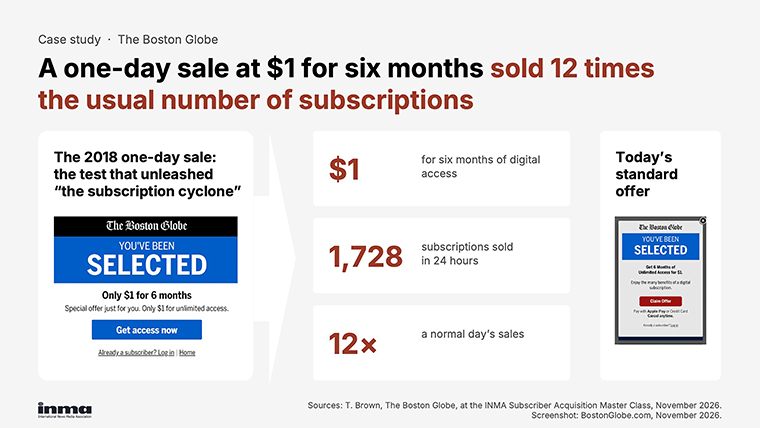
On September 27, 2018, The Boston Globe offered six months of digital access for US$1. By the end of the day, 1,728 people had subscribed, about 12 times the roughly 140 starts The Globe saw on a normal day.
That one-day sale was the start of what we now call “the subscription cyclone” — sell fast at a token price, then use a long trial to earn the full one.
The question was what would happen six months later, when those readers got their first full-price bill.
Tom Brown, The Globe’s chief consumer revenue officer, took us back to that experiment this November at the INMA Subscriber Acquisition Master Class.
At the time, The Globe had about 75,000 digital subscribers, but year-on-year growth had slipped below 10%.
The team believed more people in New England would pay for the journalism if they had a chance to make it part of their lives. Asking a new reader to commit to roughly US$30 a month was a high hurdle.
Asking for US$1 gave The Globe six months to show what the journalism was worth.
What happened after the trial
The team worried a flash sale might simply bring forward purchases that would have happened anyway. And it would not know for six months whether these readers would stay once the price rose.
One early sign was good: The new subscribers were reading more than subscribers who had joined on the previous four-week offer.
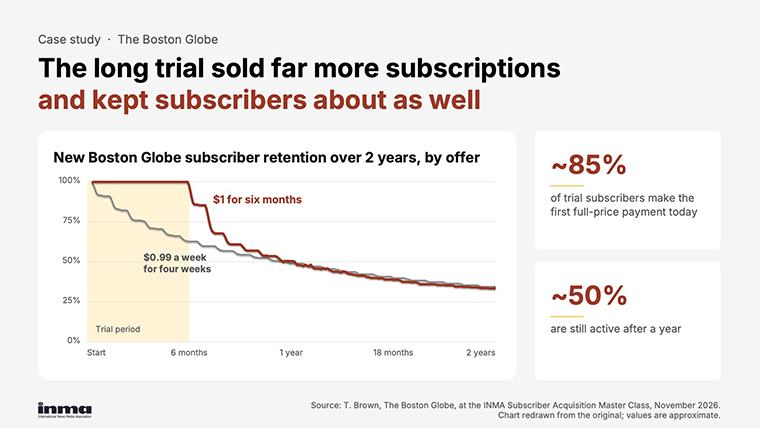
The six-month cohort did see bigger drops at its first two full-price payments. But by the one-year mark, its retention curve was close to the old offer’s.
The curves stayed close at 18 months and two years. The Globe was keeping a similar share of a much larger group.
That is the business logic of the long trial. A deeply discounted long offer converts far more readers than a short one — and keeps them about as well.
Each of those subscribers is worth less on average because the first six months bring in only US$1. But there are many more of them, so total revenue is higher. The Globe chooses the total.
“Our most important metric is total revenue,” Brown said. “It is not subscriber volume or average rate paid.”
Managers trained to maximise lifetime value per customer may find that counter-intuitive.
Unleashing the cyclone
The Globe made the six-month trial its standard offer in 2019.
It had taken The Globe seven years to reach 100,000 digital subscribers. It took less than one more to reach 200,000. The subscriber base grew 51% in 2019 and 55% in 2020.
In the class Q&A, Brown gave today’s numbers. About 85% of trial subscribers make the first full-price payment, around 75% make a second, about 65% a third, and close to half are still active after a year.
He also described what happens when a publisher moves heavily into long trials. For the first six months, more people are coming in, but they are paying very little. Brown called it a “cash flow valley.” The publisher has to be able to carry that gap while it finds out how many readers will stay.
The full price trial subscribers step up to is high. A Globe digital subscription costs US$6.93 a week, billed as US$27.72 every four weeks (so The Globe’s full year has 13 payments).
The new bundle with Boston.com and Boston magazine steps up to US$32 every four weeks or US$416 a year. Brown said the team tested US$30, US$32, US$34, and US$36 before settling on it.
For comparison, The New York Times lists its All Access bundle at US$30 every four weeks after the first year. The median brand in INMA’s benchmarks earns about US$12 a month per subscription, discounts included. We adjust revenue metrics for differences in purchasing power between countries.
The subscription cyclone — eight years later
In 2019, The New York Times also introduced US$1 a week for 12 months. Others followed.
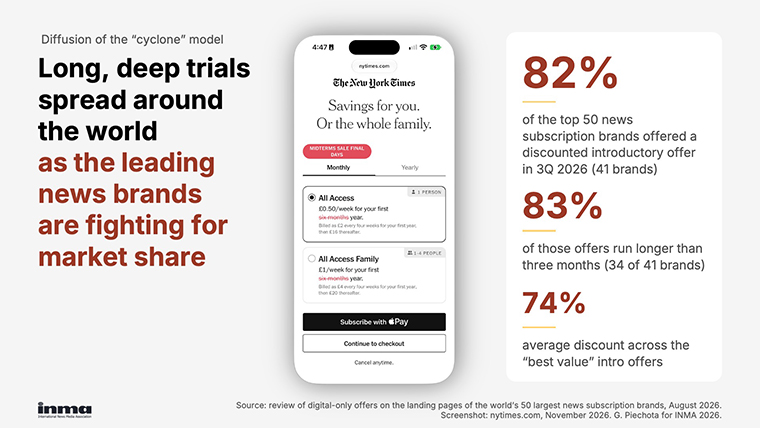
When I first counted in early 2022, 68% of the world’s 50 largest news subscription brands offered a discounted trial, and two-thirds of those ran longer than three months. The cyclone had spread.
In the third quarter of 2026, I reviewed the same brands’ public offers again. Of the top 50, 82% offered a discounted introduction. Of those, 83% had an introductory offer lasting more than three months.
The offers highlighted as best value on their landing pages averaged 74% below the subsequent price.
These figures describe what publishers put on their landing pages. The Globe’s cohort data tell us something the storefronts cannot: what readers did when the price changed.
Why The Globe still runs the same offer
Eight years on, a dollar for six months is still the only offer on The Globe’s paywall and the one it chose in October for the new bundle. That is unusual.
Promotions tend to wear out. Dartmouth College tracked 589 packaged-goods brands over 13 years and found the response to price promotions declined at three in four of them, by about 4% a year. At The Globe, conversion has gone the other way.
It is not for want of alternatives. Brown said The Globe has A/B tested its offers for more than a decade, including “much more complex approaches,” and still runs other prices and annual plans in channels such as e-mail, where they sometimes earn more from former subscribers.
“It’s less about the six months being the perfect science,” he told us. “It’s more about a low rate with a long intro period.”
On the paywall, where a reader wants one article, The Globe shows a single offer: “We don’t want to show them three offers.”
Does a US$1 price cheapen the brand? Brown has heard the charge that the offer is “gimmicky.” His answer is that a dollar is still a price.
“Although a deep discount, it values our product because we’re still asking you to pay for it,” he said. “We’re not giving it away for free.”
Free sampling, in his view, is what signals a lack of value. “We see it as a bet on ourselves,” he explained, “to give us six months to prove to people that we’re worth it.”
The cyclone changes when the work of engagement happens. In a conventional funnel, we try to build a habit before asking someone to pay. With a low-priced trial, someone may subscribe to get past the paywall on a single story.
Brown accepts that some readers treat the dollar as a micropayment. He prefers that to a true micropayment, which would give The Globe less time to turn them into subscribers.
So the work of giving trialists reasons to come back starts immediately. Brown said The Globe’s redesigned onboarding produced a big increase in first-month engagement against a holdout group.
Why acquisition deserves more attention
The Globe’s own numbers show where the growth came from. Since 2018, its conversion rate has risen 414%, while monthly churn has fallen 15%.
The INMA Subscription Benchmarks show the same asymmetry. In June, we looked at 175 news brands with complete data from 2019 to 2025. We asked whether publishers that grew did so mainly by acquiring better than comparable peers or by retaining better.
Above-peer acquisition had about 2.5 times the standardised association with subscriber-base growth that above-peer retention did.
This is a finding about how brands grew over the period. It shows which lever moved the base, not what either lever costs, and it is no forecast of what any particular discount will deliver.
The same work gives retention teams a reason to pay attention. According to my analysis, a sustained one-point rise in the monthly acquisition rate raises churn by about half a point within a year, almost all of it in the first four months.
That is the benchmark version of The Globe’s bigger drops at the first two payments.
The benchmarks also put a number on Brown’s valley. At panel median prices, a subscription is worth about US$207 over its life, and only US$70 of that arrives in the first 12 months.
If you were running the test today, you would keep the current offer as a control and follow both groups through several full-price bills. You’d compare renewals and cumulative revenue per reader shown the offer. And you’d check whether your company could afford the gap before the renewals came in.
The Globe knew by midnight that a dollar could sell a lot of subscriptions. It took much longer to learn that the people who bought them would keep paying. That was the result worth building a strategy around.
Greg’s Readers First newsletter is a public face of a revenue and media subscriptions initiative by INMA, outlined here. INMA members can subscribe here.
Banner photo: Adobe Stock by Mojahid Mottakin.
Related Articles
-

At Mediacorp’s CNA, loyalty means giving audiences a reason to ...
20 August 2026 -

Tribun Network turns print “dots” into AI-powered insight
20 August 2026 -

Economist launches subscription tier targeting younger audience...
20 July 2026 -

Grupo RBS builds social-first video operation to expand audienc...
20 July 2026 -

Inside Denník N’s successful subscription strategy
15 July 2026 -

10 years later, user needs must be twinned with content formats...
1 July 2026 -

Hamburger Abendblatt unlocked a 20% subscription uplift with we...
14 June 2026 -

Rheinische Post programme turns print loyalty into digital conf...
11 June 2026
Upcoming Events
-

Subscriber Acquisition Master Class
10-17 November 2026
-

Media Advertising Summit
New York, United States
07-10 December 2026
-

AI-Native News Product Master Class
02-09 February 2027
-

Media Subscriptions Summit
Oslo, Norway
08-12 March 2027
-

World Congress of News Media
New York, United States
25-30 April 2027
-

Branded Content & Partnerships Master Class
20-27 May 2027
-

Subscriber Retention Master Class
17-24 June 2027
-

Conferencia Latinoamericana
15-16 July 2027
-

South Asia News Media Festival
New Delhi, India
19-22 July 2027
-

Asia/Pacific News Media Summit
19-20 August 2027
-

CEO Roundtable at Kilkenny
Kilkenny, Ireland
24-26 August 2027
-

Media Innovation Week
Amsterdam, The Netherlands
27 September - 01 October 2027








