

Will newsletters survive the AI assault on e-mail?
Readers First Initiative Blog | 23 August 2026

Publishers know “Google Zero” as the moment search engines stop sending traffic: the AI answers, nobody clicks. The same play is now likely extending to e-mail, the last big channel publishers bet no algorithm could take away.
The evidence is in this year’s product announcements.
In January, Google declared Gmail “entering the Gemini era”: AI summaries of long threads are now free and default for everyone; asking your inbox questions is a paid tier; an AI inbox that surfaces what matters and extracts your to-dos is with trusted testers.
Since April, Microsoft’s Copilot in Outlook, for early-access customers, runs the inbox: triaging, chasing non-responders, writing rules, moving meetings. In Microsoft’s own words: “Copilot works for you, not with you.”
Apple Intelligence has been sorting and summarising mail since 2024. In July, these three companies — Google, Apple, and Microsoft — controlled 95% of global e-mail client market share, per Litmus.
This is decoupling, a disruption pattern Harvard Business School Professor Thales Teixeira and I described in our 2019 book, and have since watched repeat, most recently in AI search.
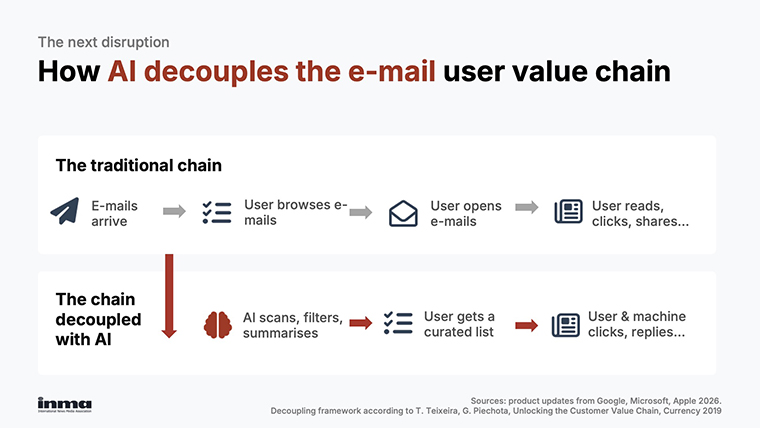
The customer value chain — “publisher sends > reader opens > reader reads” — is being cut between the first and second link.
Soon my agent will read my 30+ morning newsletters, brief me on three things worth knowing, and surface perhaps one piece worth opening: the zero-click inbox.
Bullish on e-mail, bearish on the inbox
I have argued this year that publishers underinvest in e-mail. I still do. The AI mailboxes don’t change the case. They change what the investment must buy.
The case, briefly: In the INMA Subscription Benchmarks, e-mail household reach correlates with digital subscription penetration. The headroom is vast: The median list is 5.7 times the digital subscriber base yet reaches only 12.7% of market households and grows just 0.7% a month.
And the behaviour already exists at an enormous scale: A new Northeastern University study tracking 4,608 Americans’ desktop browsing found e-mail took 24.9% of online time, a similar level with social media, 10 times news sites.
Gmail alone commanded 16.4% of online time, more than the bottom 300,000 Web sites combined.
The meaningful relationship limit
Many publishers and consultants call e-mail a “direct relationship.” An address is permission to attempt a relationship. In an AI-mediated inbox, it is not even attention.
The binding constraint is not inbox space but human relational capacity. British anthropologist Robin Dunbar’s research finds relationships organised in layers: roughly five intimate ties, then 15, 50, 150, with a steep drop-off that no technology has moved.
The Economist editor Tom Standage’s media history books show why: From Cicero’s letter network to coffee houses to the telegraph, people exchange information to maintain ties, build reputation, and decide whom to trust. Mass media was the anomaly; the constraint is permanent.
Newsletters obey the same physics. People subscribe to hundreds and form routines with a handful: a tiny inner circle read almost always, a middle ring read when relevant, a vast periphery subscribed to once and never noticed since.
In the AI inbox
Engagement is among the signals mailbox AI uses to judge whether a sender delivers value. Every ignored send is a data point; the data points compound; the classifier learns to bury your newsletters.
Growing the list and mailing the list, treated as one motion for 20 years, now pull in opposite directions. Winners will acquire aggressively and send ruthlessly less.
Meanwhile, the industry prepares for the wrong revolution. Litmus’ State of Email 2026 report finds professionals deploying AI overwhelmingly on the sender side — writing, personalising, optimising — while fewer than one-third have any strategy for AI on the recipient side, where the leverage sits.
The sociologist Dominik Batorski once told me the history of the Internet is a history of tools for navigating information overload: directories, search engines, feeds, aggregators, chatbots, now AI agents. Publishers use AI to produce more; consumers will pay AI to consume less.
E-mail strategy consultant Dan Oshinsky’s survival advice is: Build a brand with an unmistakable voice, a community that makes subscribers stakeholders, a business that extends beyond the send.
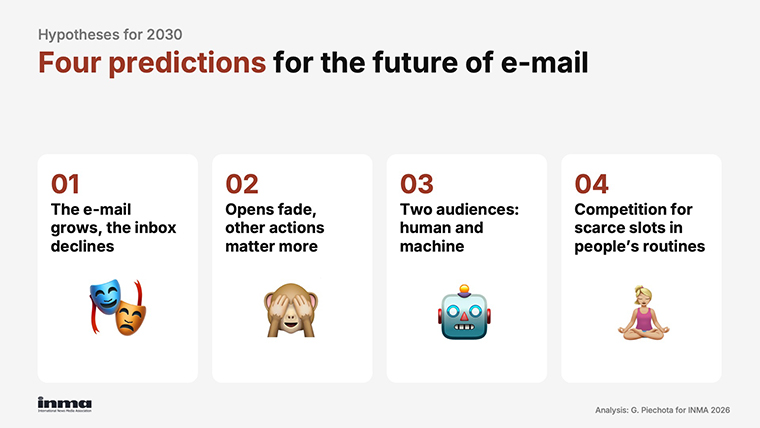
Four hypotheses for 2030
How to thrive in the era of AI-mediated discovery?
E-mail grows more important as the inbox grows less. E-mail becomes the universal infrastructure for identity, permission, and machine-to-machine correspondence, where your agent needs my address to negotiate with mine. The inbox as a destination, where an envelope competes for a human open, declines. Invest in e-mail but stop assuming the return arrives through opens.
Open rates die as a metric before opens die as a behaviour. Once summaries are default, an “open” means a model rendered your message. The successor metrics are relational: replies, direct visits, attendance, willingness to pay.
Every newsletter gets a second reader. Machines will parse your content to decide whether humans see it. Deliverability depends on clarity, structure, and an attributable voice. You now write for the reader, and for … the reader’s bouncer.
The competition was never for the inbox. It is for one of a cognitively limited number of slots in a person’s repertoire of relationships and routines, and it is channel-agnostic. For younger audiences, those slots already sit in group chats and creator feeds more than in their inbox.
For 20 years the publisher’s question was “Can we reach you?” The AI era demands a harder one: “Are we important enough that you, or your agent, choose us?”
Greg’s Readers First newsletter is a public face of a revenue and media subscriptions initiative by INMA, outlined here. INMA members can subscribe here.
Banner photo: Adobe Stock by CuteBee.
Related Articles
-

Marketers should outsource tasks, not thinking
25 October 2026 -

What’s next for newsletters in the age of AI?
21 October 2026 -

Bundling is a pricing decision, rebundling is an organisational...
18 October 2026 -

AI’s effect on super user math
15 September 2026 -

The front door is gone — and Asia-Pacific publishers are rebuil...
26 August 2026 -

At Mediacorp’s CNA, loyalty means giving audiences a reason to ...
20 August 2026 -

Tribun Network turns print “dots” into AI-powered insight
20 August 2026 -

Nation Media Group focuses editorial strategy on stories that m...
4 August 2026
Upcoming Events
-

Subscriber Acquisition Master Class
10-17 November 2026
-

Media Advertising Summit
New York, United States
07-10 December 2026
-

AI-Native News Product Master Class
18-25 February 2027
-

Media Subscriptions Summit
Oslo, Norway
08-12 March 2027
-

World Congress of News Media
New York, United States
25-30 April 2027
-

Branded Content & Partnerships Master Class
20-27 May 2027
-

Subscriber Retention Master Class
17-24 June 2027
-

Conferencia Latinoamericana
15-16 July 2027
-

South Asia News Media Festival
New Delhi, India
19-22 July 2027
-

Asia/Pacific News Media Summit
19-20 August 2027
-

CEO Roundtable at Kilkenny
Kilkenny, Ireland
24-26 August 2027
-

Media Innovation Week
Amsterdam, The Netherlands
27 September - 01 October 2027








