

Creator journalism succeeds when tightly focused on audience needs
Young Audiences Initiative Blog | 29 September 2026

At the INMA Young Audiences Summit, Deutsche Welle journalist Johanna Rüdiger said her foray into creator journalism did not begin with a lofty plan, but with curiosity.
Launching Deutsche Welle’s first TikTok account in 2020, when “there weren’t many media houses or journalists on TikTok,” she had few examples to follow, so she began experimenting. She opened a personal account, tested formats, and used whatever worked to inform DW’s strategy. What began as a learning exercise soon grew into a thriving personal channel with a loyal international audience.
Audience-driven content
From day one, her content has been “extremely audience-driven,” which helped it resonate with viewers. She posted news updates about Germany in English because “basically that’s the only thing I know how to do,” and discovered a niche she hadn’t anticipated: immigrants in Germany who needed clear, accessible explanations of how news and policy affected their daily lives.
“I discovered this community of immigrants in Germany who don’t speak German yet, and there’s this really big knowledge gap in Germany,” she explained. She also found a following with “people around the world who are interested in Germany or have been in Germany or want to come.”
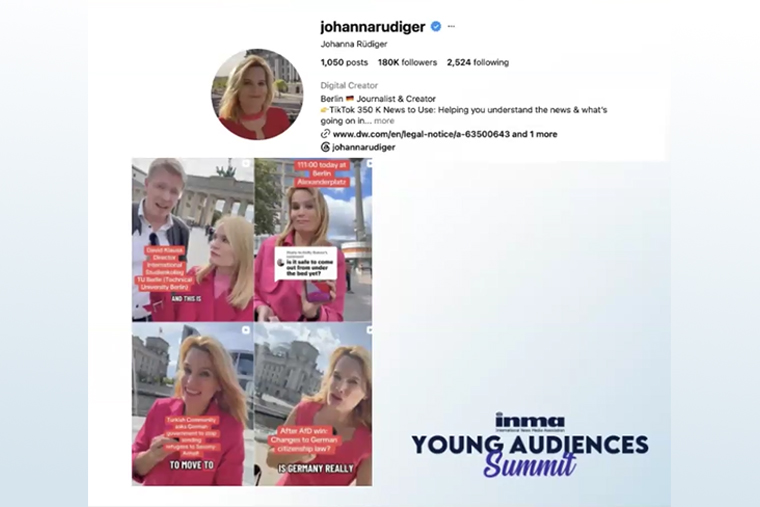
That audience shaped her editorial direction, reinforcing her belief that creator journalism must be built from listening rather than planning. Her style and approach evolved organically, and today her content is instantly recognisable, thanks to her strategic use of Berlin landmarks and her signature red‑and‑pink wardrobe.
Content strategy
Her approach is equally distinctive. Rüdiger’s videos often break down new laws, explain bureaucratic changes, or debunk disinformation — especially around the rise of the far‑right AfD. But she also produces quick, reactive updates when strikes or disruptions hit public life.
Those videos, she admitted, come with a unique pressure: “Now I feel guilty if I don’t [post on an event]. If something happens, sometimes I’m like, oh, not now, because then I have to go out and make a video because most people in my community think that is my day job,” she said. “They’re very demanding in the sense they’re like, why haven’t you post on this topic yet?”
That tension — between creator expectations and newsroom responsibilities — was a recurring theme in the conversation. Hasse asked how traditional colleagues reacted when Rüdiger first began posting, and she admitted the scepticism was immediate. Some dismissed TikTok journalism as unserious, even embarrassing.
Rüdiger recalled being asked on a panel whether she felt ashamed of her work. Many people were shocked to discover that she has an extensive traditional news background, including 10 years of print journalism. The reaction to creator journalism is reminiscent of the reaction to online journalism’s early days, she said.
“It was kind of the same arguments: ‘How dare you? That’s not journalism. If it’s online, that’s not journalism.’ I’ve never thought that way,” Rüdiger pointed out. “The journalism doesn’t depend on the platform; the platform is just another channel for me to bring my journalism to the people.”
It still requires the diligence of print and online reporting: “I have to do my research. I have to be fast. I have to be sure about my sources.” TikTok simply requires a different storytelling approach, one that prioritises relevance, clarity, and audience connection.
The power of branding
Branding strengthens that connection, something Rüdiger learned unintentionally. Her color‑coded outfits and Berlin backdrops became visual cues that helped viewers recognise her instantly. “People don’t know my name. They say the lady in the red coat,” she said.
In a realm where attention is fleeting, recognisability is everything.
Yet even with a strong brand, she learned the hard way that straying from her niche doesn’t work. Early in her creator journey, she tried posting travel content while on vacation. Her audience immediately rejected it.
“Nobody wanted to see me having fun in Rome,” she recalled. “People would comment, ‘When are you back to Germany?’”
That experience cemented her belief that creator journalism succeeds when it stays tightly focused on what the audience needs — not what the creator feels like posting.
Balancing her work as a creator journalist with her full‑time role at DW requires meticulous planning. She batch‑films multiple scripts in one session, changes coats to vary the visuals, and pre‑produces content for predictable news events.
Her videos may look spontaneous, but they’re carefully prepared. Above all, one rule never changes: “I can’t make mistakes. I can’t be wrong. It has to be true.”
Her dual role also raises questions inside DW about competition and brand identity. Rüdiger acknowledged that some managers worry about journalists building personal followings, but she has made a point of amplifying DW’s work on her own channels — interviewing DW fact‑checkers, promoting new shows, and directing her audience toward DW accounts.
“I’ve always made very sure … I’m amplifying the Deutsche Welle brand.”
Now, in her new position as coordinator for digital talents and content creators, she supports both newsroom creators and journalists building personal channels, ensuring their work reflects DW’s values.
The role is experimental, she said, but necessary. With more than 100 social media channels across DW, creator‑style reporting is becoming central to the organisation’s strategy.
One of her biggest takeaways from training journalists is that talent is not defined by age or platform familiarity. In fact, traditional journalists, with their strong reporting instincts, often adapt better than expected, while younger journalists sometimes struggle because they adopt stiff, overly formal scripts.
“Content creation is great for people who are really great journalists,” she emphasised. “So don’t make it all about the platform.”
What matters most is endurance. Many people want to be creators; few stick with it. The work requires consistency, resilience, and a willingness to push through discomfort.
“You just have to do it,” she said. “I think you just have to push through and embrace it.”
Related Articles
-

WSJ executive councils show how publishers build communities th...
19 October 2026 -

What a week in Madrid taught publishers about young audiences
27 September 2026 -

AI’s effect on super user math
15 September 2026 -

What I told 40 CEOs (and won’t gatekeep from you)
30 August 2026 -

At Mediacorp’s CNA, loyalty means giving audiences a reason to ...
20 August 2026 -

Indian Express builds a video-first future around trusted journ...
20 July 2026 -

Economist launches subscription tier targeting younger audience...
20 July 2026 -

Grupo RBS builds social-first video operation to expand audienc...
20 July 2026
Upcoming Events
-

Subscriber Acquisition Master Class
10-17 November 2026
-

Media Advertising Summit
New York, United States
07-10 December 2026
-

AI-Native News Product Master Class
18-25 February 2027
-

Media Subscriptions Summit
Oslo, Norway
08-12 March 2027
-

World Congress of News Media
New York, United States
25-30 April 2027
-

Branded Content & Partnerships Master Class
20-27 May 2027
-

Subscriber Retention Master Class
17-24 June 2027
-

Conferencia Latinoamericana
15-16 July 2027
-

South Asia News Media Festival
New Delhi, India
19-22 July 2027
-

Asia/Pacific News Media Summit
19-20 August 2027
-

CEO Roundtable at Kilkenny
Kilkenny, Ireland
24-26 August 2027
-

Media Innovation Week
Amsterdam, The Netherlands
27 September - 01 October 2027








