

Where creator journalists fit in the news ecosystem
Young Audiences Initiative Blog | 21 September 2026

What is creator journalism?
At INMA’s recent Young Audiences Summit, Liz Kelly Nelson, founder of Project C, set the definition of a creator journalist as an individual who combines elements of journalism with content creation techniques to produce news stories or informational content for digital platforms.
“What I want you to primarily think about today is that creator and influencer are marketing terms,” Nelson told INMA members. “The creator ecosystem is a medium in the same way print or broadcast are.”
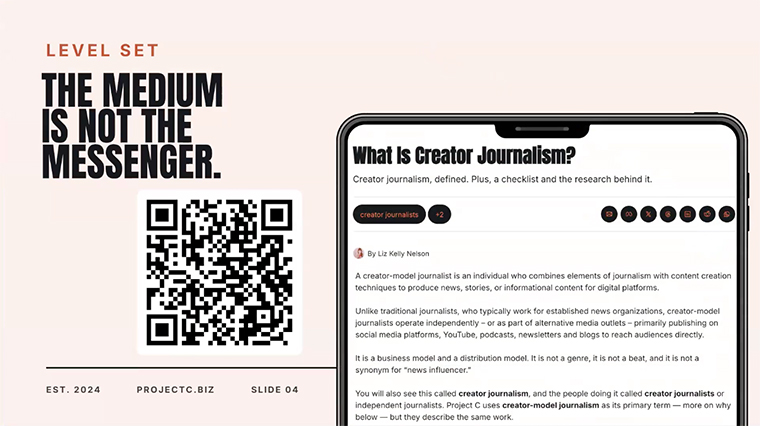
Creator journalists are journalists as much as those in print or broadcast. The term “creator” describes the medium rather than the messenger.
When a new potential member applies to join Project C, they are taken through a five-point checklist to determine if they are, in fact, a creator journalist.
- They produce journalistic work: original reporting, opinion, or aggregation.
- They usually cover a niche topic rather than general news.
- They are a trusted messenger for a loyal audience.
- They work independently, outside a traditional news organisation.
- They leverage the creator economy to build a sustainable career.
Kelly shared the top reasons she has found that journalists are leaving traditional newsrooms for the creator ecosystem:
- Editorial freedom and control.
- Ability to monetise their own work and audience members they were bringing in.
- To be where audiences were going.
The last reason is the one Kelly feels is most compelling.
“In 2023, we were starting to see traffic to owned and operated Web sites nosedive as audiences were turning away from traditional news because of loss of trust, but also because it was easier to find news and information, and keep up with the world, on platforms like TikTok, Instagram, or YouTube.”
Transition from newsroom journalist to creator journalist
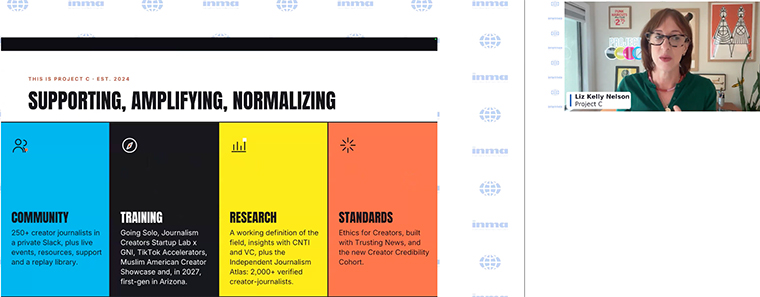
For Kelly, Project C is a way to ensure that rigorous, fact-based journalism is making its way onto those platforms, as well as helping journalists make the pivot to creators.
“It’s a given that this is part of the news industry now,” she said. “It’s something that’s understood both in the U.S. and globally. I do think there is still a learning curve that we are all on as an industry.”
The pandemic in 2020 was the pivotal global shift that launched 98% of today’s top 50 creator journalists in the United States. Between layoffs and increasing difficulty monetising traditional news publishing, people began founding their own independent creator news brands.
Threats against democracy are another major motivation for journalists to strike out as creators. In Europe, particularly, creators are going into specialised niches that they’re unable to cover at traditional news media companies.
Kelly pointed out that even though Project C is geared towards independent journalists, the skillset is transferable and becoming more in demand in traditional newsrooms as well. She encouraged newsrooms to explore creator journalism tactics themselves as ways to repurpose content and reach new audiences on platforms such as YouTube or Substack.
She also encouraged publishers to think about finding niches the way creators are doing: “That might be a more effective way for you to be reaching audiences on these distributed platforms without having to reinvent yourselves as creators.”
Creator versus influencer
The question of whether creators are actually journalists or are merely “news influencers” is one Kelly addresses regularly.
The distribution platforms such as Substack, Instagram, TikTok, and others are not accessible only to independent creators. Large media publishers also have access to and publish on these platforms. She defines influencers as creators who are not producing journalistic content but rather are sharing their take and opinion on topics.
“I often think of it as the opinion section of the Internet. Where that becomes a bit of a blurred line is there are creator journalists who are producing opinion content that is journalistically rigorous. I think where it bleeds into news influencers is where you’re not seeing those guardrails, you’re not seeing people taking care to separate fact from opinion. You’re not seeing people who are citing their sources.”
True creator journalists apply editorial rigour, like Paul Krugman or Dave Jorgensen, while people like Joe Rogan are clearly influencers sharing their opinions.
News publishers and creator content
For news publishers that would like to establish creator-type content channels, Kelly suggests they invest in marquee talent they already have in-house and new ways of reaching audiences. They should also be mindful of the loss of trust audiences are increasingly reporting in traditional news media.
“That may mean that you as a news brand may need to become more comfortable centering a personality and putting them forward as kind of the lead connector for these audiences than your brand,” she said.
“You need to figure out how yo1qu’re going to keep them,” she added. “Think about those journalists I talked to who left because they didn’t feel like they were incentivised for the work they were doing to bring in new audiences.”
Another option is to find creators doing work that aligns with your brand and partner with them.
“Don’t reinvent the wheel. Can you create an editorial partnership with them? They’re trying to do the same thing you are. They’re trying to reach audiences and build a society where people feel informed and are connected to their communities. So if they’re more connected than you are, it makes sense for you to build a relationship with them.”
Keep in mind that this type of journalistic partnership is very different from partnering with influencers or sponsored content, she said.
Focusing on a niche for creator content is key, Kelly said — providing value-added insights for an audience that feels like they aren’t getting that in another way or from a source they feel a connection with.
Banner image: Image: Adobe stock image by hogehoge511.
Related Articles
-

Axel Springer trainees bring creator skills from academy to new...
7 October 2026 -

Nation Media Group focuses editorial strategy on stories that m...
4 August 2026 -

Indian Express builds a video-first future around trusted journ...
20 July 2026 -

Economist launches subscription tier targeting younger audience...
20 July 2026 -

Grupo RBS builds social-first video operation to expand audienc...
20 July 2026 -

Inside Denník N’s successful subscription strategy
15 July 2026 -

AI adoption in newsrooms should move from experiment to strateg...
12 July 2026 -

As creator economy meets the newsroom, new collaboration models...
9 July 2026
Upcoming Events
-

Subscriber Acquisition Master Class
10-17 November 2026
-

Media Advertising Summit
New York, United States
07-10 December 2026
-

AI-Native News Product Master Class
18-25 February 2027
-

Media Subscriptions Summit
Oslo, Norway
08-12 March 2027
-

World Congress of News Media
New York, United States
25-30 April 2027
-

Branded Content & Partnerships Master Class
20-27 May 2027
-

Subscriber Retention Master Class
17-24 June 2027
-

Conferencia Latinoamericana
15-16 July 2027
-

South Asia News Media Festival
New Delhi, India
19-22 July 2027
-

Asia/Pacific News Media Summit
19-20 August 2027
-

CEO Roundtable at Kilkenny
Kilkenny, Ireland
24-26 August 2027
-

Media Innovation Week
Amsterdam, The Netherlands
27 September - 01 October 2027








