

A look at 30+ revenue streams publishers are actually building
Advertising Initiative Blog | 31 August 2026

I talk about diversification a lot for a reason. Some studies find “other” revenue now at 25% or more of publisher revenue, and Digiday+ research found events passing subscriptions among publishers’ top-cited revenue sources this year.
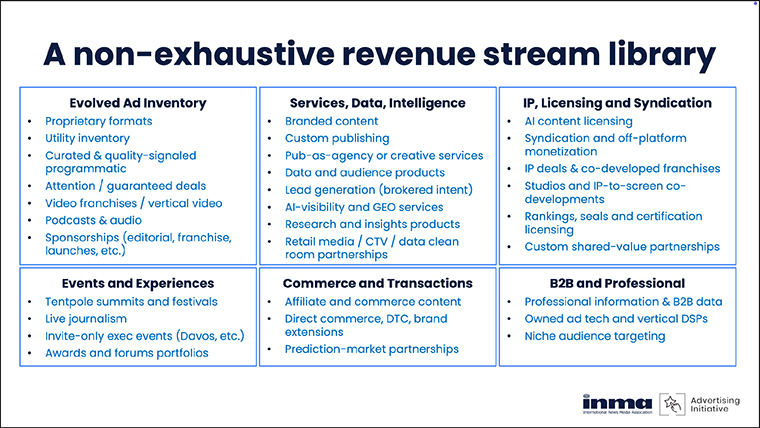
So as part of the recent CEO Roundtable advertising session in Vail, I pulled together a list of all the known possibilities and categorised them.
Here is the full catalogue, compiled from the last 15 months of studying the evolving market: 30+ streams in six families. A few of the bigger opportunities get more detail. Obviously you can’t do everything, and what’s right for you is going to differ by model, market, trajectory, and more.
Advertising, evolved
Proprietary custom formats. Invented in-house instead of standard IAB units, usually aimed at logged-in audiences. The New York Times’ Flex Suite is a great example: digital ad revenue up 31.6% in Q1 and 20.7% in Q2.
Utility inventory. Russmedia’s reframe: Stop selling ad space, sell ad function. Sales teams vibe-code small working tools inside articles (a ski-price tracker for a resort, dinner suggestions for a grocer) priced per outcome, at roughly one-tenth the cost of a rich-media spot. Georg Burtscher’s great POV: “People will pay for emotion, not for CPM.”
Curated and quality-signaled programmatic. Same pipes, restructured supply. Arena Group moved about 15% of open-market deals into curated “smart slots” at 1.5x open-market CPMs, and direct plus programmatic guaranteed is already more than 75% of U.S. programmatic spend.
Attention- and outcome-guaranteed deals. WSJ and Barron’s sell an attention guarantee scored by Adelaide. Taiwan’s United Daily News sells AI-targeted campaigns delivering CTRs significantly above standard placements. The catch: Guarantees move performance risk onto the publisher, so the measurement stack has to exist before the pricing model does.
Video franchises and vertical video. Sold as owned franchises, not pre-roll adjacency. Semafor’s video revenue is up 150% year over year; Grupo RBS in Brazil produces 13,000 short videos a year from a six-person team at roughly 70% operating margin.
Podcasts and audio. U.S. podcast ad revenue hit US$2.9 billion in 2025, per the IAB. Growing most in its on-demand, increasingly video-adjacent forms.
Single-sponsor products. One embedded sponsor, no open ad load: Semafor has run Google inside its Mixed Signals podcast since launch, The Guardian sells app takeovers to repeat clients like Tesco, and Axios sells only direct sponsorship with zero programmatic.
Franchise and IP sponsorships. Selling a named editorial franchise rather than space. InStyle’s The Intern: seven seasons, sponsors paying US$500,000-$700,000 per season against near-zero production cost.
Marketing services, data, and intelligence
Branded content and “projects.” One of the two hero growth formats for publishers (events are the other one.) Editora Globo now gets 60% of its ad revenue from projects: branded content, custom publishing, and events bundled against client outcomes. The share of publishers calling branded content a large revenue source jumped from 25% to 38% in a year.
Publisher-as-agency services. Immediate Media launched IX, an in-house experiential agency, selling brand-hosted events across its 24 titles, with the revenue described as entirely incremental.
Data and audience products. First-party behaviour packaged with its own P&L. People Inc.’s D/Cipher claims more than double the CTR of cookie-based targeting and now extends off-platform as D/Cipher+. News UK turns Times first-party data into synthetic audiences advertisers can query in seconds. Hearst’s Aura IQ builds a bespoke audience from the language of an RFP.
Lead generation. The purest per-unit pricing of intent: SmartAsset charges US$30-$250 per financial-advisor lead, NerdWallet mortgage inquiries run roughly US$160-$195. One qualified lead is worth tens of thousands of impressions at sub-US$10 CPMs — not a classic strength for news publishers, though there are success stories, such as Casa Editorial El Tiempo’s CPC & CPL products, which were featured in this year’s INMA Advertising Measurement Master Class.
AI-visibility and GEO services. Future bundles its Optic tool into branded-content deals and drove 28% growth in AI citations for a Samsung campaign in three months. BCN built GEO Brand Impact, which we’ll feature in our September 9 Webinar. All brand-new, no measurement standard yet.
Research and insights products. Morning Brew is building marketing-research products off its audience; the direct dollars are small but create pricing power.
Retail media partnerships. Bonnier News matches publisher data through a clean room to in-store screens covering most of Sweden’s retail estate, landing P&G as a first-time client. U.S. retail media is a US$63 billion channel growing 18% a year; publishers enter as audience and context suppliers.
IP, licensing, and syndication
AI licensing. People Inc. runs both deal shapes, the flat-fee “buffet” (OpenAI, roughly US$16 million a year at its 2024 baseline) and the pay-per-use “à la carte” marketplace with Microsoft. Jon Roberts is candid about the revenue lag. USA Today Co.’s “other” digital revenue, AI deals included, was up 125.6% year over year in Q1. But the share of publishers calling licensing a large revenue stream actually fell from 11% to 6%, and it stays lumpy, concentrated, and renewal-risky.
Syndication and off-platform monetisation. Reach US doubled its off-platform audience to 10 million people a day across MSN, NewsBreak, and Reddit, and grew off-platform revenue about 90%. Thin per-view yields; it works as a volume complement to a depth strategy, not a replacement for one.
Studios and IP-to-screen. Time Studios has been reported at roughly a quarter of Time’s revenue.
Rankings, seals, and certification licensing. Newsweek’s rankings business grew about 15% and pairs with its healthcare ad stack; Globo licenses award seals to winners on top of selling tables at its 12 award programmes.
Events and experiences
Tentpole summits and festivals. The most-proven stream on the map, and I’ve covered it extensively. Semafor’s events are more than half its revenue, and Justin Smith calls the model “events-first, journalism-powered.” Time’s events are pacing to roughly half of total revenue this year, from 28% in 2023, with no ticketing at all, pure sponsorship. Condé Nast grew events 40% in 2025 while Roger Lynch says plainly, “We don’t expect advertising to be a growth engine for the business.” Globo’s events alone are 32% of total company revenue across 200+ productions, priced above competitors “because it belongs to a media company.”
Awards and forums portfolios. A repeatable machine: Globo runs 12 award programmes and about 100 forums a year, with table sales alone running about twice an event’s cost.
B2B delegate and executive-community events. Closed rooms where list quality is the product. Semafor’s CEO Signal is restricted to CEOs of companies above US$500 million in revenue; Rachel Oppenheim’s framing is that most media companies do audience development, “for CEO Signal, we are doing audience defense.” The Economist’s treasury-leaders programme with Deutsche Bank doesn’t allow substitute delegates. Scale kills these by design.
Commerce and transactions
Affiliate and commerce content. The stream that cuts both ways. Wirecutter has driven more than US$1 billion in commerce, and Vox grew commerce revenue 31% while losing 35% of traffic. But Future’s affiliate revenue fell 27% in a half, AI Overviews are cutting buyers-guide traffic by up to half, and affiliate is declining as a publisher priority in the Digiday+ data. This is the model likely most exposed to AI answering “what should I buy.”
Direct commerce and brand extensions. People Inc.’s “Inversion” strategy runs 19 standalone initiatives, from Southern Living branded tea to exploratory branded housing. Outside Interactive built mapping and event-registration platforms that pushed recurring revenue past 60% of its US$125 million and produced its first-ever profit. Operating product businesses is a challenge; most of these are experiments.
Prediction-market partnerships. Substack, Dow Jones, CNN, and CNBC have all attached to Polymarket or Kalshi. Revenue figures rarely disclosed; reputational exposure is an open question and the story so far.
B2B and professional
Professional information and B2B data. This is the deepest transformation on the map. Dow Jones’ professional information business is 39% of revenue and about half of profit, with a public path to US$1 billion in EBITDA within five years. Advertising has gone from 48% of Dow Jones revenue in FY14 to 16% in FY25, and the WSJ sales team is only one-quarter sellers. Hearst’s B2B units are now 60% of total profit versus under 10% 15 years ago.
Owned ad tech and vertical DSPs. Newsweek lost about 75% of its traffic and grew revenue anyway, in large part because its acquired healthcare DSP, Adprime, is tripling and walls that revenue off from its own traffic decline. Their build-versus-buy rule is worth stealing: The risk in building isn’t cost, it’s diverting attention from what you’re already best at.
Remember, the right response to this list is not to launch 31 things. It’s to run each candidate through a decision-making rubric, pick the few that compound with your audience and your strengths, and create a reasonable pilot with clear KPIs to explore whether or not you can succeed.
If you’d like to subscribe to my bi-weekly newsletter, INMA members can do so here.
Banner photo: Adobe stock image by Premium Seller.
Related Articles
-

Spain is moving from inventory to brand partnerships
11 October 2026 -

Research: 15% of sales directly tied to news brands’ cultural r...
11 October 2026 -

6 ways news publishers are turning trust into advertising reven...
30 September 2026 -

Are events the hero product for publishers?
27 September 2026 -

The week the news business got graded on direction, not results
6 August 2026 -

South Asia’s publishers have the trust but not yet the revenue ...
26 July 2026 -

Editora Globo shifts from selling ads to selling media solution...
21 July 2026 -

The rise of quality and why that matters for advertising
16 July 2026
Upcoming Events
-

Subscriber Acquisition Master Class
10-17 November 2026
-

Media Advertising Summit
New York, United States
07-10 December 2026
-

AI-Native News Product Master Class
18-25 February 2027
-

Media Subscriptions Summit
Oslo, Norway
08-12 March 2027
-

World Congress of News Media
New York, United States
25-30 April 2027
-

Branded Content & Partnerships Master Class
20-27 May 2027
-

Subscriber Retention Master Class
17-24 June 2027
-

Conferencia Latinoamericana
15-16 July 2027
-

South Asia News Media Festival
New Delhi, India
19-22 July 2027
-

Asia/Pacific News Media Summit
19-20 August 2027
-

CEO Roundtable at Kilkenny
Kilkenny, Ireland
24-26 August 2027
-

Media Innovation Week
Amsterdam, The Netherlands
27 September - 01 October 2027








