

Editora Globo shifts from selling ads to selling media solutions
Conference Blog | 21 July 2026

With its revenue falling, Editora Globo realised its old model was no longer working. Audience numbers and print advertising continued to decline and subscription growth stalled, causing the company to rethink what works in today’s world.
During the INMA Latin American Conference, Tiago Afonso, sales and digital development director for the São Paulo-based company, explained how these impacts led to a fundamental redesign of its commercial strategy.
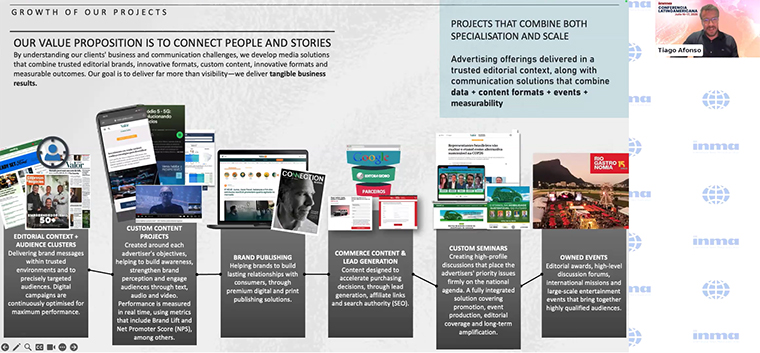
Instead of selling ad placements, Editora Globo began offering what Afonso called media solutions.
“We start listening to what [advertisers] need, what outcomes they expect,” Afonso said. “Then we combined data, context, content formats, media, events, and set KPIs to be measured.”
This approach completely transformed nearly everything the company sold. Traditional ads were no longer the end goal; they were just one piece of a larger, more customised offering.
The results speak for themselves. Last year, 60% of Editora Globo’s advertising revenue came from projects, a category that Afonso explained includes branded content, custom publishing, and events. And events alone accounted for 32% of total revenue — a remarkable share for a company historically rooted in print and digital journalism.
As Afonso put it, these projects “are the reason the total ad revenue can keep growing year by year” despite the decline in traditional advertising.
Providing value at scale
The company’s branded content operation became a core pillar of this strategy. Advertisers wanted measurable impact, not just impressions, so Editora Globo built systems to track brand lift: “Not only pageviews but how much of the impacted audience changed their opinion towards the brand because of the branded content or because of the media solution we offer.”
But events quickly became an integral part of its media solutions, Afonso said. Events were a way to convene audiences, generate content, and extend advertiser reach far beyond the physical venue.
“We are not migrating from media to events. We integrated events important for media solution.”
Events were not new to Globo — the company has been producing them since the 1950s — but what changed was the scale. Last year alone, Globo delivered more than 200 events, ranging from awards shows to entertainment festivals to editorial forums. Each type offered different monetisation opportunities.
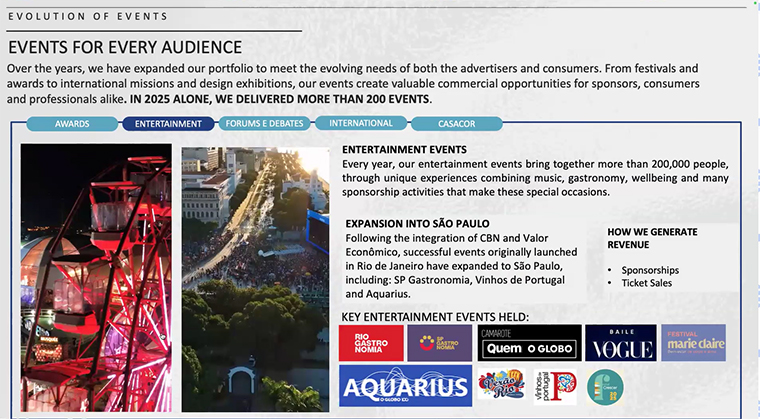
For example, Editora Globo’s flagship food festival, Rio Gastronomia, is a large event providing sponsors with multiple options:
“We offer the event activation, media coverage, and media rebate included in the sponsorship,” Afonso said.
The event competes with the global Taste festival brand, but because sponsors receive broader reach and better ROI, Globo can charge higher prices than Taste.
“We have an event more profitable because it belongs to a media company,” he said.
The event drew 120,000 attendees over 12 days last year, with revenue coming from tickets, sponsorships, and restaurant activation fees. The company’s Aquarius classical music concert series, now in its 55th year, remains a major cultural event. Carnival boxes, summer festivals, family festivals, and wine tastings round out a portfolio designed to attract diverse audiences and advertisers.
“We have events that can match different audience’s desires and different advertisers’ needs so we can monetise it differently,” Afonso said.
Awards as a revenue engine
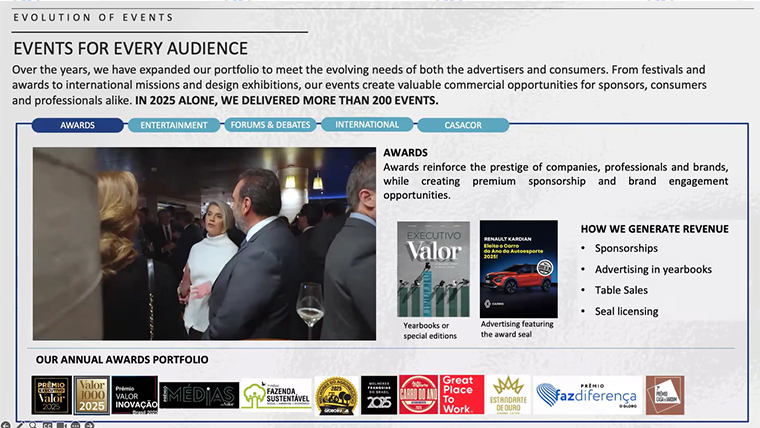
Awards have also become a lucrative staple. Editora Globo runs 12 award programmes that include most innovative companies, best CEO, best sustainable farms, best companies in agribusiness, best cars, best franchise, great place to work, and best architecture projects.
Over time, the company discovered new revenue streams within these events.
For its CEO award, executives wanted to bring not just a guest but their entire board or family. Editora Globo responded by selling tables — and the demand was so strong that “two or three CEOs bought three tables of 10 people” each.
“Now we are able to have a revenue only in tables that is pretty much as twice as the cost of the event,” Afonso said. This turns the awards ceremonies into profit centres even before sponsorship and advertising are added.
Licensing added another layer. Winners of Editora Globo’s car awards, for example, cannot use the award seal in their own advertising unless they license it. That means the company earns revenue from sponsorship, table sales, advertising in the award publication, and licensing fees.
“Those are some examples of how we can differently monetise an award,” Afonso said.
Forums — both editorial and custom — also became essential to Globo’s identity as a media solutions provider. The company produces around 100 forums per year, gathering leaders around topics of public interest. Advertisers often ask Globo to produce standalone events, but the company refuses to operate as a traditional event producer.
“We are not going to compete with productions’ companies that have 10% margin,” Afonso said. Instead, Globo insists on packaging forums with media, branded content, and distribution — a model that delivers higher profit and greater value to sponsors.
The company even expanded internationally, organising three events each year aimed at strengthening business ties between Brazil and major trade partners such as China and the United States.
“In China, we do a seminar and we also organise a China immersion with the sponsors visiting innovative companies that can inspire our business community that goes to China with us,” he explained. These trips deepen relationships and create premium sponsorship opportunities.
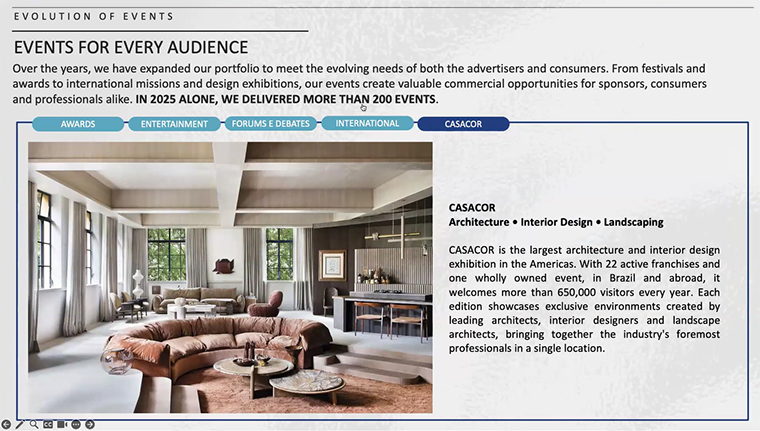
Finally, the acquisition of Casacor, an architecture and design exhibition brand, added another major revenue engine. Casacor produces 23 events annually across Brazil and Latin America, drawing 650,000 visitors. Its business model includes tickets, sponsorships, product placement, architect fees, and franchise revenue — a model that fits well into Editora Globo’s broader strategy of building event‑based ecosystems that advertisers can plug into.
Looking ahead
As it plans for the future, Editora Globo plans to expand branded content on social platforms, positioning itself as “newsfluencers” —combining its journalistic authority with influencer‑style reach, Afonso said. The company also sees room to innovate within events, noting that advertisers in Brazil are “something new seekers” who expect fresh features every year.
“We always have to bring something new,” he said. “Even if we made the best event so far, next year, we have to bring something new.
Editora Globo is also experimenting with lead generation in sectors such as automotive, real estate, and B2B, combining its data, authority, and branded content to deliver measurable results.
Related Articles
-

6 ways news publishers are turning trust into advertising reven...
30 September 2026 -

Why European news media leaders are betting on brand again
29 September 2026 -

A look at 30+ revenue streams publishers are actually building
31 August 2026 -

Newsday’s Together Long Island initiative unites companies and ...
13 August 2026 -

The week the news business got graded on direction, not results
6 August 2026 -

South Asia publishers are growing, transforming, and leading in...
3 August 2026 -

In Latin America, the diversified ad business has already arriv...
2 August 2026 -

South Asia’s publishers have the trust but not yet the revenue ...
26 July 2026
Upcoming Events
-

Subscriber Acquisition Master Class
10-17 November 2026
-

Media Advertising Summit
New York, United States
07-10 December 2026
-

AI-Native News Product Master Class
18-25 February 2027
-

Media Subscriptions Summit
Oslo, Norway
08-12 March 2027
-

World Congress of News Media
New York, United States
25-30 April 2027
-

Branded Content & Partnerships Master Class
20-27 May 2027
-

Subscriber Retention Master Class
17-24 June 2027
-

Conferencia Latinoamericana
15-16 July 2027
-

South Asia News Media Festival
New Delhi, India
19-22 July 2027
-

Asia/Pacific News Media Summit
19-20 August 2027
-

CEO Roundtable at Kilkenny
Kilkenny, Ireland
24-26 August 2027
-

Media Innovation Week
Amsterdam, The Netherlands
27 September - 01 October 2027








