

In Latin America, the diversified ad business has already arrived
Advertising Initiative Blog | 02 August 2026

INMA’s Conferencia Virtual Latinoamérica earlier this month drew 658 registrants from 111 companies across 24 countries.
I presented an updated version of the Advertising Transformation Playbook against that backdrop, which I have continued to evolve since World Congress Berlin through conversations and insights from publishers around the world.
Some underlying structural realities that make Latin America unique:
It’s the most mobile- and social-intensive region on earth, with people spending three-plus hours a day on social platforms and five of the 10 most active social markets globally. In Mexico, video is roughly half of all digital ad spend.
Meta and Google are stronger there than in most markets and platforms already capture more than 80% of digital advertising revenue in the region.
The open Web is weaker, and in retail media it is Mercado Libre, not Amazon, that dominates.
Regional digital ad spend is growing around 12% a year, and Brazil is one of the fastest-growing digital markets anywhere.
What’s most interesting, however: Perhaps because the platforms squeezed the open Web there earlier, Latin American publishers have built diversified commercial models before many of their global peers.
Editora Globo has truly advanced the model
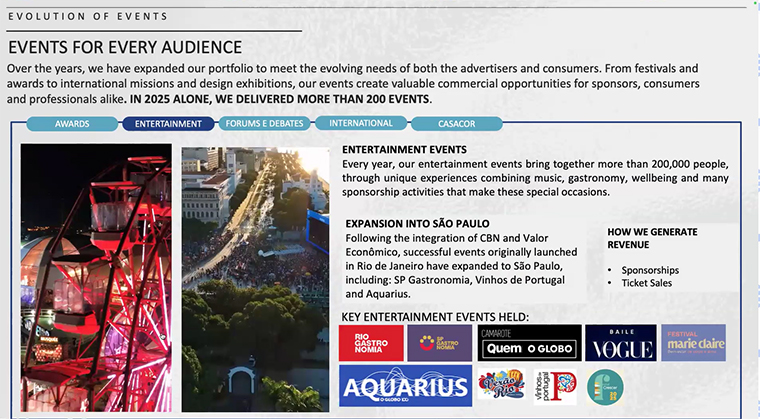
Tiago Afonso, sales and digital development director of the São Paulo-based publisher of O Globo and Valor Econômico, reported roughly 60% of Globo’s advertising revenue now comes from “projects,” meaning any ad revenue that includes a service to the advertiser: branded content, custom publishing, events. Events alone are 32% of total revenue.
The sales process inverted accordingly: “We start listening to what [advertisers] need, what outcomes they expect,” Afonso said. “Then we combine data, context, content formats, media, events, and set KPIs to be measured.”
Branded content is measured on brand lift, not pageviews. It’s all a great validation of the playbook’s principles.
Globo delivered more than 200 events last year, and each format carries its own monetiaation stack. Its 12 annual awards programmes sell sponsorships, advertising in award yearbooks, and seal licensing (car award winners cannot use the seal in their own advertising without licensing it). And when the company noticed CEO honourees wanted to bring their boards and families, it began selling tables. Table revenue alone now runs about twice the cost of the event.
Rio Gastronomia, its flagship food festival, drew 120,000 attendees over 12 days and charges sponsors more than the international Taste franchise it competes with because a media company can bundle activation, coverage, and distribution in a way a pure events producer cannot.
“We have an event more profitable because it belongs to a media company,” Afonso said.
When advertisers ask Globo to produce standalone events, it declines: “We are not an event production company, we are a media solution company.” This is what building commercialisation into products from the start looks like in practice.
Grupo OPSA demonstrated how re-centering around branded content can drive commercial success
Lizza Bobadilla de Handal of Honduras-based Grupo OPSA described how Estrategia y Negocios, a Central American business magazine that was losing money when OPSA acquired it in 2011, now generates roughly 90% of its advertising revenue.
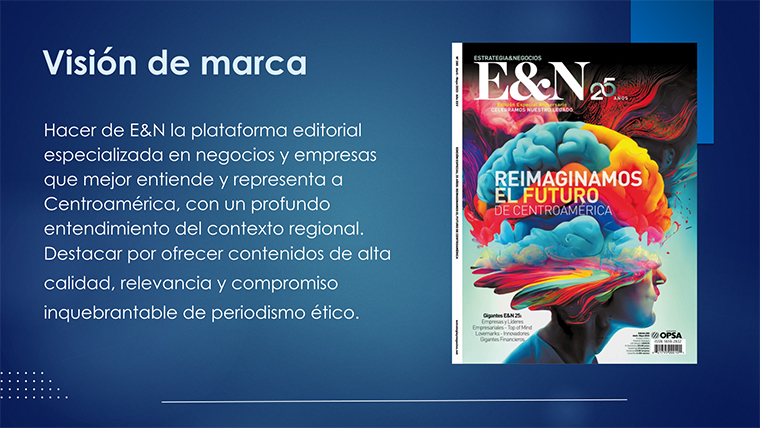
It does so through branded content, built through a brand lab where journalists and commercial staff work together, and a portfolio of franchise events (a women’s leadership summit now in its 10th edition, a Top of Mind study rolled out country by country).
The title has posted consistent double-digit revenue growth with a deliberately small core team that staffs up per project.
Grupo RBS showed the video version
Débora Pradella, digital product executive manager of the southern Brazilian group, described a social-first video operation built on a six-person team of journalist-creators producing natively for Reels, TikTok, and YouTube Shorts.
“There’s no repurposing or adapting,” she said.
The team published 13,000 short-form videos last year and drove more than 500 million views.
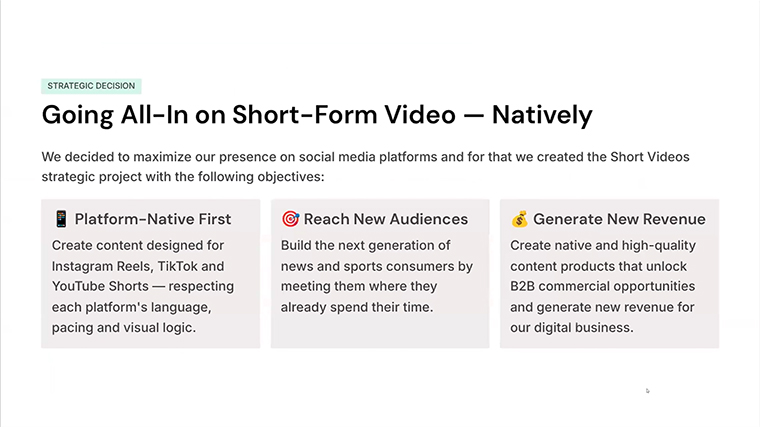
The commercial results: more than R$3 million (about US$600,000) in revenue last year, four times the level of three years ago, at a 70% operating margin, with more than 200 brand partners buying editorial sponsorships, thematic series, and on-demand branded content.
“Business results are not secondary for us,” Pradella said. “The business results are in the DNA of this team.”
In a market where 53% of Brazilians prefer to get news on social platforms, RBS treated that behaviour as an opportunity to build inventory to serve.
Milenio is building the audience layer underneath
Juan Manuel Nava described how Puntos Milenio, the Mexican publisher’s loyalty and gamification programme, rewards reading depth, commenting, and return visits rather than raw clicks.
Members consume seven times more content than ordinary registered users and spend 30% more time reading. Subscribers in the programme consume twice as much as those outside it.
“In media, the asset is no longer the audience that arrives,” Nava said. “It is the audience that returns.”
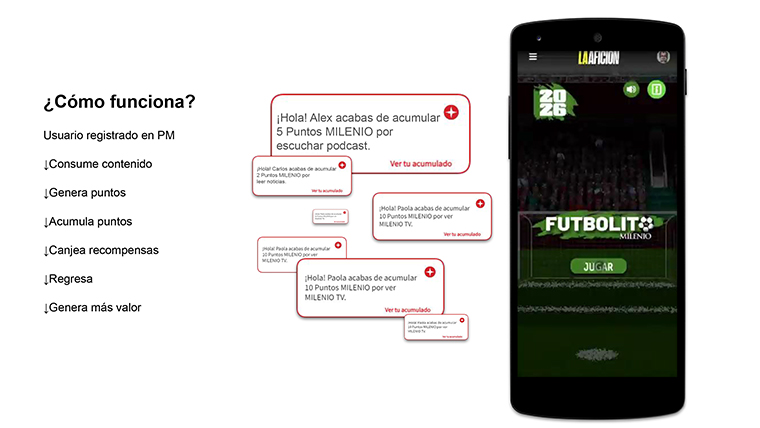
That is a subscription tool today, but it is also the known-audience infrastructure that every advertiser-facing data product eventually requires. In playbook terms, it is focusing on the most valuable users to build the first-party data moat.
In conclusion, Latin America demonstrated all the ways publishers growing commercial revenue have stopped selling inventory space as the hero product and started selling outcomes that only a media company can deliver, with events and branded content as the anchor products.
If you’d like to subscribe to my bi-weekly newsletter, INMA members can do so here.
Banner photo: Adobe stock image by Khuefa.
Related Articles
-

The next business is brand partnerships, not ad inventory
25 October 2026 -

Why European news media leaders are betting on brand again
29 September 2026 -

What’s really defensible in the age of AI?
30 August 2026 -

Newsday’s Together Long Island initiative unites companies and ...
13 August 2026 -

South Asia publishers are growing, transforming, and leading in...
3 August 2026 -

Editora Globo shifts from selling ads to selling media solution...
21 July 2026 -

Latin American publishers must rewrite ad strategies around out...
20 July 2026 -

Platforms took the Croisette in Cannes, and the ad business is ...
6 July 2026
Upcoming Events
-

Subscriber Acquisition Master Class
10-17 November 2026
-

Media Advertising Summit
New York, United States
07-10 December 2026
-

AI-Native News Product Master Class
18-25 February 2027
-

Media Subscriptions Summit
Oslo, Norway
08-12 March 2027
-

World Congress of News Media
New York, United States
25-30 April 2027
-

Branded Content & Partnerships Master Class
20-27 May 2027
-

Subscriber Retention Master Class
17-24 June 2027
-

Conferencia Latinoamericana
15-16 July 2027
-

South Asia News Media Festival
New Delhi, India
19-22 July 2027
-

Asia/Pacific News Media Summit
19-20 August 2027
-

CEO Roundtable at Kilkenny
Kilkenny, Ireland
24-26 August 2027
-

Media Innovation Week
Amsterdam, The Netherlands
27 September - 01 October 2027








