

South Asia publishers are growing, transforming, and leading in advertising
Advertising Initiative Blog | 03 August 2026

The INMA South Asia News Media Festival in New Delhi last week gathered roughly 195 delegates from eight countries in a market that looks, on the surface, like a global exception.
Advertising in India is growing 12%-13% a year, roughly double the global rate. And at only 0.41% of GDP, it has more room to grow (advertising is ~1% of GDP in markets like the U.S. and the EU).
Print circulation and print advertising are roughly flat to growing, making India the last major market where print is not yet in managed decline. Reader revenue is early, which concentrates the business model on advertising (and adds more pressure to succeed there).
And yet the conference focused on transformation with an urgency that exceeded almost any event I’ve attended this year because the levers underneath are moving fast.
It was my first visit to the region, and I spent the weeks ahead diving into as much background research as I could get my hands on. I spent the week of my keynote in site visits and conversations with 14 South Asian publishers to gather firsthand perspectives, test, validate, and ensure what I had to say onstage that week would be as relevant, true, and useful as possible.
In conversation after conversation, publishers told me the referral traffic declines that arrived in the fourth quarter of last year were driving a huge sense of urgency, and I heard a consistent figure: down 40%.
Conference sessions provided further proof of the urgency. The Hindu Group CEO and INMA South Asia Board of Directors President L.V. Navaneeth framed the entire conference in his opening address: Publishers must “move beyond selling inventory and demonstrate attention, context, influence, and outcomes. Trusted environments should command greater value because they deliver greater value.”
The supply squeeze hypothesis from Times Internet and HT Digital
In their panel, Times Internet COO Puneet Gupt argued that a supply squeeze is coming to the open Web as traffic falls and that publishers should respond by reinvesting in display rather than abandoning it:
“It’s time to bring back focus on our display business like we’ve never done before in our history.”
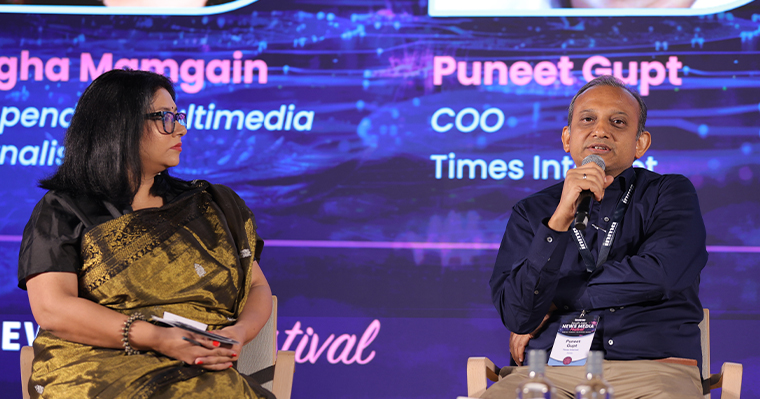
He expects “at least a 30% increase in eCPMs on display advertising in India” over the next few years and laid out the preparation required: inventory quality, audience enrichment, direct sales alongside open marketplaces, and better yield management. His internal reframe is telling.
“We are calling it building users, and building data, and building customers, and not rebuilding traffic,” he said. “We built stadiums to fill them with people, but we didn’t take phone numbers of people who came in.”
HT Digital CEO Puneet Jain made the complementary argument: “Stop treating traffic as a destination, and start seeing it as a launchpad.” HT decoupled revenue from traffic deliberately and is now seeing double-digit CPM growth year over year, he said, after years of declines. “Reach without relationship is a depreciating asset.”
Does this mean I’m wrong about the idea of the declining relevance of display? I’d argue the opposite — the first principle of the playbook is rethinking inventory. If we’re free from the traditional standard banner, what does the combination of AI, structured data, the idea of liquid content, your creativity, and client partnerships enable you to build and sell that you couldn’t before in terms of inventory?
That’d be my build on Puneet Gupt’s “focus on our display business like we’ve never done before.” Focus on evolving and reinventing the idea of what display is and can be.
The buy side brought a shared diagnosis
Shubhranshu Singh, the former CMO of Tata Motors’ commercial vehicles business and a veteran of Hindustan Unilever, Visa, and Star Sports, told conference attendees the collapse of news advertising was “postural, not technological.”
His numbers: Of the US$1 trillion in global advertising revenue outside China last year, US$700 billion went to Google, Amazon, Meta, and TikTok; in India, of roughly ₹1,11,000 crore in ad spend, about ₹70,000 crore goes to the Google and Meta ecosystems.
“The disruption happened, but the surrender happened faster than the challenge,” he said. “Reach is a commodity. Trust is the premium. Publishers spent a decade selling the commodity and giving the premium away.”
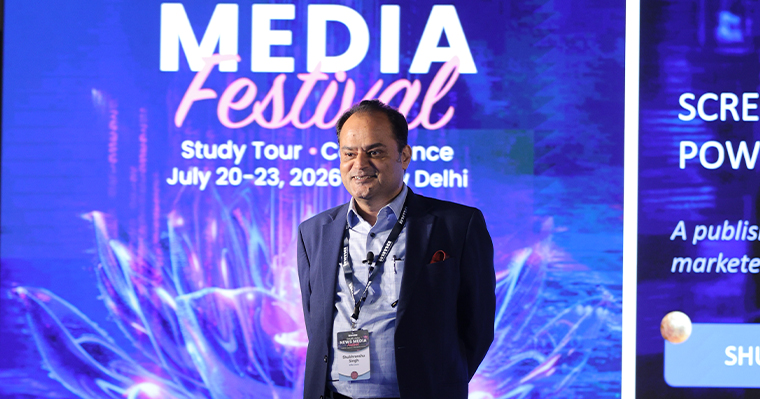
What he would pay a premium for now: audiences that vouch for a brand, context that “raises the price of belief,” and scarcity of editorial stance. “When a publisher offers genuine context and authority, premium brands will always pay a surplus to align with that trust.”
In other words, stop competing on undifferentiated reach, direct from the buy side.
Measurement is where the value argument gets practical
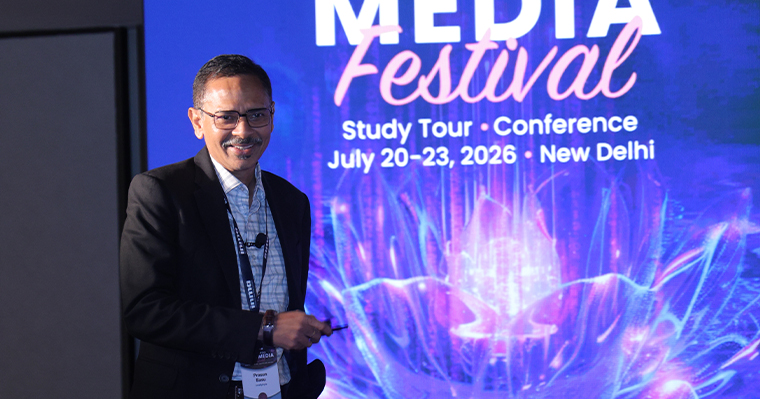
Prasun Basu, co-founder and CEO of Inteliphyle, presented a 12,000-respondent study showing Indian ad spend rewired far faster than audience behaviour did: Since 2019, total ad spend grew 2.3x and digital up to 6x, while newspaper ad spend grew just 1.04x, even though absolute newspaper readership in the measured markets rose and 87% of consumers use both traditional and digital media monthly.
Affluent audiences over-index on newspapers by 36%. His trust-attention-conversion index scores newspapers at 5.37 against 2.85 for television and 1.0 for online news, and his conclusion was a pricing argument: move from reach-based CPMs to impact-based CPMs.
The CTV panel made the same case from the other direction. India has no CTV equivalent of BARC, so news publishers watch their premium living-room inventory get “lumped into digital video buys at standard digital CPMs,” as ABP Network Chief Digital Officer Anushrav Gulati put it.
India Today Group’s Vivek Malhotra was blunter: “Today most smart TV sales happen on a news package ... . Why should I invest in the 500 reporters I have?”
Different data, same argument: Value has to be demonstrated in outcomes and impact, then it will be priced that way.
Diversification looks different in a print-strong market, but it is very much underway
B. Srinivasan, managing director of the 100-year-old Tamil magazine group Vikatan, reported that within its print business, 75% of revenue now comes from readers and only 25% from ad sales, and that “events is the single biggest profitable part of our print business.”
His candor about the old model: “I can’t go sell a magazine page to an advertiser.”
Vikatan sells multi-month event sponsorships directly to clients instead. ABP’s CEO described a new live-events vertical launched with a profitable 10-city Arijit Singh tour.
Conclusions: We have to transform the advertising portfolio here, too
I’ll repeat what I said onstage last Thursday and to the South Asia Board of Directors on Friday.
I came away convinced that while South Asia and India have extraordinary diversity, cultural richness, and singular cultural assets that still feel underutilised — and there are structural conditions of the South Asian and Indian economy, ad market, and population that are fundamentally unique — all the same principles of advertising transformation apply here, too.
It’s all a matter of time and timing.
It’s all the same elements, all the same buyer demand and consumer behaviour trends occurring on slightly different timelines:
Traffic declines are just hitting now.
Print is not yet in managed decline, but it looks like it’s on the horizon.
And reader revenue strategies are still early, making advertising revenue much more vital.
The window is still open, but the clock is ticking and the stakes are high.
We need to stop competing on undifferentiated reach (a losing proposition against the platforms) and instead rebuild the advertising business around premium, machine-legible, outcome-oriented products anchored in first-party data and audience trust.
That means branded content, events, first-party-data-enriched direct deals, premium print innovation, short-form vertical video, and creator partnerships; with self-serve, AI-assisted ads for the SME market, and quality signals wired into the agentic-buying and standards now being set.
That means we must invest in data and measurement infrastructure, reorganise sales from order-takers to consultants, reorganise the offering from formats to industry solutions, and focus the advertising business on high-value logged-in audiences.
And for South Asia, a market that has a reverence and love for print (which I share), there is something else. I think there’s a lingering belief among some in South Asia that print and broadcast are highly journalistic, brand-building mediums, but digital is largely transactional and functional, and digital advertising is largely a commodity.
Success in this transformation requires the belief and conviction that digital media can be premium, prestigious, elevated and brand-positive, too — that it can build net-positive brand expression, brand equity, and premium positioning in the ad market. If you don’t believe it, you can’t sell it.
If you’d like to subscribe to my bi-weekly newsletter, INMA members can do so here.
Related Articles
-

As the traffic ad model ends, publishers need a new advertising...
14 October 2026 -

Why European news media leaders are betting on brand again
29 September 2026 -

What’s really defensible in the age of AI?
30 August 2026 -

Newsday’s Together Long Island initiative unites companies and ...
13 August 2026 -

Editora Globo shifts from selling ads to selling media solution...
21 July 2026 -

Latin American publishers must rewrite ad strategies around out...
20 July 2026 -

Platforms took the Croisette in Cannes, and the ad business is ...
6 July 2026 -

ABP’s Anandabazar.com makes Durga Pujo more accessible to audie...
22 April 2026
Upcoming Events
-

Subscriber Acquisition Master Class
10-17 November 2026
-

Media Advertising Summit
New York, United States
07-10 December 2026
-

AI-Native News Product Master Class
18-25 February 2027
-

Media Subscriptions Summit
Oslo, Norway
08-12 March 2027
-

World Congress of News Media
New York, United States
25-30 April 2027
-

Branded Content & Partnerships Master Class
20-27 May 2027
-

Subscriber Retention Master Class
17-24 June 2027
-

Conferencia Latinoamericana
15-16 July 2027
-

South Asia News Media Festival
New Delhi, India
19-22 July 2027
-

Asia/Pacific News Media Summit
19-20 August 2027
-

CEO Roundtable at Kilkenny
Kilkenny, Ireland
24-26 August 2027
-

Media Innovation Week
Amsterdam, The Netherlands
27 September - 01 October 2027








