

News publishers came to sell in Cannes
Advertising Initiative Blog | 07 July 2026

By all accounts, news publishers made quite a showing this year at the Cannes Lions Festival of Advertising.
The Wall Street Journal ran Journal House, its long-running venue near the Palais, with four days of programming. Bloomberg Media took over a cafe and ran Bloomberg Studios out of it. Axios had Axios House, The Washington Post hosted a “Power of News” executive roundtable in its WP Studio. There, Publisher/CEO Jeff D'Onofrio, Chief Strategy Officer Suzi Watford, and Chief Revenue Officer Karl Wells made the trusted-media case alongside Omnicom and leaders from Ad Fontes, BCG, Cloudflare, and TikTok.
The New York Times ran an HQ apartment and brought senior leaders from advertising, brand, newsroom, and the C-suite, including Global Chief Advertising Officer Joy Robins, Senior Vice President of Ad Marketing Tusar Barik, Chief Brand Officer David Rubin, and CEO Meredith Kopit-Levien. They all hosted dinners and participated in panels and conversations throughout the week.
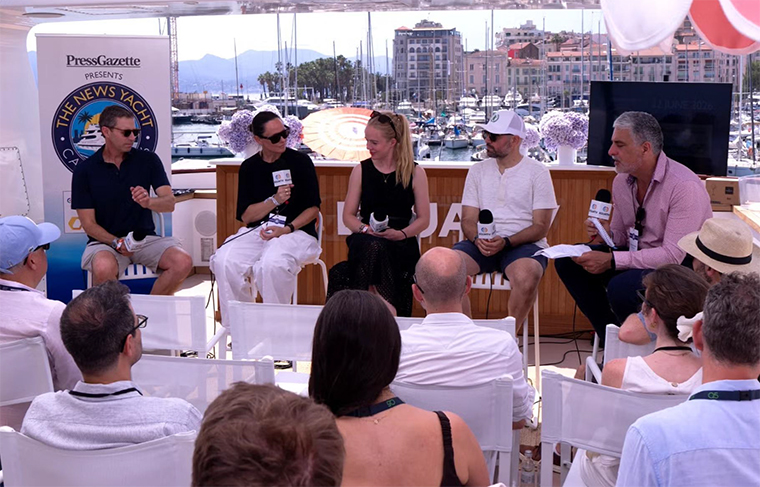
Press Gazette anchored a News Yacht that gathered execs from Time, Axios, The Guardian, The Washington Post, Future, and Hearst. And The Rebooting’s Brian Morrissey ran a mixer, dinner, and a run of video podcasts with revenue and editorial leaders from WSJ, NBCUniversal, USA Today, People Inc., Spotify, The Guardian, Axios, the New York Post, Morning Brew, The Atlantic, Atlas Obscura, 1440, Dow Jones, and Yahoo News.
Publishers also came with real products and real news.
The most concrete was Hearst’s AURA IQ, an agentic layer on top of its first-party-data platform that turns an RFP into a bespoke audience in minutes rather than hours and, in testing across five verticals, doubled clickthrough rates. Notably, Hearst is keeping it out of the open exchange.
There were also a wave of AI-visibility products highlighted (most launched well before the festival), aka what the industry is starting to call GEO (Generative Engine Optimisation): Time is selling branded content into a stripped-down, bot-readable version of its site built for the LLMs, The Washington Post has turned its “Ask the Post” chatbot into a sponsored-answer format, Future has a product called Optic, and Germany’s BCN is selling GEO Brand Impact across roughly 300 titles.
This is another flavour of the post-traffic playbook I keep pointing to: publishers building products the platforms cannot self-serve, sold on first-party data and authority rather than the open auction.
The deeper current under all of this (and something I’ll be digging into further) is that there are real signs the value of news content is rising. As Adweek’s Mark Stenberg reported, the LLMs have now trained on the whole Web, so the thing that differentiates them is access to new, quality information, and premium publishers are finding their negotiating power with the AI firms more robust than they expected a year ago.
The 3C Ventures strategist Alex Brownstein wrote a Cannes-focused LinkedIn essay arguing publishers are the fuel of the Internet, yet the ecosystem they power still pays them last.
He made the point that a CMO buying against The Atlantic or Condé Nast is buying editorial credibility that rubs off on the product, while a CMO buying against user-generated content is buying proximity to whatever the algorithm surfaced that hour. Brownstein pegs premium direct CPMs at US$8-US$15 against US$1.24 on the open exchange, a gap of 7-12x.
At AdWeek House’s Business of News panel, moderated by Kara Swisher, General Motors Chief Media Officer Shenan Reed said the company has increased its news investment by double digits over three years, especially locally, because the technology to advertise in news confidently has finally caught up.
The Trade Desk’s Jeff Green said he has spent years building products so “news gets its fair share,” and Ad Fontes’ Vanessa Otero made the point that as AI floods the zone with synthetic content, human-made news is where quality still lives.

Underneath the optimism, publishers came with a colder eye, and Jessica Davies and Sara Guaglione captured it in their read of publishers’ real Cannes agenda. Two questions ran through every meeting: Who is going to pay for the open Web in an AI world? And is agentic media buying a genuine fix or just a freshly branded ad-tech tax?
Publishers do not want to be written out of the agentic rails and taxed the same way they were with programmatic. As one global-publisher exec told Digiday, the rebuild of the programmatic ecosystem “was done to publishers” last time, and they want a say in the rules now.
WSJ’s Josh Stinchcomb said the frontier is discoverability as readers move to chatbots, and Yahoo’s Matt Sanchez said the agentic standards, AdCP and MCP, are gaining real momentum.
IAB Tech Lab CEO Anthony Katsur’s report highlights a split among publishers: Smaller publishers are leaning into agentic first because being found and selected by a buying agent is a discoverability lifeline, while larger publishers are moving more deliberately, with CTV the clear exception.
So from afar on first read, the publisher story at Cannes was genuinely better than it has been in years, even while very big questions remain. Publishers were in the room and very much on offense, but they are by no means the main event. The path forward remains owning and inventing products buyers cannot get from the platforms, moving toward outcome-based selling, and showing up at the table where the agentic rails get written.
That is the work, and it is exactly what we will get into in December at the INMA Media Advertising Summit, where many of the people doing it, from Hearst to CNN to NYT to Omnicom and many more will be on stage.
If you were on the Croisette and saw something I missed, as always, I would love to hear from you.
If you’d like to subscribe to my bi-weekly newsletter, INMA members can do so here.
Banner photo: Adobe stock image by blende11.photo.
Related Articles
-

Spain is moving from inventory to brand partnerships
11 October 2026 -

Research: 15% of sales directly tied to news brands’ cultural r...
11 October 2026 -

6 ways news publishers are turning trust into advertising reven...
30 September 2026 -

Are events the hero product for publishers?
27 September 2026 -

A look at 30+ revenue streams publishers are actually building
31 August 2026 -

The week the news business got graded on direction, not results
6 August 2026 -

South Asia’s publishers have the trust but not yet the revenue ...
26 July 2026 -

Editora Globo shifts from selling ads to selling media solution...
21 July 2026
Upcoming Events
-

Subscriber Acquisition Master Class
10-17 November 2026
-

Media Advertising Summit
New York, United States
07-10 December 2026
-

AI-Native News Product Master Class
18-25 February 2027
-

Media Subscriptions Summit
Oslo, Norway
08-12 March 2027
-

World Congress of News Media
New York, United States
25-30 April 2027
-

Branded Content & Partnerships Master Class
20-27 May 2027
-

Subscriber Retention Master Class
17-24 June 2027
-

Conferencia Latinoamericana
15-16 July 2027
-

South Asia News Media Festival
New Delhi, India
19-22 July 2027
-

Asia/Pacific News Media Summit
19-20 August 2027
-

CEO Roundtable at Kilkenny
Kilkenny, Ireland
24-26 August 2027
-

Media Innovation Week
Amsterdam, The Netherlands
27 September - 01 October 2027








