

A different way to think about video on publisher platforms
Product & Tech Initiative Blog | 04 August 2026

For years, publishers have invested heavily in bringing video onto their own Web sites and apps.
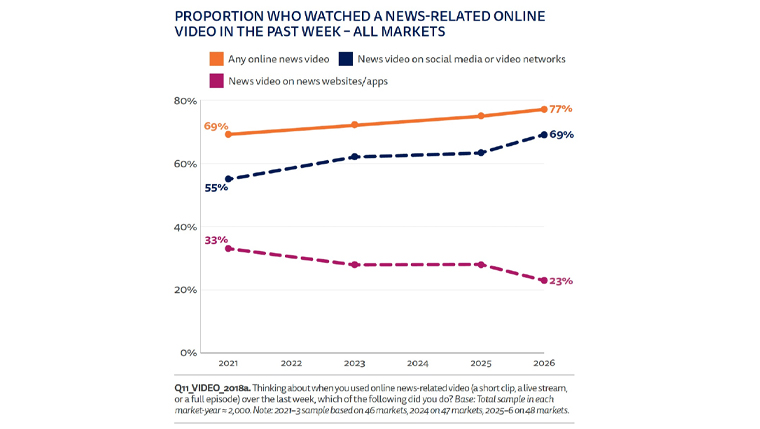
Yet, despite producing better journalism and increasingly sophisticated video products, most consumer behaviour still points in the opposite direction: Consumers want video, just not on our platforms.
Why format first makes sense
The reason may be simpler than we think.
Consumers increasingly choose formats first, not brands first.
When someone wants to watch short-form video, they instinctively open TikTok, YouTube Shorts, or Instagram Reels. When they want long-form entertainment, they open Netflix. For audio, they open Spotify or Apple Podcasts. Increasingly, when they want answers, they open ChatGPT or Gemini.
The first decision is no longer, “Which news brand do I trust?” It is, “What format am I looking for?”
That doesn’t mean journalism has become less valuable. It means the places where people expect to consume different formats have become deeply embedded in daily habits.
This helps explain why off-platform video continues to grow while on-site video often struggles. Consumers are not rejecting publisher content — they are consuming it in the environments that feel most natural for that format (and maybe their subscriptions should follow them).
We think of platforms as marketing channels, but is the journey too broken?
Publishers have largely accepted that TikTok, YouTube, Instagram, and increasingly AI assistants are top-of-funnel discovery channels.
The strategy is straightforward: Attract attention there and drive audiences back to owned-and-operated products where subscriptions, advertising, and deeper engagement can happen.
The problem is the user experience between those worlds is often painfully abrupt.
A user moves from a beautifully designed, highly personalised TikTok feed into a publisher Web site filled with navigation menus, display advertising, cookie notices, autoplay elements, and article layouts that bear little resemblance to the experience they just left.
The transition feels less like continuing a journey and more like changing products entirely.
Perhaps the question is no longer whether social platforms can drive traffic. They clearly can.
The more important question is whether the destination is wrong.
Instead of pushing users directly into a traditional article page, should publishers experiment with transition products?
A TikTok user could arrive at a clean video experience rather than a text-heavy homepage. An AI conversation might link into a conversational topic hub instead of a standard article template. Podcast listeners might enter an audio-first experience designed around listening rather than reading.
In other words, rather than asking users to immediately adapt to publisher products, publishers could gradually guide them through experiences that feel familiar before introducing the wider ecosystem.
Whether these transition products generate enough additional engagement to justify the investment remains an open question — but it is one worth testing.
Because if consumers increasingly live inside platforms, then perhaps the funnel itself should become a product.
If you’d like to subscribe to my bi-weekly newsletter, INMA members can do so here.
Banner photo: Adobe stock image by Panuwat.
Related Articles
-

7 themes from Madrid show publishers trading traffic for relati...
28 September 2026 -

The 3 editorial pillars of Chile’s first streaming news channel
23 September 2026 -

At Mediacorp’s CNA, loyalty means giving audiences a reason to ...
20 August 2026 -

Indian Express builds a video-first future around trusted journ...
20 July 2026 -

Grupo RBS builds social-first video operation to expand audienc...
20 July 2026 -

Amedia scaled video to provide news for younger audiences
5 July 2026 -

10 years later, user needs must be twinned with content formats...
1 July 2026 -

Australian Community Media reinvents its travel brand, unlocks ...
30 June 2026
Upcoming Events
-

Subscriber Acquisition Master Class
10-17 November 2026
-

Media Advertising Summit
New York, United States
07-10 December 2026
-

AI-Native News Product Master Class
18-25 February 2027
-

Media Subscriptions Summit
Oslo, Norway
08-12 March 2027
-

World Congress of News Media
New York, United States
25-30 April 2027
-

Branded Content & Partnerships Master Class
20-27 May 2027
-

Subscriber Retention Master Class
17-24 June 2027
-

Conferencia Latinoamericana
15-16 July 2027
-

South Asia News Media Festival
New Delhi, India
19-22 July 2027
-

Asia/Pacific News Media Summit
19-20 August 2027
-

CEO Roundtable at Kilkenny
Kilkenny, Ireland
24-26 August 2027
-

Media Innovation Week
Amsterdam, The Netherlands
27 September - 01 October 2027








