

AI doesn’t want your Web site
Product & Tech Initiative Blog | 08 July 2026

The media industry is spending a lot of time discussing AI distribution. We’re debating licensing deals, referral traffic, AI Overviews, ChatGPT citations, and whether answer engines will replace search.
But there is a more fundamental question few publishers are discussing: Should Web sites be optimised for machines as well as humans? Or at least preparing to serve the machines to give optionality later?
Most publisher content today is designed for Web sites. Humans arrive on a page and see headlines, navigation, images, subscription prompts, recommendation widgets, comments, and advertising.
Machines don’t need any of that. An AI system wants something much simpler, a format that is easy to parse and understand.
As I firmly believe we will want to do this in future, I’ve been asking around about how to best do this. LLMs.txt has come up in a couple of conversations but I can’t find any media companies actively using it. The directory shows a concentration of tech focused companies. So I asked Shailley Singh, COO and executive vice president/product at IAB Tech Lab, about it. His response was: “For media companies, llms.txt can make sense if there are well-defined templates which can organise an article into different sections.“
He suggested a simpler solution, which I have now spoken to several media companies about: Markdown.
Markdown files, typically saved with a .md extension, are simple text documents that use lightweight formatting to create structure.
A story might look something like this:
Headline.
Summary.
Key facts.
Analysis.
Quotes.
Sources.
To a human, it looks almost too simple. To an AI system, it is ideal. There is no navigation. No advertising. No JavaScript. No design elements. No clutter. Just content and structure.
And structure matters. Most large language models have been trained on enormous amounts of Markdown from software documentation, GitHub repositories, technical blogs, and open-source projects. They are exceptionally good at understanding it.
Unlike a modern Web page, which may contain thousands of lines of code surrounding a single article, a Markdown file presents information in a clean hierarchy. The model immediately understands what is a headline, what is a section, what is supporting information, and what is subordinate to something else. That hierarchy is one of Markdown’s biggest advantages.
Now consider a news article. A publisher may know which paragraphs contain verified reporting, which contain analysis, which are direct quotes, and which provide background context. A Web page often obscures those distinctions. Markdown can make them explicit.
Key facts
The election was held on June 5.
Turnout reached 68%.
Analysis
The result suggests growing support among younger voters.
Sources
Election Commission.
Government statistics office.
The structure itself becomes information. And unlike many technologies currently being discussed in AI circles, Markdown is remarkably future-proof. HTML has evolved continuously for decades. Web sites are redesigned. Content management systems are replaced. Front-end frameworks come and go.
Markdown written 10 years ago still works perfectly today. It is portable, durable, and readable by both humans and machines. Which brings us to an important distinction: Markdown is not the same thing as llms.txt.
llms.txt is essentially a directory. Think of it as a signpost for AI systems. It tells them where useful information can be found and how a site is organised. Markdown is the content itself.
One helps machines find information. The other helps machines understand it.
The challenge is most publishers don’t create content in Markdown today. Content is typically created inside a CMS and rendered directly into HTML. That means any meaningful shift towards machine-readable journalism requires changes much deeper in the technology stack. And CMS changes are notoriously difficult. They touch editorial workflows, publishing processes, templates, metadata, integrations, and archives.
Many news organisations are still operating on systems that were designed for a Web-first world. The challenge now is designing for a world where content may be consumed by Web sites, apps, newsletters, audio products, AI assistants, search engines, recommendation systems, and autonomous agents.
One possible future looks something like this:
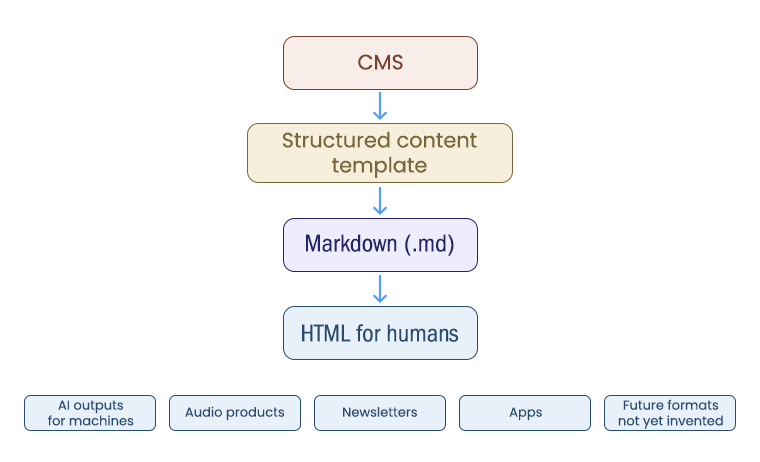
In this model, Markdown is not the final destination. It becomes an intermediary layer between journalism and distribution. The same underlying content can be transformed into whatever format is needed. The real question is whether new media companies have structured content models that can support machine-readable outputs at all.
Because AI doesn’t want your Web site; it wants your content. More specifically, it wants content that is organised, structured, and understandable.
For years, publishers have talked about creating content once and publishing everywhere. AI may finally force the industry to take that idea seriously.
The publishers best positioned for an AI-first future may be the ones quietly rebuilding their content architecture so journalism can exist independently of the Web page. Because as interfaces become conversational and agents become the new intermediaries, the value increasingly moves upstream: from presentation to structure, from pages to content, from Web sites to infrastructure.
If you’d like to subscribe to my bi-weekly newsletter, INMA members can do so here.
Banner image: Adobe stock image By Supapich.
Related Articles
-

VG turned AI video into discovery engine for premium content
14 September 2026 -

What news CEOs are investing in — and what they are killing
8 September 2026 -

USA Today asks: Is a human really needed in every loop?
25 August 2026 -

WSJ Japan finds AI translation is “not a one-and-done deal”
24 August 2026 -

Amid a flood of content, Nation develops ways to stop doing com...
12 August 2026 -

Legit’s Briefly News introduced an AI tool that wins the newsro...
11 August 2026 -

BusinessDay moves from business content to business intelligenc...
6 August 2026 -

Nation Media Group focuses editorial strategy on stories that m...
4 August 2026
Upcoming Events
-

Subscriber Acquisition Master Class
10-17 November 2026
-

Media Advertising Summit
New York, United States
07-10 December 2026
-

AI-Native News Product Master Class
18-25 February 2027
-

Media Subscriptions Summit
Oslo, Norway
08-12 March 2027
-

World Congress of News Media
New York, United States
25-30 April 2027
-

Branded Content & Partnerships Master Class
20-27 May 2027
-

Subscriber Retention Master Class
17-24 June 2027
-

Conferencia Latinoamericana
15-16 July 2027
-

South Asia News Media Festival
New Delhi, India
19-22 July 2027
-

Asia/Pacific News Media Summit
19-20 August 2027
-

CEO Roundtable at Kilkenny
Kilkenny, Ireland
24-26 August 2027
-

Media Innovation Week
Amsterdam, The Netherlands
27 September - 01 October 2027








