

AI will force a fundamental rethink of news production
Product & Tech Initiative Blog | 18 May 2026

When I started the Product Initiative more than five years ago and we spoke about what product actually is, a respected executive told me: “Product is the content experience. Editorial is the content; we are the wrapper.”
That has remained true. But the lines are becoming increasingly blurred with AI.
At last year’s Media, Tech & AI Week, I had a realisation: There are some fundamental shifts that need to happen as the Internat shifts to accommodate agentic AI.
Recently, our survey ahead of World Congress 2026 told us 72% of companies believe AI will “likely to change the UX/products we create and UX will change significantly.”
If you’ve been following this newsletter for some time, you’ll know that I agree. We need personalisation — not just in content but in formats, too. We need liquid content, at least to some degree.
To do that, we cannot work backwards. We need to start from the beginning.
Today, we still largely think in products. A journalist writes an article or creates a video. But Finnish broadcaster YLE told us last week in Berlin that the story has to stay at the center, and the formats should flow from it afterwards. And this has to start at the very beginning — in how we gather and create journalism itself.
Think about it like an iceberg. Out of all the information a journalist collects, we capture only a small amount: the content needed for a specific article, video, or podcast.
We need to capture all of it. The interview transcripts. The data. The PDFs. The video. The photos. Everything.
Then we need to verify it. What is factual? What is not? What is nuanced? In an AI world, understanding what is wrong may become just as important as understanding what is right. Bad input will not allow us to move forward. The underlying journalism has to be highly accurate. And knowing what has been classified as inaccurate or false may help future systems automatically flag or even correct mistakes.
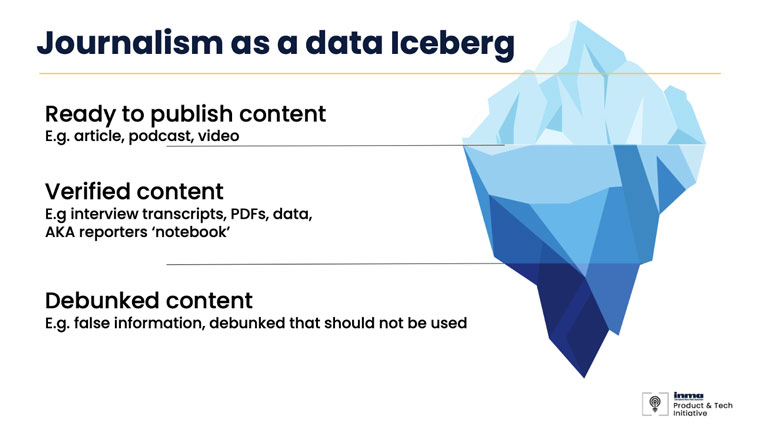
Once we have that information, that journalism, split into “news atoms,” product and editorial teams will need to work together to build experiences from it. Maybe that becomes live updates, a newsletter, an article, a short video, a long-form documentary, an audio briefing, or show notes for a podcast.
The point is the journalism exists independently of the format.
To support this, technology will have to change. We need smarter ways to capture, sort, structure, and store information.
We will need new processes. New workflows. Possibly new skill sets.
And product and editorial teams are going to have to become far more tightly connected. That may mean deeper collaboration. It may mean formal organisational change.
I am becoming increasingly convinced of both the scale of this shift and the urgency of it.
If you’d like to subscribe to my bi-weekly newsletter, INMA members can do so here.
Related Articles
-

Marketers should outsource tasks, not thinking
25 October 2026 -

AI’s effect on super user math
15 September 2026 -

At Mediacorp’s CNA, loyalty means giving audiences a reason to ...
20 August 2026 -

Tribun Network turns print “dots” into AI-powered insight
20 August 2026 -

Nation Media Group focuses editorial strategy on stories that m...
4 August 2026 -

Briefly News empowers journalists with AI tool suite Nova
4 August 2026 -

Indian Express builds a video-first future around trusted journ...
20 July 2026 -

Inside Denník N’s successful subscription strategy
15 July 2026
Upcoming Events
-

Subscriber Acquisition Master Class
10-17 November 2026
-

Media Advertising Summit
New York, United States
07-10 December 2026
-

AI-Native News Product Master Class
18-25 February 2027
-

Media Subscriptions Summit
Oslo, Norway
08-12 March 2027
-

World Congress of News Media
New York, United States
25-30 April 2027
-

Branded Content & Partnerships Master Class
20-27 May 2027
-

Subscriber Retention Master Class
17-24 June 2027
-

Conferencia Latinoamericana
15-16 July 2027
-

South Asia News Media Festival
New Delhi, India
19-22 July 2027
-

Asia/Pacific News Media Summit
19-20 August 2027
-

CEO Roundtable at Kilkenny
Kilkenny, Ireland
24-26 August 2027
-

Media Innovation Week
Amsterdam, The Netherlands
27 September - 01 October 2027








