

News companies now have 3 audiences — how best to serve them?
Product & Tech Initiative Blog | 26 May 2026

Until a year or so ago, most media companies believed they understood their audience.
We knew there were different groups inside that audience. We built subscriber personas. We debated loyal versus casual readers. We invested in understanding formats, platforms, habits, and needs. Product teams focused on engagement. Editorial teams focused on storytelling. Marketing teams focused on conversion.
And then came the bots.
At first, they arrived quietly. Most publishers barely noticed them. Then traffic patterns started to shift. AI crawlers began ingesting vast amounts of content. Suddenly media companies could see them everywhere.
The reaction was predictable: Block them.
Today, many publishers block most bots unless there is some form of value exchange — data, audience, licensing revenue, attribution, or distribution. But I suspect this is only a temporary phase. Over time, the industry will likely become more nuanced about which bots matter, which don’t, and where value actually exists.
Some bots may ultimately become useful distribution channels.
Some content may be intentionally optimised for LLM visibility.
Some publishers may eventually decide they want parts of their journalism surfaced inside AI systems because those systems become part of the discovery funnel.
That may sound optimistic. But it is not entirely different from how publishers eventually approached social media. We build communities there. We distribute content there. We understand those platforms are rarely the final destination, but they can drive awareness, subscriptions, advertising, and brand affinity further down the funnel. This is how the Economist is starting to build for AI agents.
The important point is that bots do not consume content the way humans do. And, increasingly, neither do agents.
One of the most striking examples I’ve seen recently is heat map tracking from Columbia and Yale researchers showed shopping agents “view” pages very differently depending on the model and version being used.
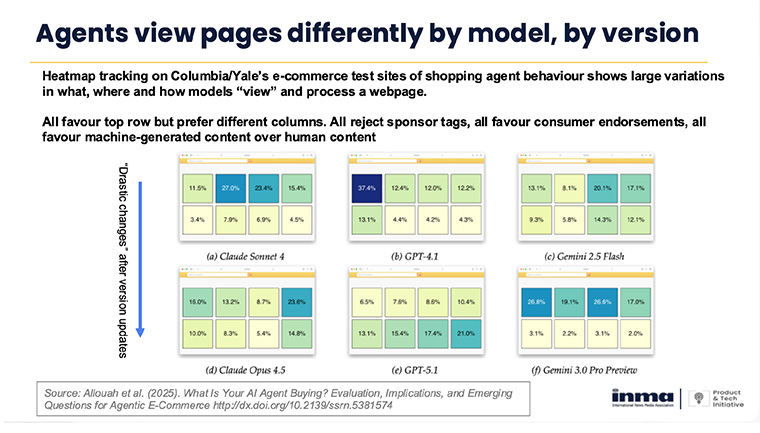
Different models focused on different parts of the same page. Some prioritised specific columns. Most ignored sponsor tags. Many favoured structured consumer endorsements and machine-readable content over human-written prose. And behaviour changed dramatically after version updates.
That matters. Because it means we are no longer designing content experiences for one audience. We now have at least three. As Madhav Chinnappa recently said to me, this is our new audience ABC:
Agents.
Bots.
Consumers.
Consumers still want stories, emotion, context, personality, and trust.
Bots and agents want something else entirely. They want structured data. They want machine-readable signals. They want clarity, metadata, hierarchy, relationships, attributes, and confidence markers.
Humans want content. Machines want data.
News organisations think in narratives and formats. Engineers think in systems. Journalists produce articles, videos, podcasts. Machines parse entities, relationships, and structured information.
For years, publishers have optimised around output: the finished article, video, podcast, or homepage package. That made perfect sense in a consumer Internet.
But in an agentic Internet, input suddenly becomes just as important as output.
If your journalism cannot be broken down, interpreted, verified, structured, and reused by machines, then increasingly it risks becoming invisible inside AI-driven discovery systems.
That does not mean abandoning storytelling. Quite the opposite. Trusted journalism becomes even more valuable in a world flooded with synthetic content.
But it does mean we need to start thinking differently about how journalism is structured underneath the story layer. The media industry needs to get far more serious about content as infrastructure.
That means thinking about journalism in smaller, reusable units. Structured metadata. Entity relationships. Attribution layers. Context blocks. What some in the industry are starting to describe as “news atoms.”
We can also compare traditional product storytelling with AI-optimised product data. The human-written version was evocative and beautifully descriptive. The AI-optimised version was structured around machine-readable attributes: dimensions, materials, use cases, child-friendliness, room fit, certifications, and price ranges.
The conclusion was simple: Product storytelling without structured proof is invisible to AI.
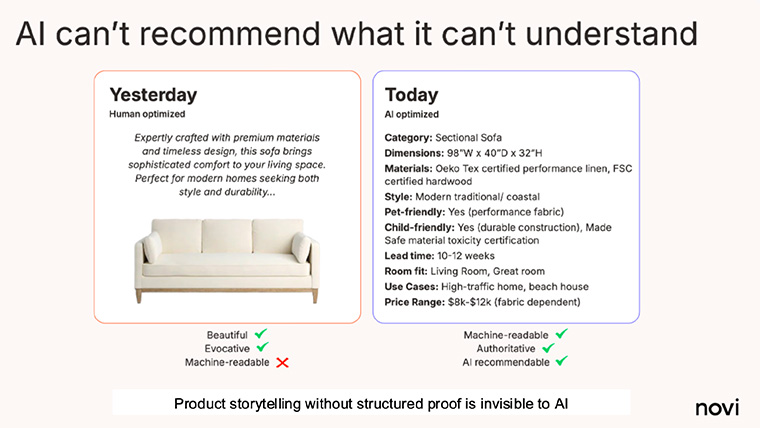
The same principle increasingly applies to journalism. For decades, publishers built for readers. Now we must also build for systems that read on behalf of readers.
If you’d like to subscribe to my bi-weekly newsletter, INMA members can do so here.
Related Articles
-

Stuff builds a “liquid content CMS” to free journalists for big...
26 October 2026 -

Why publishers are doing less, but better, to win in the AI era
22 October 2026 -
How to market news subscriptions in the era of AI content
20 October 2026 -

VG turned AI video into discovery engine for premium content
14 September 2026 -

The front door is gone — and Asia-Pacific publishers are rebuil...
26 August 2026 -

WSJ Japan finds AI translation is “not a one-and-done deal”
24 August 2026 -

Punch builds an AI-ready newsroom without sacrificing trust
6 August 2026 -

Infobae embeds AI into newsroom while keeping journalists in co...
21 July 2026
Upcoming Events
-

Subscriber Acquisition Master Class
10-17 November 2026
-

Media Advertising Summit
New York, United States
07-10 December 2026
-

AI-Native News Product Master Class
18-25 February 2027
-

Media Subscriptions Summit
Oslo, Norway
08-12 March 2027
-

World Congress of News Media
New York, United States
25-30 April 2027
-

Branded Content & Partnerships Master Class
20-27 May 2027
-

Subscriber Retention Master Class
17-24 June 2027
-

Conferencia Latinoamericana
15-16 July 2027
-

South Asia News Media Festival
New Delhi, India
19-22 July 2027
-

Asia/Pacific News Media Summit
19-20 August 2027
-

CEO Roundtable at Kilkenny
Kilkenny, Ireland
24-26 August 2027
-

Media Innovation Week
Amsterdam, The Netherlands
27 September - 01 October 2027








