

The Atlantic asks readers if they want to leave
Product & Tech Initiative Blog | 27 July 2026

This e-mail landed in my inbox. Short, straightforward, and somewhat surprising for a media brand.
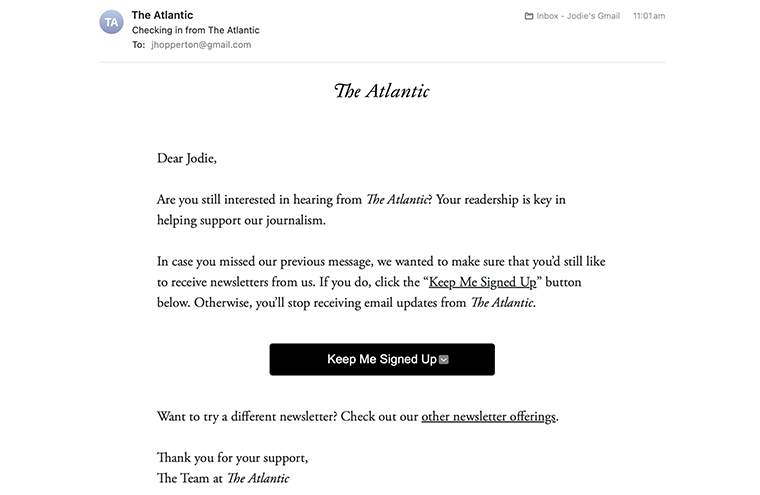
It felt slightly counterintuitive for a publisher to deliberately send an e-mail asking readers whether they still want to receive its newsletters.
Rather than quietly continuing to send e-mails to inactive subscribers, it sent a simple message asking readers to confirm they still wanted to hear from them. Click one button and everything continued as normal. Ignore it, and newsletter subscriptions would eventually stop.
It’s not a new idea. Netflix used a similar approach when it asked inactive members whether they were still watching, helping distinguish genuine users from abandoned accounts. At one point if they didn’t get a response to the e-mail suggesting a user wasn’t watching, they even canceled the inactive subscription. They did it for the long-term gain, building trust with subscribers who may want to return.
But it’s not the mechanics that strike me; it’s the confidence behind the approach — and the focus on engaged, longer-term relationships.
We talk about the need for direct relationships, even more so in an AI-driven world. But how often do we stop and ask whether we have the right audience for our products?
An inactive subscriber doesn’t just reduce open rates. They make it harder to understand what your audience actually values. Engagement metrics become noisier, deliverability can suffer, and editorial teams end up making decisions based on people who may have mentally left months ago.
By asking readers to actively opt back in, you’re effectively saying: We value an engaged relationship more than a bigger database.
There are other benefits, too. The e-mail itself creates a moment of interaction. Even readers who had forgotten about the newsletter are reminded why they signed up in the first place. For active readers, it’s another touchpoint that reinforces the brand.
Of course, there are also risks. Some readers won’t bother clicking, even if they still enjoy the newsletter. Others may simply decide this is the moment to unsubscribe. On paper, the audience shrinks. That makes this strategy uncomfortable for organisations focused primarily on list size.
It also raises an interesting question: Does this approach work best for free products?
For newsletters supported by advertising, removing disengaged readers can improve engagement rates and create a healthier audience for advertisers. For subscription businesses, however, the calculation is more nuanced. If someone is paying but rarely engaging, should you encourage them to reconsider or quietly accept that low-engagement subscribers still contribute revenue?
There is not a universal answer.
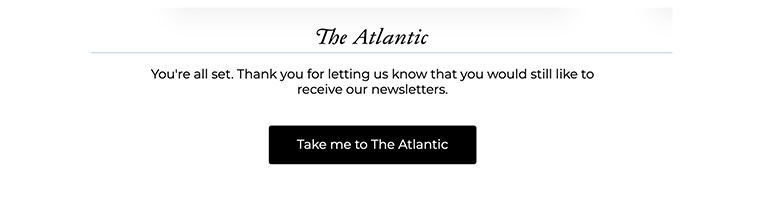
What The Atlantic demonstrates is engagement isn’t simply about acquiring more readers. Sometimes it’s about having the confidence to ask whether the relationship is still valuable for both sides.
As inboxes become more crowded and AI-generated content makes attention even harder to earn, cultivating a smaller, more intentional audience may be a stronger long-term strategy than simply chasing bigger numbers.
Perhaps the real lesson isn’t about cleaning your e-mail list. It’s about recognising that sometimes the healthiest relationship with your audience begins by asking a very simple question: Do you still want us in your inbox?
If you’d like to subscribe to my bi-weekly newsletter, INMA members can do so here.
Banner photo: Adobe stock image By Panumas.
Related Articles
-

WSJ executive councils show how publishers build communities th...
19 October 2026 -

Bundling is a pricing decision, rebundling is an organisational...
18 October 2026 -

7 themes from Madrid show publishers trading traffic for relati...
28 September 2026 -

5 lessons from the INMA Young Audiences Summit
28 September 2026 -

AI’s effect on super user math
15 September 2026 -

What I told 40 CEOs (and won’t gatekeep from you)
30 August 2026 -

At Mediacorp’s CNA, loyalty means giving audiences a reason to ...
20 August 2026 -

Indian Express builds a video-first future around trusted journ...
20 July 2026
Upcoming Events
-

Subscriber Acquisition Master Class
10-17 November 2026
-

Media Advertising Summit
New York, United States
07-10 December 2026
-

AI-Native News Product Master Class
18-25 February 2027
-

Media Subscriptions Summit
Oslo, Norway
08-12 March 2027
-

World Congress of News Media
New York, United States
25-30 April 2027
-

Branded Content & Partnerships Master Class
20-27 May 2027
-

Subscriber Retention Master Class
17-24 June 2027
-

Conferencia Latinoamericana
15-16 July 2027
-

South Asia News Media Festival
New Delhi, India
19-22 July 2027
-

Asia/Pacific News Media Summit
19-20 August 2027
-

CEO Roundtable at Kilkenny
Kilkenny, Ireland
24-26 August 2027
-

Media Innovation Week
Amsterdam, The Netherlands
27 September - 01 October 2027








