

What publishers learned with OpenAI about agentic AI and audience growth
Product & Tech Initiative Blog | 27 October 2026

The technology can move quickly. Getting an organisation ready to use it well takes more work.
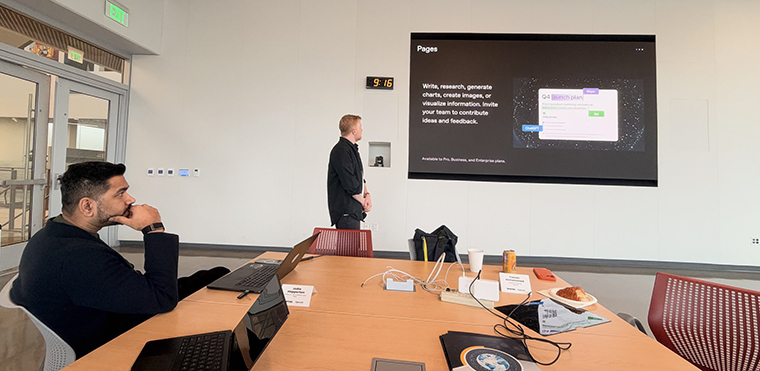
That was a recurring theme at last week’s INMA Audience Growth Workshop with OpenAI in San Francisco (part of our Media, Tech & AI Week). We brought together a small group of senior news media leaders to explore where agentic AI could help solve real audience challenges and what would need to happen inside their organisations to make that possible.
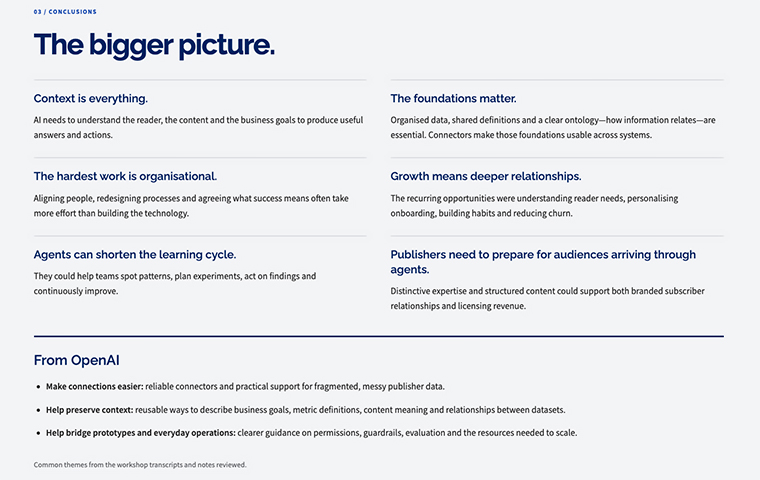
Across the discussions, six conclusions stood out.
Context is everything
Giving AI access to information is only the beginning. To produce useful answers and actions, it needs to understand the reader, the journalism, and the business objective.
Consider subscriber onboarding. A reader early in their career may want something quite different from a senior executive. Helping each person find value requires an understanding of their needs, the content available, and what the publisher hopes to achieve during those first weeks.
The same applies to analysis. Asking which stories drive engagement is useful only when we explain what engagement means, whose behaviour we are examining, and which decisions the answer should inform.
The foundations matter
Organised data, shared definitions, and a clear understanding of how information relates are essential.
That last point — described as an ontology seemingly everywhere we went in San Francisco — can sound abstract. In practice, it means making relationships explicit: how an article connects to a topic, how a reader’s behaviour connects to their subscription, or how a metric relates to a business goal.
Publishers have information spread across analytics platforms, subscription systems, content archives, and spreadsheets. Connectors make that information accessible across systems. Shared definitions help make it usable.
One practical opportunity raised during the workshop was to use an agent to identify gaps in existing data and help prioritise what to collect next. For teams with limited resources, knowing which missing information matters most could be valuable in itself.
The hardest work is organisational
The discussion around implementation effort was particularly revealing. Participants repeatedly returned to people, processes, and alignment.
Who needs access to which information? Who owns the decision? What should remain a human responsibility? How will the workflow change? What would count as success?
Those questions take time to resolve. A prototype may come together quickly while the work of securing resources, connecting systems, and changing established processes takes much longer.
That has implications for how leaders assess AI projects. The resources needed to demonstrate an idea are different from those needed to make it dependable in everyday operations.
Growth means deeper relationships
The recurring audience opportunities centred on understanding reader needs, personalising onboarding, building habits, and reducing churn.
Participants explored how AI could help connect content consumption with longer-term subscriber behaviour. Which coverage is associated with readers staying? What do highly engaged subscribers do? How could those insights help a new subscriber discover more value?
These are questions publishers already care about. Agentic tools offer a way to investigate them more deeply and potentially make the findings useful to more people across the organisation.
Agents can shorten the learning cycle
There is also an opportunity to connect the stages of audience work more closely.
An agent could help a team spot a pattern, develop a hypothesis, plan an experiment, and assess the results. That could reduce the distance between finding something interesting in the data and doing something useful with it.
The value will depend on the quality of the context and evaluation. A pattern needs interpretation; a proposed action needs a clear objective. Teams will still need to decide which findings deserve attention and whether an intervention made a meaningful difference.
Publishers need to prepare for audiences arriving through agents
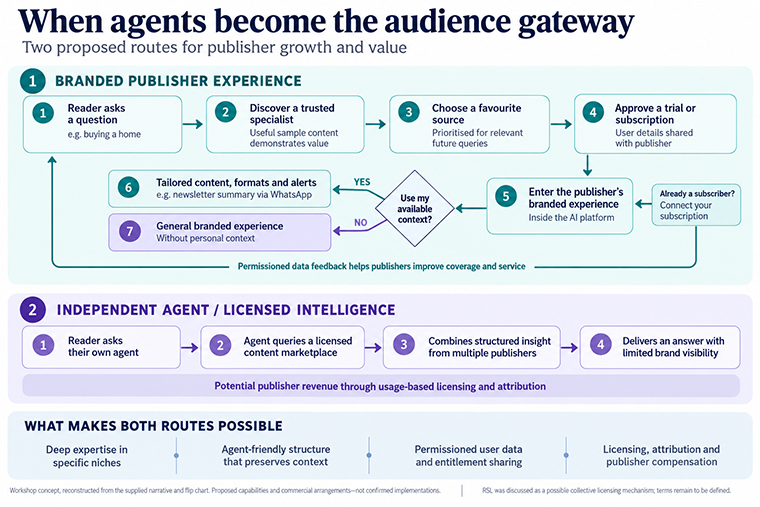
We also explored how a reader’s own AI agent could become their route to journalism.
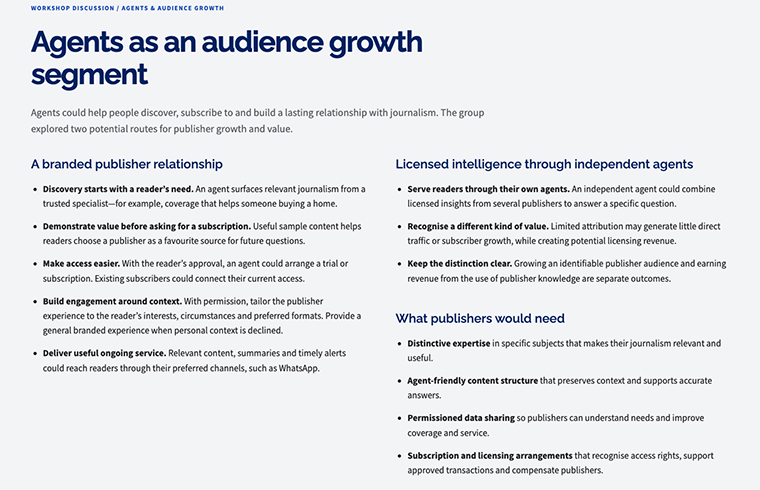
The group considered two potential models: an agent helping someone discover and subscribe to a publisher, and an independent agent drawing on licensed publisher insights to answer a question.
The first could support a branded subscriber relationship. The second could create licensing revenue with limited direct audience contact. Publishers will need to understand the distinction as they consider where value is created and how they are compensated.
Distinctive expertise and content structured to preserve meaning could matter in both models. Access, permissions, and commercial arrangements still need to be worked through.
The discussions also surfaced three practical needs for OpenAI and other tool providers:
- Make connections to fragmented publisher data easier.
- Help preserve business context and definitions in reusable ways.
- Provide clearer support for moving from prototypes into daily operations, including permissions, guardrails, evaluation and resourcing.
These are useful priorities because they address the work between an impressive demonstration and a tool that a team can rely on.
Do not miss this
We captured the day’s ideas, opportunity map, and conclusions in a workshop Web site created during the session using OpenAI’s agentic tools. It is a practical example of turning a discussion into a shared resource, and a starting point for taking the workshop’s ideas into the next round of experiments.
If you’d like to subscribe to my bi-weekly newsletter, INMA members can do so here.
Related Articles
-

Marketers should outsource tasks, not thinking
25 October 2026 -

WSJ executive councils show how publishers build communities th...
19 October 2026 -

AI’s effect on super user math
15 September 2026 -

At Mediacorp’s CNA, loyalty means giving audiences a reason to ...
20 August 2026 -

Tribun Network turns print “dots” into AI-powered insight
20 August 2026 -

Nation Media Group focuses editorial strategy on stories that m...
4 August 2026 -

Briefly News empowers journalists with AI tool suite Nova
4 August 2026 -

Indian Express builds a video-first future around trusted journ...
20 July 2026
Upcoming Events
-

Subscriber Acquisition Master Class
10-17 November 2026
-

Media Advertising Summit
New York, United States
07-10 December 2026
-

AI-Native News Product Master Class
18-25 February 2027
-

Media Subscriptions Summit
Oslo, Norway
08-12 March 2027
-

World Congress of News Media
New York, United States
25-30 April 2027
-

Branded Content & Partnerships Master Class
20-27 May 2027
-

Subscriber Retention Master Class
17-24 June 2027
-

Conferencia Latinoamericana
15-16 July 2027
-

South Asia News Media Festival
New Delhi, India
19-22 July 2027
-

Asia/Pacific News Media Summit
19-20 August 2027
-

CEO Roundtable at Kilkenny
Kilkenny, Ireland
24-26 August 2027
-

Media Innovation Week
Amsterdam, The Netherlands
27 September - 01 October 2027








