

How Svenska Dagbladet turned the reader “aha” moment into a metric
Readers First Initiative Blog | 19 October 2026

When did a piece of journalism last give you an “aha” moment? Can a newsroom even measure that? Unique ambitions and metrics can help companies differentiate in crowded markets, academic research suggests.
In search of brand and product distinctiveness, Swedish news brand Svenska Dagbladet has the “aha moment” central to its journalistic ambition: helping readers discover new perspectives, gain deeper understanding, and see the world in a different light.
“People like to have new insights,” Lisa Irenius, editor-in-chief and CEO, told INMA. “It’s a positive feeling when you see: Oh, now I understand how it all fits together.”
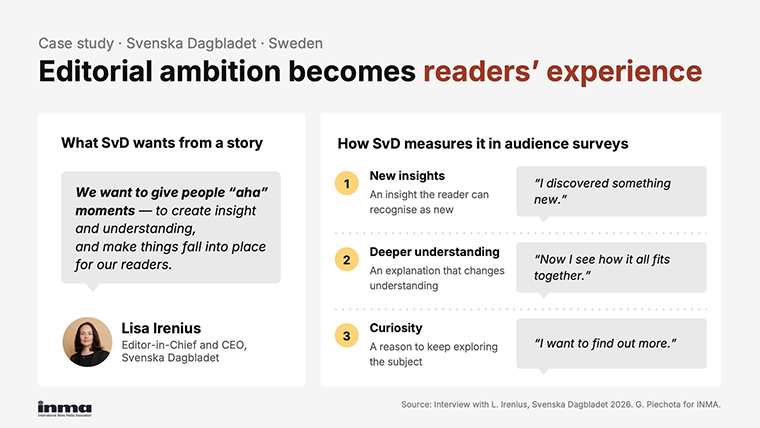
The news company has then developed ways to measure whether it succeeds, for example, with three survey questions: Did you discover something new? Do you understand something more deeply? Do you want to find out more?
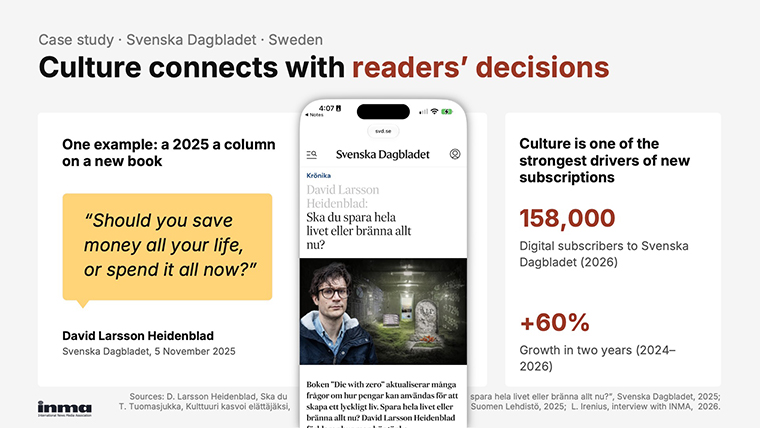
Digital subscriptions grew roughly 60% in two years, up to 158,000, from a No. 2 position in a competitive market, and Lisa Irenius believes SvD’s focus work on strategic differentiation contributed to success.
Why is it different?
Newsrooms usually define ambition by outputs they produce (e.g., editorial standards, exclusives, investigations) and success by reader engagement (e.g., read, return, pay). They rarely touch outcomes (e.g., gain in knowledge, attitude, or behaviour change).
An “aha” is unique in setting a bar for output (“new to readers”), outcome (“understood deeply”), and engagement (“want to learn more”). Most newsrooms ask the first question, skip the second, and have only engagement data for the third.
Reported “aha” moments are based on readers’ perception, which may run ahead of the reality — readers might feel they gained understanding, but that gain is not really measured. And different people might perceive things differently.
Polling tracks “aha” perceptions, and the newsroom is also experimenting with AI personas based on in-depth reader interviews, exploring how they can help journalists better understand readers’ needs.
How does it work?
The new approach is an emerging practice with some promising results. Lisa Irenius gave an example of SvD’s cultural coverage.
Culture has become one of the strongest drivers of new subscriptions. Other publishers often see hard news and political opinions as leading.
One example is David Larsson Heidenblad’s 2025 column on the book Die With Zero: Should you save all your life, or spend it now while you can enjoy it?
The book is a pretext for a discussion about money, ageing, and what people are going to do with the years they have left. The “aha” is the moment the question many readers are asking gets clearer.
That is culture used as a lens on people’s life choices, which is a different job from culture as coverage of the arts. Lisa Irenius was SvD’s culture editor before taking the chief editor and CEO’s joint role in 2023.
Why does it work?
In crowded news media markets facing increased competition for attention from creators and unlimited content supply from AI, news publishers need to make their products more distinct.
“Unique metrics may help to strategically differentiate brands and products,” Stanford professor Amir Goldberg argued when I attended his lecture in Palo Alto in 2025.
Together with colleagues, he found there are broadly two ways to be different. Being different in what you sell gets punished if customers cannot place you in the right category, so they compare you with the wrong rivals. Being different in how you deal with customers within your category gets rewarded: They read it as a skill rivals cannot copy.
The focus on “aha” moments provides a shared ambition across editorial, product, and marketing teams. This helps guide editorial priorities, encourages reflection on what readers actually gain from journalism, and creates a clearer foundation for the brand’s communication.

In March 2026, SvD launched a brand campaign “Tänk om?”, which in Swedish reads both as “What if?” and “Think again.” The creators observed that news journalism has spent years marketing itself defensively, by what it is not — e.g., partisan, political, wrong — and wanted to return to what journalism is for: new perspectives.
“The newspaper needs a clear picture of what it actually wants to do and why you should choose to read this one in particular,” explained Lisa Irenius.
Greg’s Readers First newsletter is a public face of a revenue and media subscriptions initiative by INMA, outlined here. INMA members can subscribe here.
Banner photo: Adobe Stock by FutureLogic Studio.
Related Articles
-

Bundling is a pricing decision, rebundling is an organisational...
18 October 2026 -

AI’s effect on super user math
15 September 2026 -

Nation Media Group focuses editorial strategy on stories that m...
4 August 2026 -

Indian Express builds a video-first future around trusted journ...
20 July 2026 -

Economist launches subscription tier targeting younger audience...
20 July 2026 -

Grupo RBS builds social-first video operation to expand audienc...
20 July 2026 -

Inside Denník N’s successful subscription strategy
15 July 2026 -

AI adoption in newsrooms should move from experiment to strateg...
12 July 2026
Upcoming Events
-

Subscriber Acquisition Master Class
10-17 November 2026
-

Media Advertising Summit
New York, United States
07-10 December 2026
-

AI-Native News Product Master Class
18-25 February 2027
-

Media Subscriptions Summit
Oslo, Norway
08-12 March 2027
-

World Congress of News Media
New York, United States
25-30 April 2027
-

Branded Content & Partnerships Master Class
20-27 May 2027
-

Subscriber Retention Master Class
17-24 June 2027
-

Conferencia Latinoamericana
15-16 July 2027
-

South Asia News Media Festival
New Delhi, India
19-22 July 2027
-

Asia/Pacific News Media Summit
19-20 August 2027
-

CEO Roundtable at Kilkenny
Kilkenny, Ireland
24-26 August 2027
-

Media Innovation Week
Amsterdam, The Netherlands
27 September - 01 October 2027








