

News subscription leaders are rethinking growth strategies
Readers First Initiative Blog | 12 May 2026

Readers now fund 60% of news. The paywall model and straightforward funnel that got you here might not get you further. INMA asked the subscription masters: What is next?
For more than a decade, digital subscriptions have been the news industry’s answer to declining advertising and print business: grow reach, convert through the paywall, optimise pricing, reduce churn, repeat.
The funnel worked. Based on INMA Subscription Benchmarks from 317 news brands, the median publisher nearly quadrupled digital subscriptions since 2019 and more than quadrupled the revenue.
Then discovery fragmented. Traffic became less predictable. Acquisition got harder and more expensive. And growth slowed — not because publishers stopped trying, but because a simple paywall and straight funnel are no longer enough.
Eight subscription masters
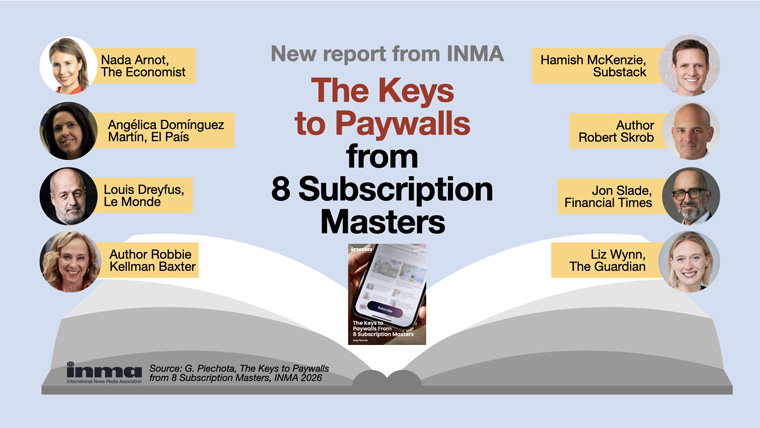
That is the problem my new report for INMA, “The Keys to Paywalls From 8 Subscription Masters,” starts from.
Between March 2025 and March 2026, I conducted live interviews with eight people who have built some of the most successful and distinctive reader revenue businesses in the world:
Nada Arnot at The Economist.
Angélica Domínguez Martín at El País.
Louis Dreyfus at Le Monde.
Hamish McKenzie at Substack.
Jon Slade at the Financial Times.
Liz Wynn at The Guardian.
And subscription strategy authors Robbie Kellman Baxter and Robert Skrob.
Each conversation ran about an hour. Hundreds of news executives joined live and shaped the discussion. The INMA report compiles those interviews into a single report, a distillation of the main lessons learned.
From paywalls to systems
What emerged across all eight conversations is a consistent argument: The paywall is not the model. It is one part of a system you need to build.
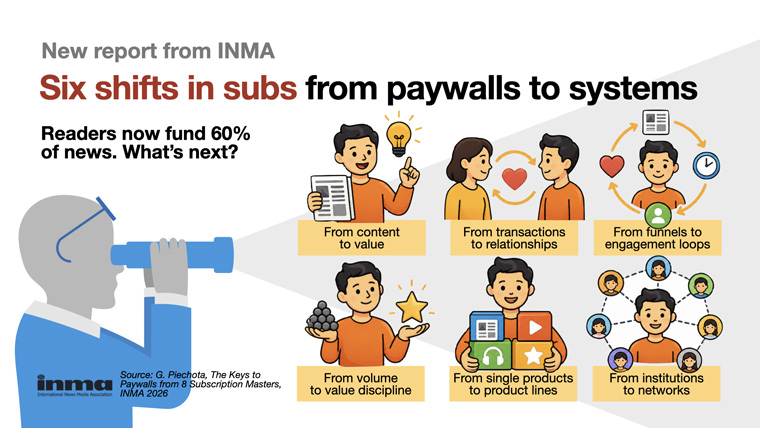
Six shifts define what that system looks like:
From content to value. Information is abundant. Readers don’t pay for it but rather for understanding, judgment, and usefulness. As The Economist puts it, the product is not news but judgment. Robert Skrob frames it differently: People are not buying content; they are buying outcomes.
From transactions to relationships. A subscription value is not defined at a conversion. It is the beginning of a long-term connection: the stronger, the higher lifetime value. At the FT, that relationship drives pricing power and product development. At The Guardian, it is framed explicitly as support for a mission, not a transaction. At Substack, the entire model is built around creators owning their audience relationships directly.
From funnels to engagement loops. While many publishers still think in straightforward funnels, my interviewees think in loops. Reach feeds engagement. Engagement drives conversion and sustains retention. Retention funds the journalism that rebuilds reach. The metric that ties these together is regular use. Robbie Kellman Baxter pushed for even closer relationships — belonging on top of habits.
From volume to value discipline. The dominant growth playbook for several years has been low entry prices, long trials, and volume. Several leaders (FT, Le Monde) explicitly reject it. A long discounted trial may be a reasonable introduction, but a sustainable relationship requires fit, value for money, and genuine integration into someone's life.
From single products to product lines. One subscription, one price, one product is no longer adequate for mature businesses. El País now runs a premium tier, bundles, and lightweight formats. The Guardian operates contributions alongside subscriptions alongside vertical products. Different users have different needs, and subscription leaders map those and design around them.
From institutions to networks. Substack’s framing is the most structurally disruptive: The media ecosystem is moving from centralised institutions to distributed networks. Discovery is fragmented. Trust is personalised. Audiences follow voices more than brands. Publishers must now justify their role as gatekeepers.
Keys to mastery
Across all eight conversations in the Webinar series Subscription Masters, I identified five components of that mastery:
Clear differentiated value.
Direct ongoing relationships with users.
Frequent habitual engagement.
A product system with multiple entry points.
And the discipline to hold on pricing, quality, and long-term focus.
When these five align, growth becomes more predictable. When they do not, no amount of optimisation compensates.
Download the report. Watch the full interviews on demand. Let me know what you think at greg.piechota@inma.org.
Greg’s Readers First newsletter is a public face of a revenue and media subscriptions initiative by INMA, outlined here. INMA members can subscribe here.
Banner art: Adobe Stock By Atif.
Related Articles
-

Bundling is a pricing decision, rebundling is an organisational...
18 October 2026 -

7 themes from Madrid show publishers trading traffic for relati...
28 September 2026 -

Spain’s publishers show there’s more than one road to digital t...
24 September 2026 -

AI’s effect on super user math
15 September 2026 -

What I told 40 CEOs (and won’t gatekeep from you)
30 August 2026 -

Economist launches subscription tier targeting younger audience...
20 July 2026 -

Hamburger Abendblatt unlocked a 20% subscription uplift with we...
14 June 2026 -

Rheinische Post programme turns print loyalty into digital conf...
11 June 2026
Upcoming Events
-

Subscriber Acquisition Master Class
10-17 November 2026
-

Media Advertising Summit
New York, United States
07-10 December 2026
-

AI-Native News Product Master Class
18-25 February 2027
-

Media Subscriptions Summit
Oslo, Norway
08-12 March 2027
-

World Congress of News Media
New York, United States
25-30 April 2027
-

Branded Content & Partnerships Master Class
20-27 May 2027
-

Subscriber Retention Master Class
17-24 June 2027
-

Conferencia Latinoamericana
15-16 July 2027
-

South Asia News Media Festival
New Delhi, India
19-22 July 2027
-

Asia/Pacific News Media Summit
19-20 August 2027
-

CEO Roundtable at Kilkenny
Kilkenny, Ireland
24-26 August 2027
-

Media Innovation Week
Amsterdam, The Netherlands
27 September - 01 October 2027








