

The news industry lost communities — now it wants them back
Readers First Initiative Blog | 11 May 2026

Social media is becoming less social and less valuable for publishers. This creates an opening. In the Czech Republic, a publisher-owned social network is already bigger than X (formerly Twitter).
In 2025, Seznam turned its comments feature into a platform. Lide.cz aggregates conversations across its news sites, more than 70 other Czech publishers, and connects them all into a broader network.
In March 2026, Lidé attracted 33 million visits in the Czech Republic, more than twice the traffic of X (14 million) but still three times less than Facebook (106 million), according to Semrush.
Seznam is not a typical publisher. It reaches 87% of the 11 million Czechs monthly, which is just 1-2 percentage points fewer than Google and Meta. It operates the country’s leading news portals, e-mail, maps, and marketplaces.
While not every publisher has a Seznam’s scale and wants to build a social network, many are investing in a social layer on top of news, for example, The New York Times in the U.S., Telegraph in the U.K., and Toronto Star in Canada.
The broken bargain
For two decades, news companies watched as Facebook, X, and other platforms captured the conversation around content, decoupling publishers’ value chain, as described in my 2019 book with Thales Teixeira.
Publishers set the agenda. Platforms harvested the identities, reactions, comments, and part of time spent around that agenda. Desperate for online growth, publishers kept feeding the platforms with content in exchange for referral traffic.
Now the bargain looks weaker.
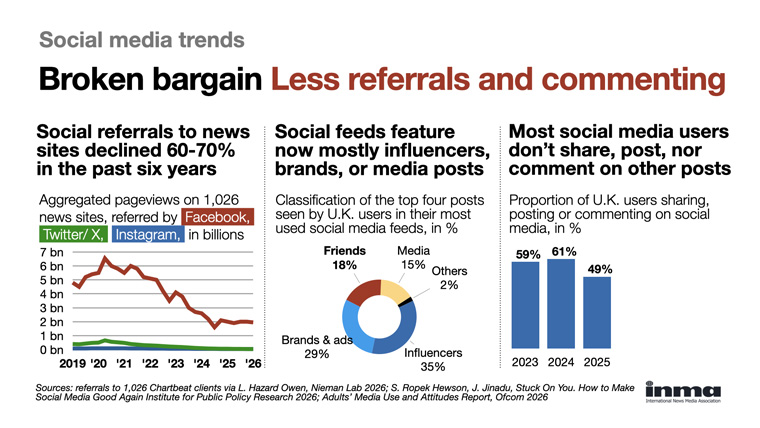
Traffic from Facebook and X has fallen 60%-70% since 2019, according to the latest data from Chartbeat.
The referred users are also spending less time on news sites.
And according to Piano data, they also convert less than users coming from other channels.
Not-so-social media
Major platforms are transforming into broadcasters and maximising users’ time spent watching content and advertisements, abandoning their social roots.
A 2026 IPPR study found only 18% of posts in U.K. feeds come from people users know, while most comes from influencers, public figures, and brands, including ads.
Ofcom data confirmed U.K. social media users are increasingly passive. The proportion of U.K. users who share, post, or comment fell from 61% to 49% year on year.
So publishers face a double loss. Platforms are less valuable as distribution channels and less useful as places where readers meaningfully interact around journalism.
The paradox: Platforms are becoming content media just as the Internet is flooded with AI-generated content, increasing the value of human interaction.
At the same time, academics have long provided evidence that social activities on media Web sites increased users’ commitment to the sites and willingness to pay for their services.
Rebuilding the social layer
These are the reasons many publishers see an opportunity to rebuild social experiences around journalism and reclaim lost value.
Across conversations with executives at The New York Times, Seznam, Telegraph, and Toronto Star, a business logic emerges:
Deeper engagement: Comments extend article lifespan, increase frequency of visits and time spent, feeding into habits. Few users add comments (1% at Seznam) and they tend to be heavy readers, too. As INMA Subscription Benchmarks proved across 317 news sites, these few super users generate a disproportionate share of the revenue.
Editorial insight: Social interactions surface interests of this most valuable user segment, help generate story ideas, and feed back into content strategy that improves product-market fit.
Identity capture: Gifting articles or adding comments often require logging in or subscribing, which unlocks addressability for direct communication, targeting advertising, or subscription offers.
Network effects: Sharing access to content through family subscriptions or gifting articles, or aggregating comments across Web sites, expands publishers’ audiences and creates potential for viral growth dynamics.

Safe communities
Seznam did not launch a social network first. It started five years ago by fixing comments.
“While major publishers were shutting down their discussion forums, we decided to rebuild them and do the comment sections right,” Pavel Bouška, director of international business development at Seznam, said in an interview with INMA.
Scaled moderation with AI: The old reason for abandoning comments was toxicity and cost of moderation. AI changed the economics: Seznam processes up to 100,000 new comments per day with just four moderators. In addition, 85% of comments are approved by AI without any need for human attention, and only 1%-2% of comments are taken down after review.
Collaboration with fact checkers: Disagreements or misleading comments are not necessarily abusive, so rather deleting them outright, Seznam adds context. AI detects misinformation narratives and pairs comments with fact-checking boxes. The database now includes over 400 fact-checked topics from partners such as news wires, nonprofits, or universities, which are surfaced around 5,000 times monthly.
Scoring sources rather than just claims: Seznam found abuse is concentrated within a very small subset of users. Instead of reviewing all claims, it scores the commenters based on their accounts’ age, whether they suddenly become highly active, their behaviour looks coordinated, or they frequently trigger human reviews.
Policing abusers through identity and isolation: All commenters must verify with phone numbers. The suspected abusers can be asked to additionally verify through bank IDs. Punishments are progressive: 24 hours bans for cooling-off, 48 hours, longer suspensions, and eventually permanent bans from the service.
From comments to a social network
Last year, comments generated 1 billion extra pageviews for Seznam and millions of euro in revenue. On a news vertical Novinky.cz alone, discussions added 7.5% more pageviews, 13% more visits, and 11% more time spent.
Once Seznam had rebuilt discussions, it took the next step: aggregating them across Czech Web sites. Users can follow other users, see profiles and activities, engage with the most important topics of the day, and move between the social platform and original publisher content.
Bouška told INMA they did not set out from day one to build a social network. The idea emerged after comments formed a core community and reached a plateau. Lidé is still early: It surpassed X in the Czech Republic but 95% of traffic still comes from publisher sites. Posts independent from articles are still marginal.
The long-term ambition is international. Seznam is pitching peers in neighbouring countries for joint ventures around its technology, local news content and moderators, shared governance and revenue. Bouška describes success in 2030 as “a European-wide social platform owned and run by publishers.”
Publishers reclaim social interactions
Across the world, news publishers tell INMA about their community efforts. The New York Times built up virality features into their successful subscription model, trying to turn super user engagement into growth in the era of fragmented discovery.
“The bottom of your funnel is not a subscriber. It is the evangelist. It’s a person who’s sharing and bringing other people in,” Hannah Poferl, formerly with The Times and now at Universal Music Group, said in March at the INMA Media Subscriptions Summit in Toronto.
By the end of 2025, less than 366,000 or 3% of 12 million digital subscribers to The Times upgraded to family plans, allowing them to share their subscription with three more people. A feature allowing gifting paywalled articles rewarded subscribers but also attracted new qualified audiences with higher intent, conversion, and retention rates.
In Canada, the shift is cultural. “The old newsroom rule ‘never read the comments’ has been tossed out,” revealed Toronto Star Editor Nicole MacIntyre.
A six-week pilot selected 12 journalists to engage directly with the community through comments and live Q&As. The results, shared during a seminar with engagement tech vendor Viafoura, were striking. In one article about speed cameras, journalist engagement doubled the lifespan of a news article, generating 13x more comments and replies than the rest of the site.
Compared with fly-by users, community contributors to the Star generate 24x pageviews per user and 28x time on site per user.
In the United Kingdom, Telegraph pioneered “below the line” engagement tactics in search of differentiation in the era of AI content. Articles where authors go live and talk to readers see a 44% uplift in engaged time, double the number of comments and “significant increase in the proportion of readers who feel a sense of belonging.”
At an INMA master class last year, community editor Arielle Goldstein told peers: “AI can’t replicate human connections.”
Greg’s Readers First newsletter is a public face of a revenue and media subscriptions initiative by INMA, outlined here. INMA members can subscribe here.
Banner photo: Adobe Stock By Thaspol.
Related Articles
-

Bundling is a pricing decision, rebundling is an organisational...
18 October 2026 -

5 lessons from the INMA Young Audiences Summit
28 September 2026 -

The 3 editorial pillars of Chile’s first streaming news channel
23 September 2026 -

AI’s effect on super user math
15 September 2026 -

What I told 40 CEOs (and won’t gatekeep from you)
30 August 2026 -

Nation Media Group focuses editorial strategy on stories that m...
4 August 2026 -

Economist launches subscription tier targeting younger audience...
20 July 2026 -

Grupo RBS builds social-first video operation to expand audienc...
20 July 2026
Upcoming Events
-

Subscriber Acquisition Master Class
10-17 November 2026
-

Media Advertising Summit
New York, United States
07-10 December 2026
-

AI-Native News Product Master Class
18-25 February 2027
-

Media Subscriptions Summit
Oslo, Norway
08-12 March 2027
-

World Congress of News Media
New York, United States
25-30 April 2027
-

Branded Content & Partnerships Master Class
20-27 May 2027
-

Subscriber Retention Master Class
17-24 June 2027
-

Conferencia Latinoamericana
15-16 July 2027
-

South Asia News Media Festival
New Delhi, India
19-22 July 2027
-

Asia/Pacific News Media Summit
19-20 August 2027
-

CEO Roundtable at Kilkenny
Kilkenny, Ireland
24-26 August 2027
-

Media Innovation Week
Amsterdam, The Netherlands
27 September - 01 October 2027








