

Liquid content is reshaping journalism across platforms, products, and audiences
World Congress Blog | 12 May 2026

One of the strongest themes running through last week’s INMA World Congress of News Media in Berlin was the rise of what many executives called “liquid content” — journalism designed to move fluidly across platforms, formats, and audience experiences rather than existing as a single article, broadcast, or destination.
In practice, the term refers to stories being created as adaptable assets that can become TikTok videos, YouTube explainers, podcasts, livestreams, newsletters, clips, social posts, live events, and subscription products simultaneously.
Rather than building journalism primarily for a homepage, print edition, or television schedule, publishers increasingly are designing content to travel wherever audiences already spend time as audience behaviour fragments across platforms, streaming environments, podcasts, video, and social feeds.
The shift is particularly visible among younger consumers, whose media habits changed first and fastest. But news executives throughout the week made the case that the transformation increasingly affects all audiences and every part of the modern newsroom.
The idea surfaced repeatedly across the week’s study tours, conference sessions, and seminars, from the content format strategies discussed at Die Zeit to newsroom workflow changes at Sky News and audience engagement sessions focused on changing consumption habits and platform-native storytelling.
For many executives in Berlin, the shift was framed not as a trend but as a structural response to changing audience behaviour.
YLE helped define the concept
Executives from Finland’s public broadcaster YLE shared how the Finnish company is rethinking journalism as modular, adaptable content designed to move fluidly across formats, audiences, and platforms.
Mika Rahkonen, head of strategy, said many publishers still misunderstand what “liquid content” actually means.
Simply repurposing articles into video, audio, or apps is not enough, he argued. The larger shift is treating journalistic knowledge itself — rather than the finished article, video, or social post — as the core asset that can be adapted and personalised for different audiences and contexts.
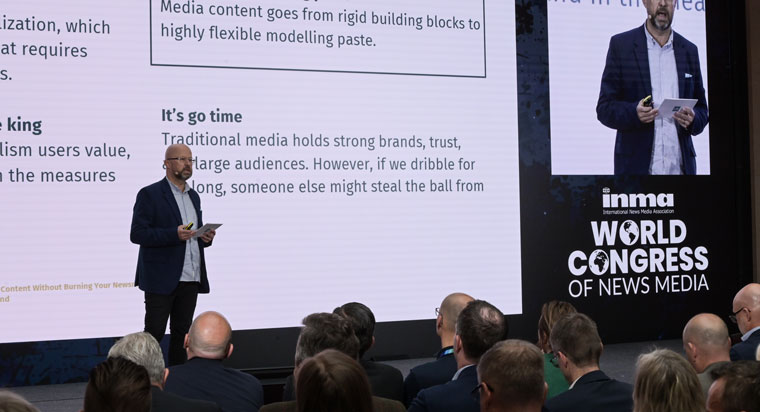
“What was funny was that 13 years ago, we were building our first personalised news algorithm,” Rahkonen said. “Meaning that your content can have different forms. It can be served in different sizes at specific times or at specific locations.”
Publishers increasingly need to think less about creating a single “finished” product and more about how journalistic knowledge can travel through many different user experiences, Rahkonen said.
“The content finds their audience. The audiences don't have to find the content.”
Many news organisations still are operating with audience assumptions shaped during the print and broadcast eras Rahkonen said.
Rather than treating the article as the defining unit of journalism, Rahkonen described a future where publishers capture reporting, expertise, context, images, and research as flexible knowledge assets that can be reassembled and personalised in different ways for different audiences.
Die Zeit builds audiences through podcasts and video
The study tour stop at Die Zeit provided one of the clearest operational examples of “liquid content” in practice.
Mark Heywinkel, deputy editor-in-chief and head of formats development, described how the German publisher is aggressively expanding beyond traditional text journalism into podcasts, video, social storytelling, data visualisation, and live experiences.
Die Zeit now operates multiple video-focused teams, including the “Hochkant” or vertical-video unit, which reached 96 million TikTok views in January and publishes two to three videos daily, Heywinkel said.
He described the company’s strategic ambition as becoming a “video powerhouse” while persuading traditionally print-focused journalists to embrace on-camera storytelling. Leadership estimates Die Zeit now reaches roughly 20 million people monthly in Germany through video content.
Constanze Kainz, head of podcasts at Die Zeit, said podcasts have become another major audience engine for the publisher. Die Zeit now averages roughly 15 million podcast downloads and streams per month, making it one of Germany’s leading media podcast brands.
Podcasts increasingly introduce younger and more female audiences to the brand, often serving as their first interaction with Die Zeit journalism, Kainz said.
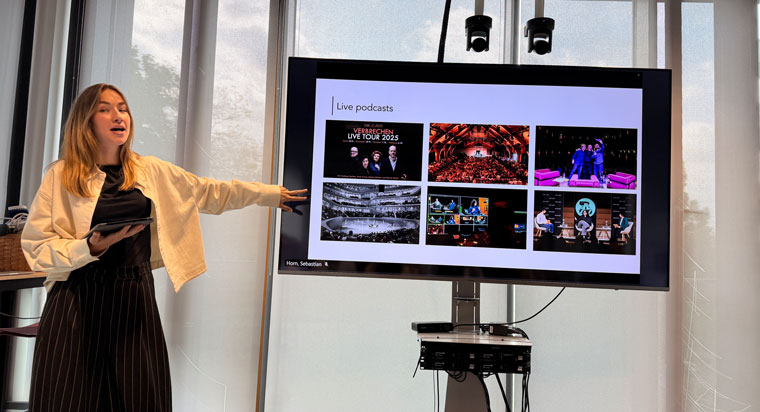
Die Zeit increasingly treats podcasts as multi-format products that can generate video clips, newsletters, live events, documentaries, subscription offerings, and social content. Video clips from podcasts travel much farther on TikTok and YouTube Shorts than audio alone, executives said, helping drive discovery and stronger audience connection.
Sky News redesigns workflows around platforms
Andy Thomson, executive director of business operations at Sky News, said the London-based news company is restructuring parts of its newsroom and production workflows around platform-native storytelling.
“What works on television doesn’t automatically work on social or streaming,” Thomson said. “Content has to be designed from the outset for digital platforms.”
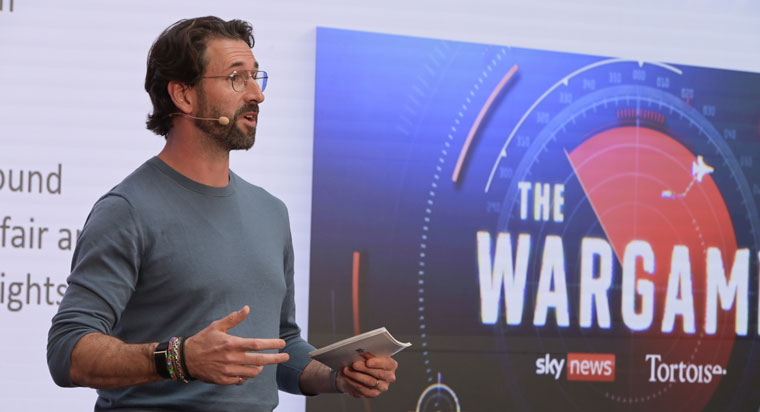
Editorial, product, and production teams increasingly are working together earlier in the reporting process to think not only about the journalism itself, but also how stories will be packaged, distributed, and experienced across platforms, he said.
He described projects now being developed simultaneously for television, YouTube, TikTok, streaming, and social environments rather than being adapted for digital after broadcast. Thomson said Sky News’ TikTok account recently surpassed 11 million followers.
He described replacing some traditional television workflows with formats that allow digital video assets produced throughout the day to flow directly into broadcast programming.
Audience behaviour is driving newsroom change
Throughout the week, news leaders repeatedly said that audiences increasingly expect journalism to feel native to the platforms and formats they already use.
Sessions on younger audiences argued publishers are struggling not because younger consumers avoid news but because much journalism still is not designed for how audiences consume media today.
Sessions focused on audience engagement highlighted growing demand for:
-
Interactive storytelling.
-
Personality-driven journalism.
-
Creator-style formats.
-
Podcasts and vertical video.
-
Community participation and co-creation.
Speakers also discussed experimentation with TikTok collaborations, audience workshops, pop-up editorial offices, and focus-group-driven product development.
The pressure to adapt is especially visible with younger audiences, executives said, because their consumption habits evolved first and fastest. But many speakers argued the broader behavioural shift now extends well beyond Gen Z.
Platforms are now audience infrastructure
Pippa Leary, managing director and publisher of free news and lifestyle at News Corp Australia, described how publishers increasingly view social platforms as long-term audience infrastructure rather than simply traffic sources.
During the Diversifying the Advertising Portfolio Seminar, Leary said publishers need to operate where audiences already spend time, even while recognising the risks of platform dependency.
“We know it’s a risk,” she said. “So what we’ve done is we’ve developed five reasons for why we go off-platform.”
Those reasons include brand awareness, referrals, engagement revenue, affiliate commerce, and sponsorships.

News companies increasingly must treat social distribution as part of their marketing and audience acquisition strategy rather than simply a referral mechanism, Leary said.
She also argued professionally produced journalism often performs substantially better than ordinary creator content on social platforms, generating engagement rates five to eight times higher in some cases.
News Corp Australia also increasingly bundles on-platform and off-platform inventory together for advertisers as a unified commercial offering. Leary argued publishers retain one major advantage over many creator-led media businesses: longstanding direct relationships with brands and agencies.
A different kind of newsroom
Across the World Congress, speakers repeatedly framed “liquid content” less as a technology shift than a newsroom and workflow transformation.
Publishers increasingly need workflows capable of producing journalism that can move fluidly between formats, platforms, audiences, and commercial models without overwhelming newsroom staff.
That requires closer collaboration between editorial, product, audience, visual, and commercial teams — along with a willingness to rethink assumptions built during the print and broadcast eras.
For many news organisations presenting in Berlin, the strategic question was no longer whether journalism should adapt to platform-native consumption habits.
The question now is whether publishers can redesign their newsrooms quickly enough to keep up.
All photos by Robert Downs Photography.
Related Articles
-

7 themes from Madrid show publishers trading traffic for relati...
28 September 2026 -

The 3 editorial pillars of Chile’s first streaming news channel
23 September 2026 -

At Mediacorp’s CNA, loyalty means giving audiences a reason to ...
20 August 2026 -

Nation Media Group focuses editorial strategy on stories that m...
4 August 2026 -

Indian Express builds a video-first future around trusted journ...
20 July 2026 -

Grupo RBS builds social-first video operation to expand audienc...
20 July 2026 -

Inside Denník N’s successful subscription strategy
15 July 2026 -

AI adoption in newsrooms should move from experiment to strateg...
12 July 2026
Upcoming Events
-

Subscriber Acquisition Master Class
10-17 November 2026
-

Media Advertising Summit
New York, United States
07-10 December 2026
-

AI-Native News Product Master Class
18-25 February 2027
-

Media Subscriptions Summit
Oslo, Norway
08-12 March 2027
-

World Congress of News Media
New York, United States
25-30 April 2027
-

Branded Content & Partnerships Master Class
20-27 May 2027
-

Subscriber Retention Master Class
17-24 June 2027
-

Conferencia Latinoamericana
15-16 July 2027
-

South Asia News Media Festival
New Delhi, India
19-22 July 2027
-

Asia/Pacific News Media Summit
19-20 August 2027
-

CEO Roundtable at Kilkenny
Kilkenny, Ireland
24-26 August 2027
-

Media Innovation Week
Amsterdam, The Netherlands
27 September - 01 October 2027








