

3 lessons INMA’s new president, and Schibsted’s CEO, taught me
Young Audiences Initiative Blog | 13 September 2026

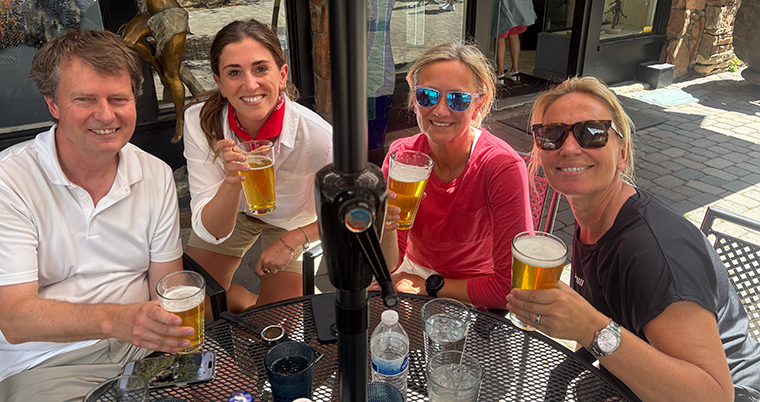
A few weeks ago I traded my desk for hiking boots and headed to Vail, Colorado, for the INMA CEO Roundtable. We hiked, we spotted actual black bears, nobody panicked (mostly), and somewhere between the trail and the next AI conversation, I got the chance to sit down with Siv Juvik Tveitnes, CEO of Schibsted and INMA’s new president.
What did I lear from her?
I had signed up for the intermediate hike. Sensible, I thought, given the altitude. Siv Juvik Tveitnes, CEO of Schibsted and INMA’s new president, thought otherwise.
“What?” she said when she found out. “You’re Swiss!”
There wasn’t really a way back from that, so I followed her lead. We ended up on the advanced hike together, and, of course, it was amazing and totally fine.
I admire Siv, both for the person she is on a mountain trail and for the way she leads Schibsted as CEO. So once we were back down and I had her for an hour, I wasn’t going to waste it. I sat her down for a conversation for the podcast.
I’d been carrying one question around all week: With AI eating every agenda item right now, do CEOs even still have room in their heads for young audiences?
Siv didn’t dodge the question. AI and sustainable business models are, unsurprisingly, top of mind. But she put young audiences right next to them, not behind them.
“We are about to lose a new generation of media users,” she told me. “We really need to be on top of this, really try to understand what is happening in the market.”
What struck me wasn’t the sentiment; we all say some version of it. It was how personally she takes it. Her test audience isn’t a focus group. It’s her twin 19-year-old sons at home, whom she describes, with visible pride, as “very honest ones.”
“They never arrived”
Here’s the line from our conversation I haven’t stopped thinking about since: Talking about VG, one of Schibsted’s Norwegian newsrooms and an early mover on Snapchat, Siv summed up the industry’s biggest miscalculation in a few words: “It is not that the younger audiences are leaving us. They never arrive.”
We like to tell ourselves a comforting story: Young people will grow into us, the way earlier generations did. Siv’s point, backed by two decades of watching Schibsted’s own numbers, is that this was never true. If you’re not already where they are, you were never in the running.
Relevance beats seriousness, and creators beat brands
Schibsted ran its own trust study, and the finding that stuck with Siv wasn’t about investigative journalism or international coverage. It was relevance.
“That all the different user groups find our content relevant is so, so important,” she said. And for younger audiences specifically, relevance increasingly travels through a person, not a masthead: “Younger audiences, they prefer often profiles or individuals or creators more than the actual brands.”
If that sounds familiar, it should. It’s the same trust paradox I dug into with Nic Newman a few editions ago, and it’s showing up in boardrooms now, not just in research decks.
Built to be self-critical
What I found most refreshing wasn’t a strategy, it was a stance. Asked what Schibsted still isn’t doing well, Siv didn’t reach for a diplomatic non-answer.
“We can improve in all areas,” she said, “and I think that’s also a part of an innovative and creative culture: You shouldn’t be too happy with yourself.”
That instinct traces back, by her own account, to how Schibsted built its digital classifieds and online newspaper businesses decades ago: independent units, deliberately competing against the newspaper.
“Very few people actually believed in it,” she said about a bet made 25 years ago. Betting against your own legacy business is a very specific kind of courage, and it’s one she now wants to bring into her INMA presidency, starting with pushing INMA’s own content further into audio and video. (I am totally up for it!)
If there’s one instinct behind everything Siv told me, it’s this: Don’t pick the comfortable route when a harder one is sitting right there. That’s true on a mountain trail. It’s just as true for how we build for young audiences.
So borrow her yardstick for a second — ask yourself:
Did I just sign up for the intermediate hike again, the safe audience strategy, when the advanced route (the one that actually gets you to where they are) was right there?
Is the altitude even right? Are we aiming for where young audiences actually are or comfortably below it?
What’s the advanced version of this I’m avoiding, purely because it’s harder?
Now why am I telling you this? Not because Schibsted has it all figured out. Siv would be the first to tell you they don’t. But because “they never arrive” is one of those lines I want stuck in your head the way it’s stuck in mine — especially if your organisation is still planning around a young audience that shows up eventually, on its own, once it grows up a little.
You can hear the full conversation, including what Siv told me about Schibsted’s OpenAI partnership and the fully AI-run VGX newsroom experiment, on this week’s episode of No One’s Reading This.
If you’d like to subscribe to my bi-weekly newsletter, INMA members can do so here.
Related Articles
-

Four advertising lessons from Media Innovation Week
12 October 2026 -

AI is now media’s operating environment
28 September 2026 -

5 lessons from the INMA Young Audiences Summit
28 September 2026 -

The 3 editorial pillars of Chile’s first streaming news channel
23 September 2026 -

INMA spends 5 days in Madrid learning what actually works
20 September 2026 -

AI’s effect on super user math
15 September 2026 -

What I told 40 CEOs (and won’t gatekeep from you)
30 August 2026 -

There are 5 months left in 2026 to build something
17 August 2026
Upcoming Events
-

Subscriber Acquisition Master Class
10-17 November 2026
-

Media Advertising Summit
New York, United States
07-10 December 2026
-

AI-Native News Product Master Class
18-25 February 2027
-

Media Subscriptions Summit
Oslo, Norway
08-12 March 2027
-

World Congress of News Media
New York, United States
25-30 April 2027
-

Branded Content & Partnerships Master Class
20-27 May 2027
-

Subscriber Retention Master Class
17-24 June 2027
-

Conferencia Latinoamericana
15-16 July 2027
-

South Asia News Media Festival
New Delhi, India
19-22 July 2027
-

Asia/Pacific News Media Summit
19-20 August 2027
-

CEO Roundtable at Kilkenny
Kilkenny, Ireland
24-26 August 2027
-

Media Innovation Week
Amsterdam, The Netherlands
27 September - 01 October 2027








