

Creator partnerships could reshape how news organisations reach audiences
Young Audiences Initiative Blog | 12 August 2026

As more news media organisations turn to creators to reach audiences, they face new questions, challenges, and opportunities. During this week’s Webinar, presented by the INMA Young Audiences Initiative, members heard from Adriana Lacy, CEO of Field Nine Group, who shared insights into how companies can create relationships that mutually benefit news organisations, influencers, and audiences.
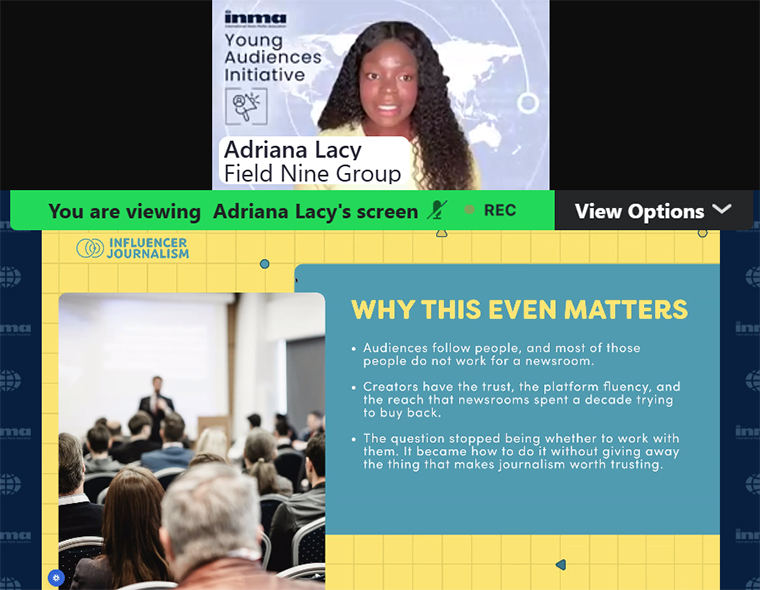
Lacy began by outlining the reality facing news media companies today: Audiences no longer turn to newspapers for the news; they turn to creators. And most of those creators do not work in newsrooms. To attract that young audience, newsrooms must learn how to work with influencers.
“Many of them don’t even have a news background,” she explained, adding that they are seeing a mix between those with and without a journalism background. However, that’s not necessarily what audiences look for: “They just know that this person is giving me news and information in a format that feels good for our audience.”
That shift has created both urgency and uncertainty. Newsrooms know they must adapt, but they often lack the internal fluency, trust, and platform‑native instincts that creators have mastered. Lacy noted that trust in media remains low — particularly in the United States — and audiences are more likely to trust individual creators than institutional brands. Creators, in return, are able to help newsrooms hone their digital skills.
“A lot of the creators that I pair with newsrooms … were able to help the newsroom figure out their digital and video strategy,” Lacy said.
A STEPP forward
To help news organisations navigate this new landscape, Lacy and her team developed a structured vetting and partnership model called the STEPP framework. “Essentially what this framework does is help newsrooms decide who they want to work with and understand how to vet creators and really make sure that these partnerships align with some of their journalistic goals as well,” she explained.
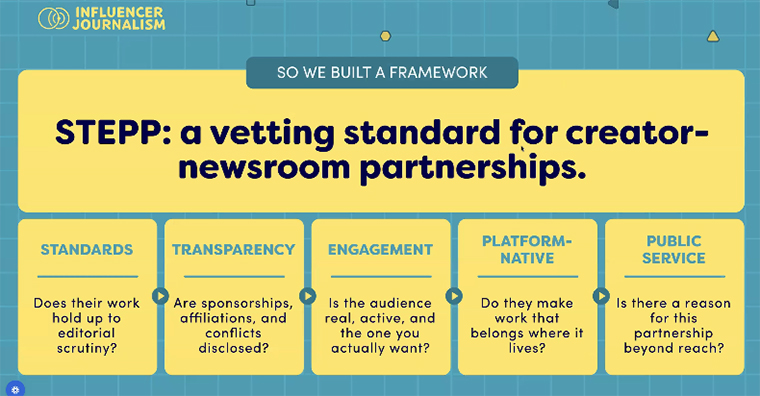
Lacy described STEPP as a practical, newsroom‑friendly method for deciding who to work with and how to work with them. It is built around five pillars:
Standards. This is the foundation of the framework and “definitely the most important thing for newsrooms,” Lacy said. Even if creators are not trained journalists, their work must meet basic editorial expectations. Lacy emphasised that newsrooms should ask: Does this creator’s content hold up to scrutiny? Do they cite credible sources? Do they demonstrate accuracy? “These people… might not be journalists, but there might be journalistic tenets that you want them to abide by,” she said.
Transparency. Creators often rely on sponsorships and brand deals, but undisclosed affiliations — especially political ones — can quickly undermine trust. Lacy noted that this is particularly important for newsrooms preparing for the upcoming U.S. elections. Her team vets creators to ensure they understand disclosure norms and avoid inappropriate partnerships. “We want to make sure that when these creators are getting sponsored, we know who they are and we know what that looks like,” she explained.
Engagement. Follower counts alone are not enough; creators should have active, meaningful audience interaction (comments, shares, conversations), not just passive consumption. Lacy encourages organisations to ask whether a creator’s audience is truly listening or simply scrolling past.
Platform-native. Creators excel at making content that feels at home on TikTok, Instagram, or YouTube. Newsrooms, by contrast, often repurpose content across platforms in ways that feel awkward or out of place. Lacy pointed to the common mistake of uploading horizontal YouTube clips directly to TikTok: “You’re seeing the black borders on each side… it’s very clear that this wasn’t made for the platform.” Creators can help newsrooms understand how to craft content that fits the rhythms, aesthetics, and expectations of each platform.
Public service. Finally, Lacy stressed that creator partnerships are more than just growth hacks. “We’re looking at, did this explainer that you did with a creator help people in your community understand a really complex issue? Did this help people be more engaged in their community? Things like that are what we’re also looking at when we talk about public service.”
Three models for collaboration
To help newsrooms imagine what creator partnerships can look like in practice, Lacy outlined three models her team uses when working with organisations across the United States.
1. Commissioned storytelling
This model is the easiest and most straightforward, Lacy said. Newsrooms identify coverage gaps and commission creators who specialise in those areas. For example, a newsroom with a strong food section might not produce recipe videos, but a creator could. Montana Free Press, she said, partnered with a food creator to reach audiences their traditional coverage didn’t. This approach allows newsrooms to expand their reach without stretching their staff or shifting editorial priorities.
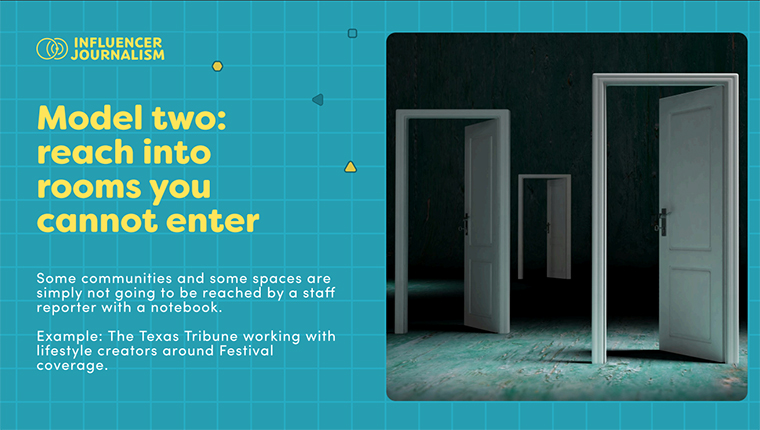
2. Rooms you can’t enter
This model focuses on trust and representation, and centres around the question of, “how do we get communities who might not have been covered well by the industry or might have not been represented as well really start to get that trust from the media.” Creators who have already established credibility within those communities can help newsrooms bridge that gap. That could include lifestyle creators covering events, openings, or cultural moments where their personality and rapport with audiences create a more welcoming entry point.
3. Building muscles in‑house
Not all creator‑style content needs to come from external partners. Many newsrooms have staff members who are eager to experiment with video, social storytelling, and platform‑native formats. Lacy shared the story of a newsroom that hired her team to train staff in social video, and they quickly found a staffer who “really, really loved making these videos.” Today, she is the company’s short-form video editor. Another newsroom built its own creator tracker based on the STEPP framework.
“A lot of this can be done on your own as well if you really understand the ecosystem and figure out the ways that you want to do this sort of work and what that looks like,” she said.
What she’s learned
Lacy also shared the biggest lessons her team has observed while working with newsrooms across the country. The first one, she said, is that creators aren’t the biggest bottleneck; it was getting buy‑in from the newsroom.
“People were wondering about their jobs and what that would look like,” she explained. “So really understanding and making sure everyone in your newsroom is on board before you start this is really great.”
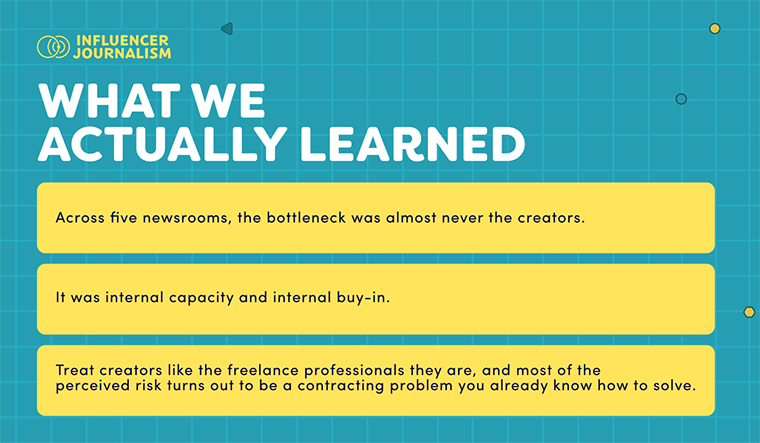
A second key learning is that internal capacity is a challenge. Creator partnerships often fall between departments, and no one “owns” the work: “Figuring out who would be in charge, who would be the person that makes the decisions, and getting that buy-in was something that was really critical for newsrooms before they start this work.”
Finally, creators should be treated like freelance professionals. They are running their own businesses and also want the partnership to be successful: “Just make sure that you are setting them up for very clear rules, very clear video briefs so they can deliver the work that is beneficial for both parties,” Lacy said.
Related Articles
-

Local news publishers need to tap into journalists’ trusted exp...
4 October 2026 -

Lessons in creator journalism from The Washington Post
1 October 2026 -

Young audiences are not abandoning news
22 September 2026 -

AI’s effect on super user math
15 September 2026 -

Tribun Network turns print “dots” into AI-powered insight
20 August 2026 -

Brut India earns young audience trust through social-first jour...
23 July 2026 -

Inside Denník N’s successful subscription strategy
15 July 2026 -

Grupo RBS approaches social media as an editorial product, not ...
25 June 2026
Upcoming Events
-

Subscriber Acquisition Master Class
10-17 November 2026
-

Media Advertising Summit
New York, United States
07-10 December 2026
-

AI-Native News Product Master Class
18-25 February 2027
-

Media Subscriptions Summit
Oslo, Norway
08-12 March 2027
-

World Congress of News Media
New York, United States
25-30 April 2027
-

Branded Content & Partnerships Master Class
20-27 May 2027
-

Subscriber Retention Master Class
17-24 June 2027
-

Conferencia Latinoamericana
15-16 July 2027
-

South Asia News Media Festival
New Delhi, India
19-22 July 2027
-

Asia/Pacific News Media Summit
19-20 August 2027
-

CEO Roundtable at Kilkenny
Kilkenny, Ireland
24-26 August 2027
-

Media Innovation Week
Amsterdam, The Netherlands
27 September - 01 October 2027








