

Young audiences are not abandoning news
Young Audiences Initiative Blog | 22 September 2026

A current-events meme page sometimes breaks news to Sofia Bliss-Carrascosa before any legacy news outlet does.
Because her phone is chronically set to do not disturb, Bliss-Carrascosa may open Instagram before checking muted news notifications. She then visits news apps and searches online to verify what she has seen.
“But the first person that has told me that this thing happened is my meme page,” she said.
Speaking at the recent INMA Young Audiences Summit, the Knight Foundation Journalism Programme Associate said younger audiences are not necessarily disengaged from news. Instead, they often discover it incidentally, assess credibility differently, and develop loyalty through repeated encounters rather than immediately following a news brand.
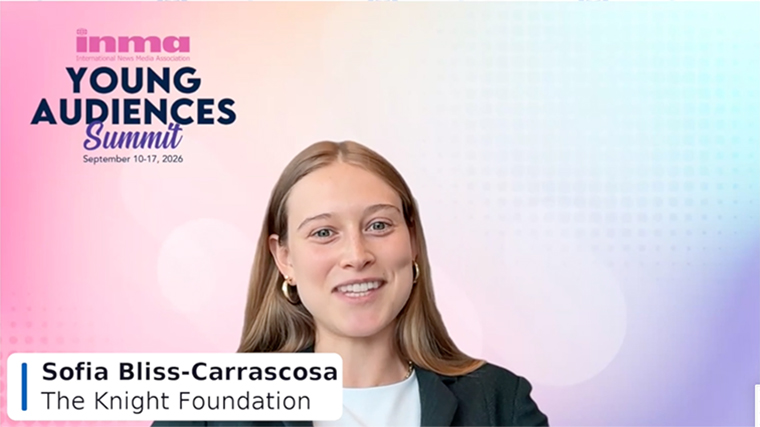
News organisations must therefore learn to “walk and talk like a creator,” Bliss-Carrascosa said, by demonstrating expertise, interacting with audiences, explaining their intentions, and understanding each platform.
Bliss-Carrascosa rarely follows a creator immediately. Their work must appear in her feed often enough that she begins to notice when it is missing.
“Only then will I follow them,” she said.
Algorithmic feeds also let audiences pursue a subject without following every organisation or person covering it. During a recent cyclospora outbreak, Bliss-Carrascosa received information from epidemiologists, public health experts, news creators, and local television stations.
She wanted extensive information about that outbreak but was not necessarily interested in everything those sources produced.
That behaviour complicates conventional measures of loyalty. Someone may engage repeatedly with a publisher’s journalism without following its account or visiting its profile.
Bliss-Carrascosa described authenticity as a tool for building trust rather than its equivalent. Citing Pew-Knight Initiative research, she said Americans ages 18 to 29 trust information from national news sources about as much as information encountered on social media.
“The institution is not credibility enough,” she said. “That’s not to say that the institution has no credibility, but that you’re kind of starting on a level playing ground.”
Drawing on the Next Gen News report, she identified three components of trust: credibility, affinity, and transparency of intention.
Creators demonstrate credibility by explaining their expertise. They build affinity by requesting ideas and responding to comments or direct messages. They provide transparency by being upfront about their values, biases, and opinions.
Creators also understand platform-specific social norms and algorithmic preferences. They know how conventions around video length, editing, self-promotion, and audience interaction vary between platforms.
“It’s their bread and butter,” Bliss-Carrascosa said.
Bliss-Carrascosa challenged the assumption that young people are uniquely uninterested in news. She said the Reuters Digital News Report found that 18- to 24-year-olds were not significantly more likely to avoid news than other people under 55.
What appears to be avoidance may instead reflect information overload. Young people have grown up amid successive events described as unprecedented and must regulate how much crisis-driven information they consume.
“You have to dose your information in tolerable loads,” she said.
Young audiences also define news more broadly and seek information relevant to their life stages. A teenager may prioritise school news, while someone new to a city may care more about meeting people and finding local activities than property issues or council elections.
Publishers should not interpret shorter, simpler content as evidence of limited interest. People encountering a story incidentally may lack its background, while younger users may still be developing knowledge of subjects such as politics or the economy.
Bliss-Carrascosa said publishers can respond by partnering with creators, hiring in-house creators, improving explanations and user experience, and creating opportunities for audience participation. For local outlets, that could include helping young people connect with each other and their communities.
Not following a brand immediately does not mean someone is ignoring its journalism. Third-party platforms, she said, represent “a huge opportunity for community building.”
Banner art: Adobe stock image by Leszekglasner.
Related Articles
-

Local news publishers need to tap into journalists’ trusted exp...
4 October 2026 -

Lessons in creator journalism from The Washington Post
1 October 2026 -

AI’s effect on super user math
15 September 2026 -

Tribun Network turns print “dots” into AI-powered insight
20 August 2026 -

Creator partnerships could reshape how news organisations reach...
12 August 2026 -

Brut India earns young audience trust through social-first jour...
23 July 2026 -

Inside Denník N’s successful subscription strategy
15 July 2026 -

Grupo RBS approaches social media as an editorial product, not ...
25 June 2026
Upcoming Events
-

Subscriber Acquisition Master Class
10-17 November 2026
-

Media Advertising Summit
New York, United States
07-10 December 2026
-

AI-Native News Product Master Class
18-25 February 2027
-

Media Subscriptions Summit
Oslo, Norway
08-12 March 2027
-

World Congress of News Media
New York, United States
25-30 April 2027
-

Branded Content & Partnerships Master Class
20-27 May 2027
-

Subscriber Retention Master Class
17-24 June 2027
-

Conferencia Latinoamericana
15-16 July 2027
-

South Asia News Media Festival
New Delhi, India
19-22 July 2027
-

Asia/Pacific News Media Summit
19-20 August 2027
-

CEO Roundtable at Kilkenny
Kilkenny, Ireland
24-26 August 2027
-

Media Innovation Week
Amsterdam, The Netherlands
27 September - 01 October 2027








