

German news literacy initiative shows 4 ways to teach young audiences
Young Audiences Initiative Blog | 22 June 2026

We talk a lot about how to reach young audiences. But there’s a question that comes before that one and it’s more uncomfortable: How do young people even learn to navigate news in the first place? It’s no longer a given.
I grew up with a newspaper on the kitchen table. A radio that ran every morning in the background. And yes, as a teenager, the late-evening news was more or less a household ritual. (Though I’ll admit, some nights a new episode of “The O.C.” won.)
Now I look at my nephew, who’s 13, and I realise that everything I learned about media, almost by osmosis, is completely foreign to him. When he watches TV at my parents’ place, he means YouTube. And the question of who makes the news? For me, that was always obvious: the people in the newspaper, on the radio, on the news platforms.
But how do you even begin to tell that on social media?
The numbers we should know
Eighty-four percent of U.S. teenagers describe news media using negative words. The top five, from a survey conducted by the News Literacy Project between April and May 2025 with 756 teens aged 13 to 18: Fake. Crazy. Boring. Biased. Sad.
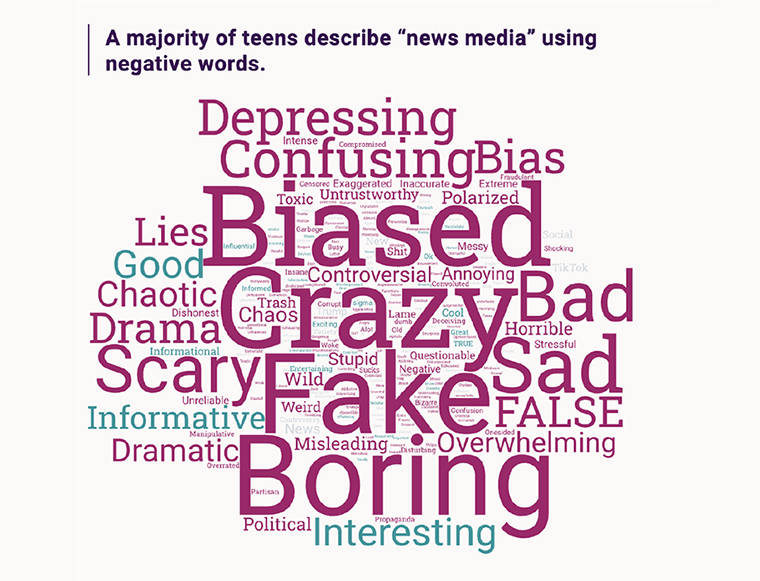
And here is what makes it worse: About half of those teens believe journalists frequently make up details and pay for sources. Not Fox News. Not tabloids. Journalists — as a category.
Vanessa Bitter is the incoming CEO of #UseTheNews, the German news literacy initiative backed by the DPA, taking over on July 1. She presented at our World Congress in Berlin, and her argument was deceptively simple: “You cannot expect young people to trust journalism if they’ve never had the chance to understand it.”
I asked her what she wants to achieve in her new role. Her answer was unambiguous: news and information literacy embedded in every German school by 2030, as self-evident as reading or arithmetic.
The argument behind it is structural, not idealistic:
“A functioning democracy requires people who can contextualise information and question sources,” she says. “Years of research and practice have shown us clearly: We reach young people above all when we work with them, not when we treat them simply as a target group.”

4 things that actually work
Bitter’s approach rests on four principles she has refined over five years:
Connect to their world, not just their platforms. Being on TikTok is not enough. You need to understand what actually matters to a 16-year-old, which means asking them, not assuming. Street interview formats work precisely because they do both at once: You get the content and you make the person feel seen.
Create transparency. Bitter is convinced the journalistic process needs to be demystified and that livestreams are one of the best tools for this — not despite their messiness but because of it. A live stream that goes slightly off-script feels more honest than a polished package. That spontaneity is the point. Offline, pop-up newsrooms and news camps, festival-like events where students meet journalists, create the same effect: Journalism stops being a black box.
Drive participation. The most effective trust building happens when young people move from passive consumers to active participants. #UseTheNews runs projects where school classes produce their own podcasts or TikTok content together with local media partners, and the content often gets published. That sense of self-efficacy, Bitter argued in Berlin, is irreplaceable.
Bring it into schools. Trust cannot be expected where it has not been taught. The CCYA, their Competence Centre for Young Audiences, is a hub where journalists, educators, and young people test new formats together before rolling them out more broadly. This can be board games for teachers, idea-thons, or cross-border news camps.
Failure of legibility
For a growing number of young news consumers, the distinction between journalist and content creator is genuinely blurry. Among adults under 30, trust in social platforms nearly matches trust in national news outlets. News and content are becoming interchangeable, and most newsrooms have not fully reckoned with what that means.
Bitter frames this not as a failure of young people’s judgment but as a failure of legibility. Journalism hasn’t made itself readable to this generation. That’s the problem we all should be looking at.
So I asked her directly: Where does a news organisation even begin? The first step, she said, is encounter.
“Media organisations that seek genuine dialogue understand young people in a way no target group analysis can replace,” she said.
In her projects, young people and editorial teams learn equally from each other. Whoever tries journalism themselves changes their relationship to media. And whoever listens and enables participation produces differently.
The stakes behind that argument are high. On TikTok and Instagram, young people constantly encounter content that looks like news but doesn’t hold up to journalistic scrutiny, and that creates a deceptive sense of being informed.
“Someone who can’t recognise disinformation makes decisions on a false basis. News literacy is therefore not a supplementary school qualification. It is a prerequisite for democratic participation.”
If you’d like to subscribe to my bi-weekly newsletter, INMA members can do so here.
Related Articles
-

AI’s effect on super user math
15 September 2026 -

What I told 40 CEOs (and won’t gatekeep from you)
30 August 2026 -

At Mediacorp’s CNA, loyalty means giving audiences a reason to ...
20 August 2026 -

Tribun Network turns print “dots” into AI-powered insight
20 August 2026 -

Economist launches subscription tier targeting younger audience...
20 July 2026 -

Grupo RBS builds social-first video operation to expand audienc...
20 July 2026 -

Inside Denník N’s successful subscription strategy
15 July 2026 -

Rheinische Post programme turns print loyalty into digital conf...
11 June 2026
Upcoming Events
-

Subscriber Acquisition Master Class
10-17 November 2026
-

Media Advertising Summit
New York, United States
07-10 December 2026
-

AI-Native News Product Master Class
18-25 February 2027
-

Media Subscriptions Summit
Oslo, Norway
08-12 March 2027
-

World Congress of News Media
New York, United States
25-30 April 2027
-

Branded Content & Partnerships Master Class
20-27 May 2027
-

Subscriber Retention Master Class
17-24 June 2027
-

Conferencia Latinoamericana
15-16 July 2027
-

South Asia News Media Festival
New Delhi, India
19-22 July 2027
-

Asia/Pacific News Media Summit
19-20 August 2027
-

CEO Roundtable at Kilkenny
Kilkenny, Ireland
24-26 August 2027
-

Media Innovation Week
Amsterdam, The Netherlands
27 September - 01 October 2027








