

Spilnews reinvents its newsroom to tap into the creator economy
Young Audiences Initiative Blog | 27 September 2026

When Mediahuis wanted to tap into the creator economy, it didn’t add on to its existing brand; it started something entirely new.
During the INMA Young Audiences Summit, Birgit Coenen, chief growth officer, explained how that became Spilnews, and outlined how the youth-oriented brand is structured.
“We did not build a brand first,” she explained. “We built room to reinvent.”
She and colleague Christopher Kenis, publisher and managing director, were given the mandate to “create a new youth brand that captures relevant market share through independent journalism and develop revenue streams,” and were instructed to build it outside any existing newsroom structure.
“Every existing frame that we know from a current newsroom, all those legacy titles had to be breakable. A newsroom or entity with an operational flow cannot afford to fail,” Coenen said. “So for us, it was really important that we had room to reinvent and ask and do everything to reinvent our place of our new experiment in the creator economy.”
The team began as a three‑person startup within the corporate structure, reporting directly to the board rather than through existing editorial hierarchies.
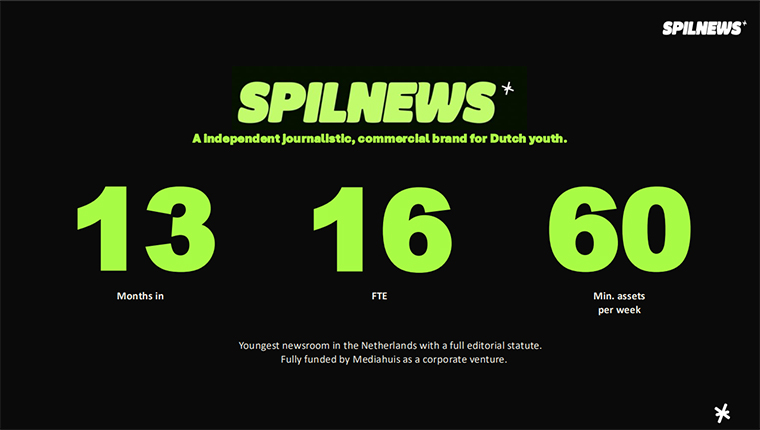
In just over a year, Spilnews has grown to 16 employees, “for most of all, young people,” and now produces 60 assets per week.Coenen described it as the youngest newsroom in the Netherlands.
Spilnews publishes on TikTok, Instagram, and YouTube, with a reach of approximately 35,700 followers and a TikTok engagement rate of 4.6%. In 2026, the brand generated 37 million views.
The goal is to be “everywhere where our audience is,” Coenen said, which means operating off‑platform on social media rather than relying on traditional distribution channels. The team has also expanded to Snapchat and Substack as part of its growth strategy.
Coenen described Spilnews’ editorial formula as a combination of three strengths: an evolving editorial core, a creator mindset, and a community‑first approach.
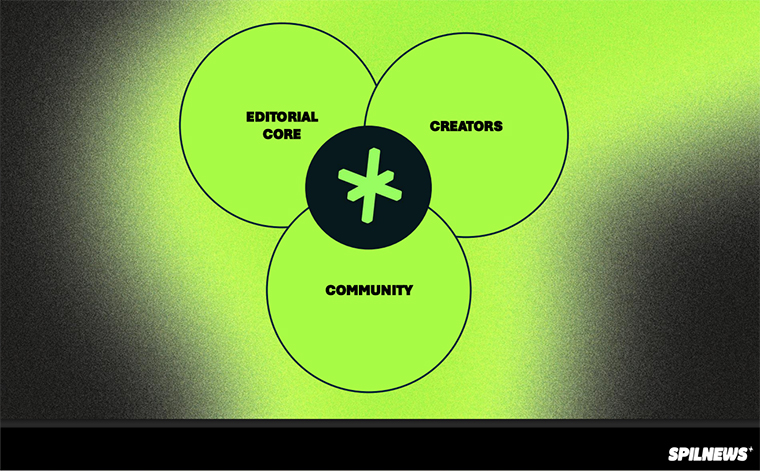
“Our editorial core is the most difficult and is developing every day,” she said. “We are still finding out what that exactly is.”
Building a creators’ newsroom
The newsroom uses both internal journalists and external creators, operating “inside out and outside in” to produce content. Journalists develop formats based on their niches, such as true crime or political reporting, while external creators contribute storytelling styles that resonate with their own audiences.
This hybrid model allows Spilnews to reach young audiences across multiple niches, Coenen said.
Community engagement is central to Spilnews’ editorial process. Team members “actively search for relevant stories” and maintain daily conversations with young audiences through comments and direct messages, Coenen said.
She described the evolution from simply being present in comment sections to building participatory journalism, saying the newsroom now incorporates audience feedback into editorial decisions.
“The most authentic content right now has the best score,” she noted. “Real, authentic content where Dutch youth feel connected with the people in the video and with the journalists. That’s the most important takeaway I would like to give.”
Spilnews’ editorial code of conduct reflects Mediahuis’ traditional standards and is built on truth, independency, transparency, and care. Independent journalism remains the core of the brand, even as it experiments with creator‑driven formats and social‑first distribution.
A new revenue strategy
One of the first things Coenen did was look at how Dutch youth viewed advertising. Those findings informed their revenue strategy.
“This was the most important for us: 71% of Dutch youth does not want to pay for news journalism content; 90% of our followers are open for branded content if it’s transparent, and 70% of Dutch youth prefer social content with creators over regular display ads,” she shared. “So we needed to have this independent research to get the first step into how a brand partnership would work for a brand like us.”
The team evaluates whether a brand aligns with its editorial values before accepting a partnership, rejecting categories such as gambling and fast food, Coenen said. Brands typically approach Spilnews because they “find it difficult to communicate with young audiences,” and seek help creating content that addresses societal topics.
Now, it has a specific workflow for brand partnerships: Spilnews conducts journalistic research, analyses audience insights, creates a format, selects a creator, develops a distribution plan, and optimises the campaign.
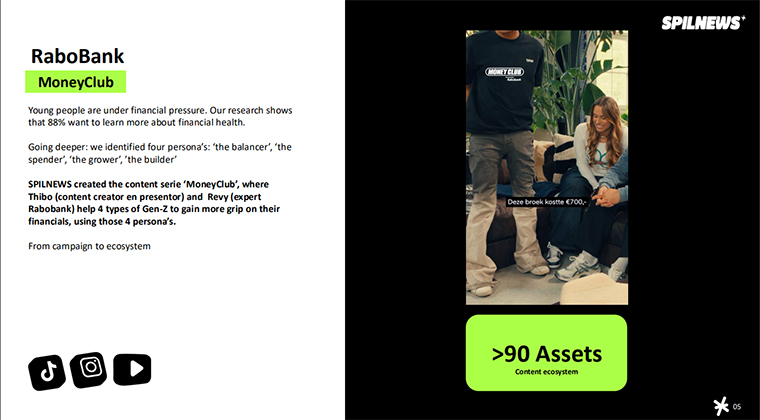
The brand’s first major client was RaboBank, for which Spilnews produced a series called MoneyClub focused on financial pressure among young people. Research showed 88% of young audiences wanted to learn more about financial health, and Spilnews identified four personas — the balancer, the spender, the grower, and the builder — to shape the content strategy.
The team produced approximately 90 assets for the campaign and now works with clients in the €20,000 to €50,000 range, with a pipeline of around 10 active clients.
Coenen emphasised that Spilnews maintains strict separation between journalism and branded content. Journalists do not participate in paid partnerships, even though some have become recognisable personalities.
For example, when a governmental organisation that was a brand partner became the subject of news coverage, Spilnews’ journalist continued reporting independently, while creators handled branded storytelling.
“You do have to protect your own journalists and newsmakers because they are the trust and the face of the news part,” Coenen said.
She acknowledged creator journalists often pursue independent partnerships on their personal channels, and Spilnews supports them in developing their own brands. However, she said journalists must avoid partnerships that conflict with their reporting responsibilities.
For example, a journalist who covers technology would not partner with Samsung but could pursue travel‑related partnerships on her personal accounts.
Coenen described Spilnews as a talent pool, adding that some journalists have already been recruited by television networks. News publishers must “reinvent their role,” she said, and accept that young journalists will leave, which is why Spilnews focuses on supporting their development rather than retaining them long‑term.
“We need to be facilitators of journalists and we have to accept that they will leave … but we’re very proud [to be part of their] journey,” she said. “We will not build our brand around faces. We will have a place where they can develop themselves, where we find ways to work together and accept that this is a given fact.”
But even as journalists leave, they have given something back to the company: “They will give back to you credibility to your brand or the publishing house you are.”
Related Articles
-

5 lessons from the INMA Young Audiences Summit
28 September 2026 -

The 3 editorial pillars of Chile’s first streaming news channel
23 September 2026 -

AI’s effect on super user math
15 September 2026 -

What I told 40 CEOs (and won’t gatekeep from you)
30 August 2026 -

Nation Media Group focuses editorial strategy on stories that m...
4 August 2026 -

Economist launches subscription tier targeting younger audience...
20 July 2026 -

Grupo RBS builds social-first video operation to expand audienc...
20 July 2026 -

AI adoption in newsrooms should move from experiment to strateg...
12 July 2026
Upcoming Events
-

Subscriber Acquisition Master Class
10-17 November 2026
-

Media Advertising Summit
New York, United States
07-10 December 2026
-

AI-Native News Product Master Class
18-25 February 2027
-

Media Subscriptions Summit
Oslo, Norway
08-12 March 2027
-

World Congress of News Media
New York, United States
25-30 April 2027
-

Branded Content & Partnerships Master Class
20-27 May 2027
-

Subscriber Retention Master Class
17-24 June 2027
-

Conferencia Latinoamericana
15-16 July 2027
-

South Asia News Media Festival
New Delhi, India
19-22 July 2027
-

Asia/Pacific News Media Summit
19-20 August 2027
-

CEO Roundtable at Kilkenny
Kilkenny, Ireland
24-26 August 2027
-

Media Innovation Week
Amsterdam, The Netherlands
27 September - 01 October 2027








