

Advertising leaders discuss Meta, brand safety, collective action
Advertising Initiative Blog | 03 June 2026

In my last blog, I covered the INMA World Congress Berlin mainstage advertising session, including my keynote and follow-up presentations from Pippa Leary (News Corp Australia) and Alexander Lydecker (Bonnier News Sweden.) We walked though the diagnosis of the moment we’re living through, strategic framing for transformation, and key principles for rebuilding publisher advertising around real audience value.
This week’s blog picks up where that one ended and covers the rest of the advertising sessions from Berlin.
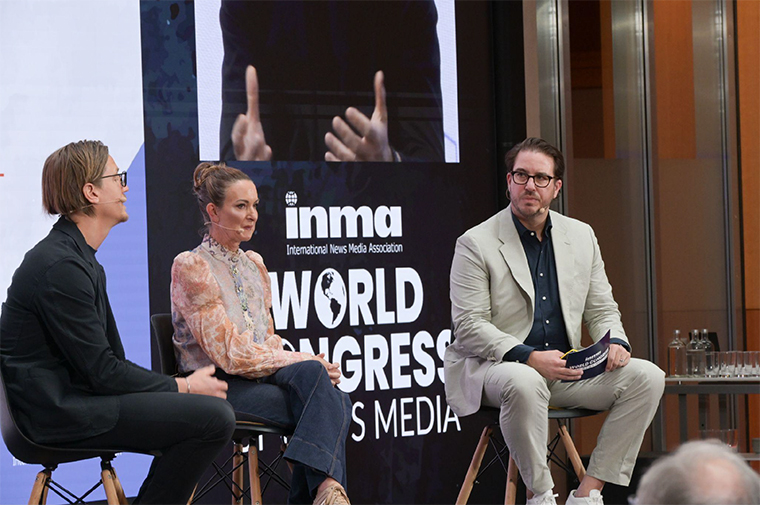
After our three presentations, Pippa, Alexander, aand I sat down for a roundtable discussion that expanded on those principles and also discussed some collective action problems.
On what changes when advertising has a real seat at the leadership table
Both Alexander and Pippa do have that seat, and both were direct about what changes when you do.
For Alexander, it means subscription and advertising are no longer competing for the same audience or the same product real estate. Registration becomes everyone’s job because registration serves both. Logged-in users become everyone’s product because logged-in users serve both. The whole company moves in one direction instead of three.
For Pippa, the engaged-reach KPI shift was as much a leadership decision as a metrics decision. The reason News Corp Australia could cascade engaged reach through the entire organisation, retool editorial around it, and hold the line with clients on it is because advertising had the standing inside the company to push the change through. Without that seat, none of it happens.
Then the conversation turned to collective action. The biggest external problems in publisher advertising are problems that no single publisher can solve alone.
On Meta and platform accountability
Alexander has sat on the IAB board in Sweden for 10 years. For years, nothing happened while platforms posted display ad revenues in the 10s of billions, weaponising publishers’ trusted brands and journalists’ faces in scam ads run against publishers’ own audiences.
Last year, Alexander and a coalition of Swedish publishers called for a petition. They got Meta voted off the board. The Swedish parliament followed with a legislative change: the first one-hour takedown rule in Europe for scam ads. If the government flags a scam ad, the platform has one hour to remove it.
His ask of the room, and of every publisher reading this, was direct: Align together, every publisher in the world. This is about defending our legacy, freedom of speech, and the role we play in democratic societies. Local pressure works. Global pressure would work more.
On Section 230
Pippa raised the second wall. Section 230, signed by U.S. President Bill Clinton in 1996, says U.S. platforms aren’t liable for what’s published on them because they’re not publishers. That’s a piece of American legislation. She asked why the rest of the world is abiding by it? Any sovereign state outside the United States is not obligated to apply U.S. law.
Pippa’s point: Changing this in even a single non-U.S. jurisdiction would have an overnight, transformational effect on our businesses.
On brand safety and the US$2.8 billion problem
As Pippa explained, brand safety technology was built 15 years ago to keep brands from appearing next to unmoderated user-generated content. The way the technology was built is incredibly blunt. It sees the word “smash” in a tennis story and blocks it as violence. It blocks a story on a European vineyard because alcohol. News Corp Australia alone is losing about 80 million page impressions a month on the word “violence.”
How much is the industry losing annually to news-blocking from blunt brand safety tools? Pippa asked the room to guess. The answer is US$2.8 billion. There are better tools. AI- and context-aware solutions like Mobian, Mantis, and Illuma already exist and work. But if any one publisher adopts them, nothing changes. We have to act as a collective, go to our clients and their agencies together, and ask them to adopt these tools too.
(For more on this, see my report from last year, How News Advertising Reclaims the Brand Safety Narrative.)
The kicker, which I said and then said again because I think it cannot be repeated too often: The current state of the advertising market is that news is “unsafe” and Meta is “safe.” Done. We have to be louder as an industry. The pressure does work, but we need more of it. One of the legacy verification players has heard the criticism, hired a head of news, and is doing research to better support publishers.
If you’d like to subscribe to my bi-weekly newsletter, INMA members can do so here.
Related Articles
-

Spain is moving from inventory to brand partnerships
11 October 2026 -

Research: 15% of sales directly tied to news brands’ cultural r...
11 October 2026 -

6 ways news publishers are turning trust into advertising reven...
30 September 2026 -

Are events the hero product for publishers?
27 September 2026 -

A look at 30+ revenue streams publishers are actually building
31 August 2026 -

The week the news business got graded on direction, not results
6 August 2026 -

South Asia’s publishers have the trust but not yet the revenue ...
26 July 2026 -

Editora Globo shifts from selling ads to selling media solution...
21 July 2026
Upcoming Events
-

Subscriber Acquisition Master Class
10-17 November 2026
-

Media Advertising Summit
New York, United States
07-10 December 2026
-

AI-Native News Product Master Class
18-25 February 2027
-

Media Subscriptions Summit
Oslo, Norway
08-12 March 2027
-

World Congress of News Media
New York, United States
25-30 April 2027
-

Branded Content & Partnerships Master Class
20-27 May 2027
-

Subscriber Retention Master Class
17-24 June 2027
-

Conferencia Latinoamericana
15-16 July 2027
-

South Asia News Media Festival
New Delhi, India
19-22 July 2027
-

Asia/Pacific News Media Summit
19-20 August 2027
-

CEO Roundtable at Kilkenny
Kilkenny, Ireland
24-26 August 2027
-

Media Innovation Week
Amsterdam, The Netherlands
27 September - 01 October 2027








