

Lessons from music industry: how to monetise super users
Readers First Initiative Blog | 07 September 2026

The music industry spent a decade under-monetising its super listeners and is now changing the direction. What are the strategic lessons for news publishers?
Across the world, media and entertainment executives are talking about super users to their investors four times more than they were two years ago, but many in the news business still cannot say who they are.
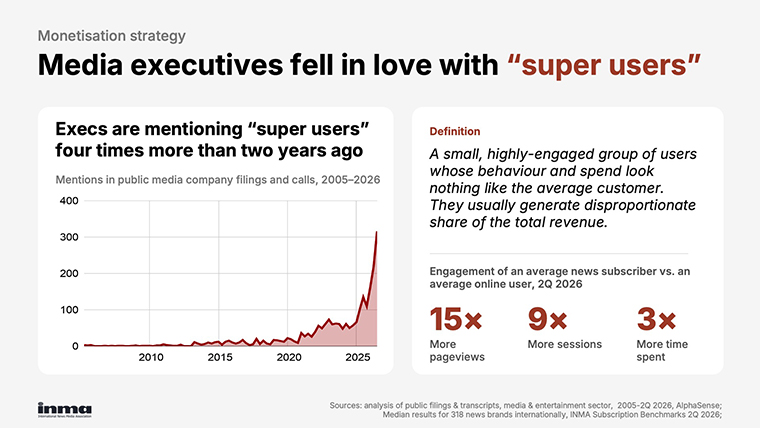
An INMA analysis of public filings and earnings calls across U.S. and international media and entertainment companies, using data from AlphaSense, found mentions of super users and superfans flat through the 2000s, drifting through the 2010s, rising from 2020, then roughly quadrupling in the two last years.
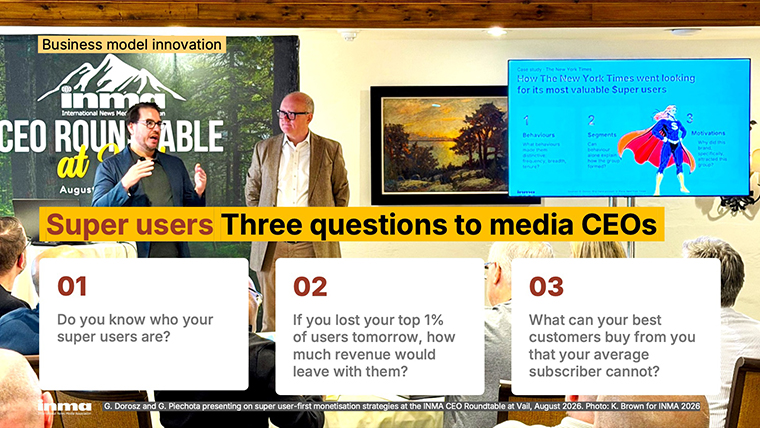
At the recent INMA CEO Roundtable in Vail in August, I asked a room of chief executives how many could say who their super users are. About five hands went up. Who knows what proportion of total revenue these super users generate? Barely anyone could.
Power laws in the news media
In the INMA Subscription Benchmarks, across 318 news brands in Q2 2026, subscribers generated 15 times the pageviews of an average user and visited nine times as often.
The 1% online users who have a subscription account for 27% of monthly pageviews at the median brand and 42% for the upper quartile of brands.
One European national brand reported at an INMA closed event that 81% of total revenue from that 1%. A South American peer found 1% producing 72% of subscription and advertising revenue combined.
Power laws are not a discovery. These are typical distributions in the consumer media business. What changed is the conclusion executives draw from them: How to grow the super user segment? And how to charge more for the extra value super users get?
Case of Spotify
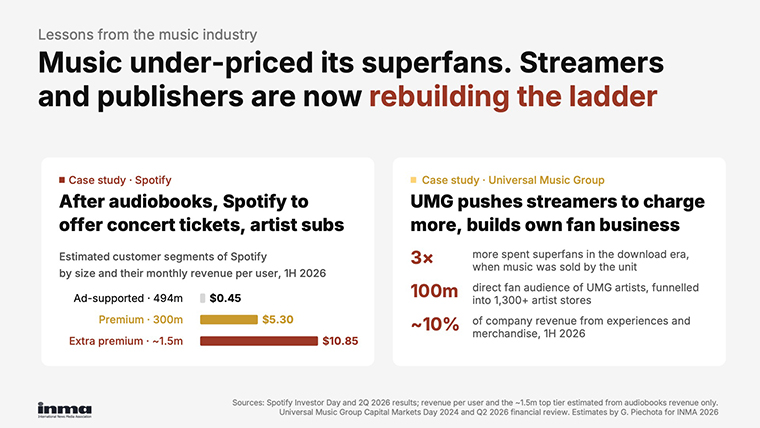
Based on my calculations of the publicly released figures, the music streamer’s user base in Q2 2026 split into roughly 494 million ad-supported listeners worth on average about US$0.45 a month, some 300 million paid subscribers worth US$5.30, and an estimated 1.5 million at the top worth US$10.85.
The top tier includes paid subscribers who bought an add-on — the access to audiobooks, which reached about US$100 million in annualised revenue by July, per my estimates, or roughly US$5.55 a head on top of the regular subscription.
At Spotify’s Investor Day, executives laid out new initiatives to increase that top tier revenue, with selling tickets to live concerts and single creator memberships.
At the same time, executives set an ambition of a billion subscribers for Spotify, planning that broader reach will supply the candidates for super listeners: “The user journey begins with free, which drives engagement, builds habits, and creates the foundation for conversion to Premium over time.”
Case of Universal Music Group
In the download music era the industry had a natural price ladder: super fans bought around three times the average because music was sold by a song or a record.
Streaming knocked down this ladder, argued Universal Music Group executives at its Capital Markets Day in 2024. An all-access subscription charges the eight-hour listener what it charges the commuter.
UMG is working with streamers on enhanced premium tiers for super fans and is repositioning the ladder outside of the subscriptions. It is, for example, doubling down on the direct fan audience (approaching 100 million) funneled into artist stores (more than 1,300).
Experiences and merchandise ran at about 10% of company revenue in the first half of 2026. UMG believes the addressable market is up to 20% of all streamers.
What this means for news
In the past decade, many news publishers have been fighting for market share and made their online product lines and pricing as simple as possible to maximise conversions.
For example, my August review of the subscription landing pages of the top 50 news subscription brands by the number of digital subscriptions found most (26) offering one all-access digital subscription product only, apart from extra paid print products if published.
Music companies such as Spotify and UMG offer inspiration where these product lines might go next:
Priority access to new content and special editions.
Audiobooks or e-books.
Archives and searchable databases.
Memberships attached to individual journalists rather than the masthead.
Tickets to live journalism events, including live Q&A sessions.
Fan merchandise.
Digital replicas of print newspapers, with proven higher willingness to pay in markets like Germany, might be a good starting point for developing new premium tiers.
More proven ideas in news: bundling with other news and magazine brands, family sharing accounts, and partner benefits and discounts are popular, for example, in Norway, United States, or Argentina.
Broader benefits might help prevent “premium tier” from becoming a synonym for “replica newspaper,” the format publishers might one day retire.
None of these ideas requires raising prices for the basic news products. And none requires locking more access to Web sites or apps.
“A super user-first company cannot become a super user-only company,” I argued in Vail. Spotify set a North Star of one billion subscribers, planning for expanding both free and paid access, as reach supplies candidates for super users. News publishers need both, too.
Greg’s Readers First newsletter is a public face of a revenue and media subscriptions initiative by INMA, outlined here. INMA members can subscribe here.
Banner photo: Adobe Stock by Zee.
Related Articles
-

Every loyal reader was a stranger first
8 October 2026 -

There is no subscription ceiling — there is a Web site ceiling
4 October 2026 -

Challenging 3 myths about audience engagement
21 September 2026 -

The inbox deserves more investment from publishers in the AI er...
26 July 2026 -

News companies should stop chasing clicks, start competing for ...
28 June 2026 -

News publishers leverage audience insights to build deeper rela...
23 June 2026 -

Subscription benchmarks reveal dynamic strategies set top news ...
15 June 2026 -

Research: Some consumers are willing to pay, unwilling to commi...
14 June 2026
Upcoming Events
-

Subscriber Acquisition Master Class
10-17 November 2026
-

Media Advertising Summit
New York, United States
07-10 December 2026
-

AI-Native News Product Master Class
18-25 February 2027
-

Media Subscriptions Summit
Oslo, Norway
08-12 March 2027
-

World Congress of News Media
New York, United States
25-30 April 2027
-

Branded Content & Partnerships Master Class
20-27 May 2027
-

Subscriber Retention Master Class
17-24 June 2027
-

Conferencia Latinoamericana
15-16 July 2027
-

South Asia News Media Festival
New Delhi, India
19-22 July 2027
-

Asia/Pacific News Media Summit
19-20 August 2027
-

CEO Roundtable at Kilkenny
Kilkenny, Ireland
24-26 August 2027
-

Media Innovation Week
Amsterdam, The Netherlands
27 September - 01 October 2027








