

Trust has moved from the masthead to the person
The Distillation Blog | 11 September 2026

The news business has always sold two things at once: the institution and the individual. This week, the INMA conversation settled which one the audience is buying.
Big reveal: It’s the individual.
On Thursday, nearly 360 people from more than 200 companies in 43 countries joined the first module of the INMA Young Audiences Summit to hear that the creator is a medium, not a personality type — and that people who get news from creators trust them more than they trust us.
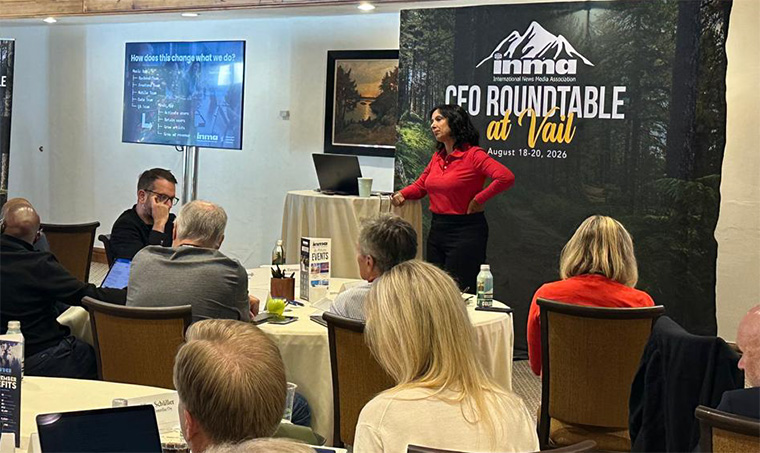
Sonali Verma reported that 40 CEOs at our recent Vail Roundtable had named human relationships the scarcest asset in the business and intend to fund star bylines and creator journalists while automating the rest.
Greg Piechota showed the money already obeys the rule: The 1% of users whose names you know generate 27% of pageviews — and, at one national brand, 81% of revenue.
And Gabe Dorosz’s Advertising Initiative Webinar supplied the twist: The machines reading your pages don’t care about the masthead either. They read authority signals and a sponsor named on the first line.
Four directions inside INMA, one storyline:
- INMA Young Audiences Summit: Kerstin Hasse’s first module, from the definition of a creator journalist to a 20-person streaming channel out-drawing Chile’s broadcasters.
- INMA Newsroom Initiative: Sonali on what CEOs will invest in, kill, and worry about in 2027.
- INMA Readers First Initiative: Greg on super users, check-outs, and the second-quarter benchmarks.
- INMA Advertising Initiative: BCN and Time on the first advertising built for AI agents.
Underneath sits one question: If the relationship is with the person, what is the brand for?
The insight: Trust was an institutional asset for a century. It is becoming a personal one, and it moves with the person. Your brand’s new job is not to be the star. It is to be the guarantee behind the star — and to get paid for it.
The Summit: The creator is a medium
Kerstin opened with the Reuters Institute numbers she unpacked on the INMA Young Audiences blog in July: 27% of people worldwide get news from a creator every week, and among those who do, creators score higher than news brands on every attribute tested — including trust and impartiality. HugoDécrypte reaches 28% of under-35s in France, more than Le Monde. Publishers know it: 70% told the Reuters Institute they worry creators are taking their audience’s attention.
Liz Kelly Nelson, founder of Project C, a community of 250+ journalists working in the creator ecosystem, gave the definition the news industry has lacked: “Creator and influencer are marketing terms. The creator ecosystem is a medium in the same way print and broadcast are.” A creator journalist stands alongside a print journalist or a broadcast journalist — the medium, not the messenger.
Her advice was practical. Invest in the marquee talent you already have, then fix the bonuses and revenue shares that sent the Vox producers out of the door. Partner with creators editorially, not as marketing. Kerstin’s own research found 95% of creator journalists want to work with traditional media and 20% feel taken seriously by it. “Bring the institution to that relationship,” Liz said. “That’s what they don’t have on their own.”
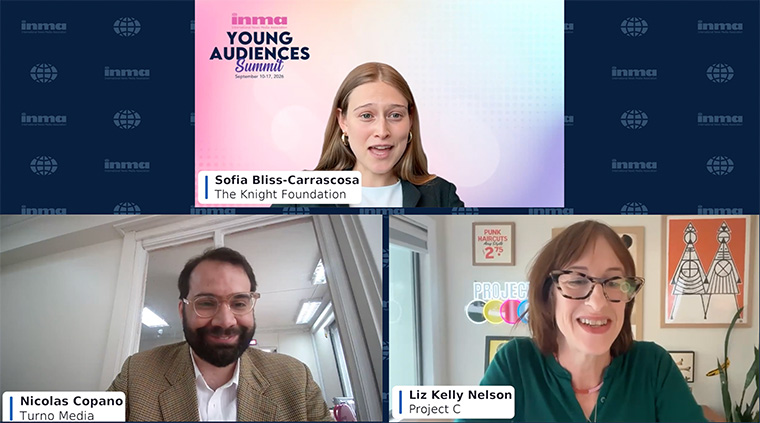
Sofia Bliss-Carrascosa of Knight Foundation, born after 9/11 and speaking for her generation, explained why the relationship has to be personal. Pew-Knight finds 18- to 29-year-olds trust national news about as much as social media. “The institution is not credibility enough.” Creators earn trust explicitly — credentials up front, affinity in the comments, intentions declared — where news brands assumed the masthead did it for them. Young people are not avoiding news, she said. They are dosing it.
Then Nicolás Copano showed the medium at full scale. Turno, Chile’s first streaming channel, broadcasts five hours live every weekday with a team of 20. In 2025 it generated more than 105 million views and 100,000 YouTube subscribers, monetised through memberships, sponsors, and events. It has no Web site — “YouTube is the best CMS on the market” — and a 3,000-strong WhatsApp community. His rule: Don’t over-produce. His audience: not followers but “emotional shareholders.”
Kerstin’s close was the sharpest line of the day. Stop asking whether someone is a creator; ask whether they are doing journalism. The opponent is not the creator. It is misinformation and AI slop.
The insight: Your journalists’ names are now a distribution channel, and most companies still hide them behind a masthead. Decide which three people in your building the audience should know by name — and what they are paid when the audience follows them.
The CEOs: Automate the commodity, fund the person
Sonali polled the recent Vail CEO Roundtable room and published the answers on the INMA Newsroom Initiative blog: what CEOs are investing in — and what they are killing. Almost every CEO wants to automate breaking news, commodity news, and the archive, and to invest in investigative units, star bylines and columnists, and “especially creator journalists.” The scarcest asset, they said, is human relationships, ahead of trust and judgement. Expect community building and live events with journalists to be funded accordingly.
The assumptions they are retiring — that social drives traffic, that audiences will keep coming to the site, that pageviews measure anything, that the subscriber relationship is exclusive — read like an obituary. Most expect only 25% to 50% of their 2019 search traffic in 2028. “News tastes like chicken,” said one. “It’s the same everywhere.” Her second dispatch is about what that does to the building: a CMS that is “the antithesis of liquid content,” agents “doing so much work that it’s really hard to keep up,” and a room asking who owns what. “It is a little bit of bedlam right now.”
In terms of news headlines INMA is following for members this week, the same bet is being placed at scale. Sonali flagged in the INMA Slack channel Mathias Döpfner’s plan, reported by Axios, to turn Axel Springer into a “creator platform” within five years, internally called “United Artists.” His line is the week in one sentence: “People follow the talent, but the label represents a certain quality and, in our case, a certain set of values.”
What is the label worth? DRIVE, the digital revenue initiative of 30 regional publishers in Germany, Austria, and Switzerland, put a number on it on the INMA Ideas blog: Publishers whose vision genuinely shapes daily decisions grew media time 22 percentage points faster year-on-year and conversions 83 points faster than those where it hangs on a wall. “The clearer a publisher’s identity, the more readers come directly.”
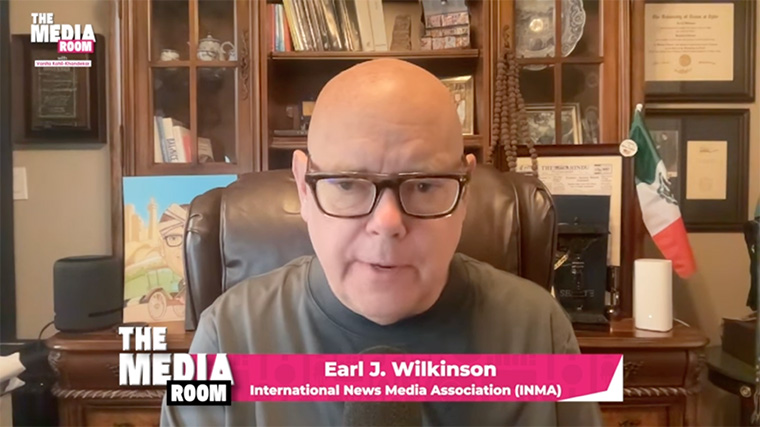
I made a related argument on The Core’s Media Room podcast from India this week: The first three years of AI in news were about efficiency; the value creation is only now beginning. And the news industry has to stop grieving the 30% margins of the past. A news company earning 5% to 10% while rebuilding around its readers is doing the work.
The insight: The Vail list and the Summit list are the same list. The CEOs will pay for the person; the audience already does. What sits between them is the incentive structure — and it is yours to fix before the talent fixes it by leaving.
The money: Fewer people, better known
Greg’s second-quarter numbers from INMA Subscription Benchmarks — 318 brands, 73 companies, 38 countries — carry the headline. World median online users fell 7.3% year-on-year — flat through 2025, then a sharp break as AI Overviews and AI Mode reached more markets. Digital-only subscriptions still grew 3.7%, revenue grew 12.75%, and churn held at 4.3%. Greg’s one-line summary for the benchmarking community: The news industry is extracting more revenue from a shrinking audience. His companion finding — that superior acquisition explains far more of the gap between growing and declining brands than superior retention — deserves a strategy meeting of its own.
Two public blogs from Greg say where the revenue is coming from.
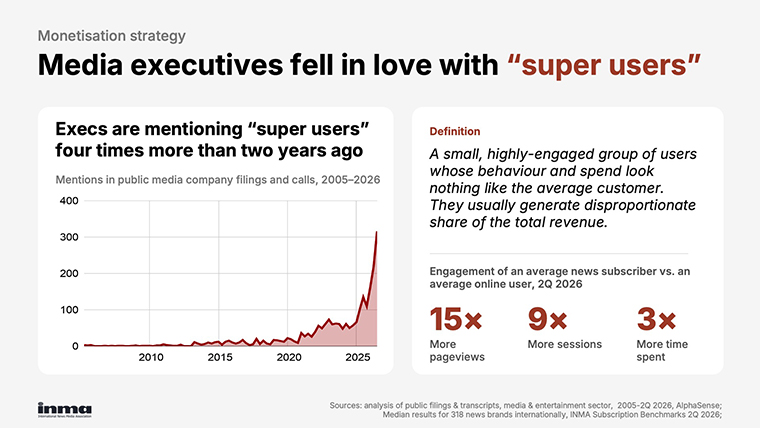
Super users. Mentions of “super users” and “superfans” in media companies’ filings and earnings calls have quadrupled in two years. In Vail, Greg asked the CEOs who could name theirs; five hands went up. Yet subscribers generate 15 times the pageviews of an average user, the 1% who subscribe account for 27% of pageviews at the median brand, and one European national brand reported 81% of total revenue from that 1%. Twenty-six of the top 50 news subscription brands still sell one all-access product; Greg’s list of next tiers starts with memberships attached to individual journalists rather than the masthead. His caveat: “A super user-first company cannot become a super user-only company.”
Check-outs. Across 149 brands with complete data, the median check-out flow now converts 38% of the readers who start it — up from 16% two years ago and ahead of online retail at roughly 30%. The top 10% convert five times the share of the bottom 10%, and the gap is executional: 39% of brands are behind at the offer, 39% inside the check-out, only 9% at both. Removing a whole step is worth several times more than tidying one.
The cases agree. Mediahuis bundled the RouteYou hiking app into its Essential Subscription: 175,000 subscribers activated it, and those who did churned 26.5% less over 12 weeks. The Washington Post says it is on track to break even this year on 17% fewer visits and 300,000 new subscriptions. The Boston Globe’s B-Side has 60,000 subscribers, 65% of them under 35 — and A Media Operator asks the question INMA’s Young Audiences Summit circled: Will Gen Z ever pay for news it gets free?
The insight: Anonymous audience is falling; known audience is paying. The three fastest levers in the business — the offer, the check-out, and the tier above all-access — all sit on your own property, in front of people whose names you already have.
The other audience: Machines don’t read mastheads either
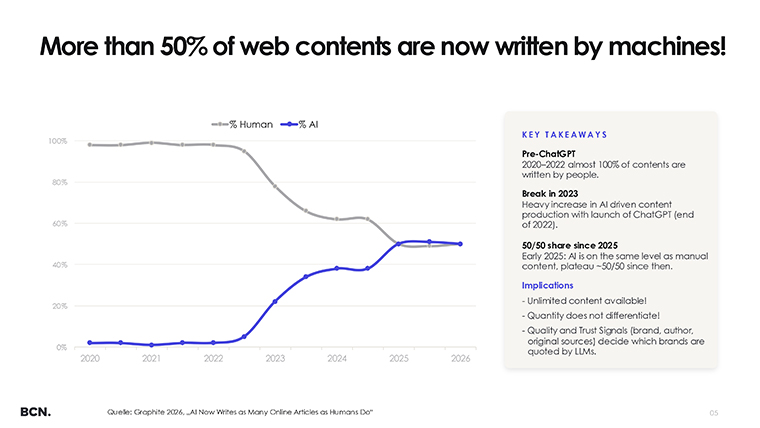
Gabe’s Wednesday Webinar on advertising to machines belongs in this storyline for one reason: The second audience behaves like the first. More than half of Web traffic is no longer human. At Time, Mark Howard said, agent and bot traffic some days runs ahead of human traffic, so Time split its site in two — a human version and a machine-readable one — and in July served its first campaigns built for agents: structured facts, sponsor named in the first line, every claim sourced. Referrals from AI answer engines, he added, convert at a significantly higher rate than search. BCN’s Stefan Betzold is selling the other side: GEO Brand Impact, influence over the AI answer itself, measured on visibility, citations, and sentiment. Only 10% to 15% of what AI answers cite comes from a brand’s own Web site; the rest is earned on sites with authority. “Brands do need to think of agents now as a highly influential and important audience,” Howard said.
Gabe also flagged for members CNN’s Guy Griggs in The Drum (by INMA Past President Mark Challinor) on “brand agents” and a sales floor that stays human because “creativity is what makes people notice, feel, and remember.” Griggs keynotes the INMA Media Advertising Summit in New York in December.
The machines are also in court. The Seattle Times and Newsday sued Microsoft and OpenAI, citing 88 words of Pulitzer-winning Boeing coverage reproduced almost verbatim, the same week Judge Sidney Stein heard summary-judgement arguments in The New York Times’ case with the U.S. Justice Department now on OpenAI’s side. And Sonali flagged Google’s US$10 million purchase of 100 million Spirit Airlines employee e-mails and 500 million Teams messages to train its models. The market has a price for a bankrupt airline’s inbox. It is still arguing about your archive.
One newsroom turned the machine on itself. At Legit in Nigeria, Kseniia Kit built a clustering script with Claude that clusters months of headlines by meaning and scores each cluster by audience need and emotional trigger. “If you work in media, chances are you’re the data analyst too.”
The insight: Human or machine, the buyer now wants the same three things: a named source, a verifiable claim, and proof of an outcome. Structure your content and your advertising so an agent can read them — and put a name on both.
The referees: A name on the machine, a curfew on the teenager
My own blog this week counted six regulatory moves in 21 days and argued they are one story: The referees have arrived, and they are not refereeing journalism. Two of the six push this week’s storyline hardest. Since August 2, the EU AI Act has required machine-drafted text on matters of public interest to be labelled — unless a named person or institution holds editorial responsibility for it. Brussels has written the provenance argument into statute: The difference between a labelled machine and a publication is a human who owns it. And Meta’s US$18 billion settlement carries a clause that could cap teenagers at one hour a day on Instagram, Facebook, YouTube, and TikTok, with a nightly blackout. Somebody gets those hours back. It will be us only if we have built something a 16-year-old wants at 10:30 p.m.

The week added three whistles. Ireland’s Coimisiún na Meán opened its first Online Safety Code investigation into X over age assurance and parental controls. On the INMA Ideas blog, News Corp Australia’s Melanie Pilling recounted how the Let Them Be Kids campaign delivered the world’s first under-16 social media ban — 4.7 million under-age accounts shut down since. And Meta extended Community Notes, its replacement for professional fact-checkers, to 16 Latin American countries; the International Fact-Checking Network called it “simply not adequate.”
The insight: Regulators are making two things scarce at once — unaccountable machine text and teenage attention. Both scarcities reward a brand with a person behind it.
What it means for your company
Distil the week, and you get three sentences:
- The audience is choosing people over mastheads, and the data says it trusts them more once it knows them.
- The money already follows the people whose names you have — super users, subscribers, the reader in your check-out flow.
- The machines and the referees want what the audience wants: a name on the work.
Three decisions for this month: Name your marquee talent and write the incentive that keeps them. Name your super users and price the tier above all-access. Name the human who owns your machine-drafted text before a regulator asks.
Dates for the diary:
- September 15 and 17: Modules two and three of the INMA Young Audiences Summit — SPIL from Mediahuis, The News Movement, and DMG Media on who is doing the job; then The Washington Post’s Sara Goo and Deutsche Welle’s Johanna Rüdiger on building creator talent.
- September 16: Greg’s Subscription Masters Webinar with RCS MediaGroup’s Fabio Napoli on how Corriere della Sera built a 730,000-subscriber business without giving up mass-market reach.
- September 21-25: INMA Media Innovation Week in Madrid — Greg and Gabe lead a study tour into Prisa Media, Vocento, Unidad Editorial, El Confidencial, and elDiario.es (September 21-22), then the conference (September 23-25), where Kerstin and Sonali take on the news industry’s fears about young audiences and AI.
- October 1: INMA Africa Audience Development Summit, a free virtual half-day on how Africa’s news media can build loyalty and compete in the creator era.
- October 8-15: Sonali’s Newsroom and AI Master Class — three modules on workflows, roles and structures, and the reimagined publishing model, with The Wall Street Journal’s Taneth Evans, VG’s Gard Steiro, Semafor’s Gina Chua, and The Times’ Anna Sbuttoni.
- October 19-23: Jodie’s INMA Media Tech & AI Week in San Francisco — a study tour inside Reddit, OpenAI, Microsoft, Cloudflare, Snowflake, Salesforce, and Hearst (October 19-21), then a two-day conference (October 22-23) that Substack’s Hamish McKenzie opens with “How to save the media.”
- October 21: Greg’s Subscription Masters Webinar with Dan Oshinsky on newsletters in the AI-powered inbox.
- November 10-17: Greg’s Subscriber Acquisition Master Class — three modules on marketing news in the age of AI, subscription offers that convert and retain, and what lies beyond the paywall.
- December 7-10: INMA Media Advertising Summit, New York — a study tour into Hearst and CNN (December 7-8), then a two-day conference at WNYC’s Greene Space co-moderated by Gabe and Kerstin (December 9-10), with CNN’s Guy Griggs, The Guardian’s Sara Badler, and Scott Havens of Dow Jones.
Which leaves one question for your executive team: If your best-known journalist walked out tomorrow with the audience she built under your name — what, exactly, would that audience be leaving behind?
The Distillation is INMA’s weekly read on where the news business is going based on our content. Available as a blog, a newsletter, and a podcast.
Upcoming Events
-

Subscriber Acquisition Master Class
10-17 November 2026
-

Media Advertising Summit
New York, United States
07-10 December 2026
-

AI-Native News Product Master Class
18-25 February 2027
-

Media Subscriptions Summit
Oslo, Norway
08-12 March 2027
-

World Congress of News Media
New York, United States
25-30 April 2027
-

Branded Content & Partnerships Master Class
20-27 May 2027
-

Subscriber Retention Master Class
17-24 June 2027
-

Conferencia Latinoamericana
15-16 July 2027
-

South Asia News Media Festival
New Delhi, India
19-22 July 2027
-

Asia/Pacific News Media Summit
19-20 August 2027
-

CEO Roundtable at Kilkenny
Kilkenny, Ireland
24-26 August 2027
-

Media Innovation Week
Amsterdam, The Netherlands
27 September - 01 October 2027








