

The media industry is in an innovation paradox
Young Audiences Initiative Blog | 08 June 2026

A colleague told me she was leaving journalism. A speech by the ex-CEO of BBC News went viral on LinkedIn. And somewhere between the two, the real question: Why does every newsroom say it wants innovation — and keep punishing the people who try?
I was at a dinner recently with a group of people from the media industry. At some point, one of my colleagues said she felt like she needed to start looking for a new job — and probably outside of journalism. The industry was too precarious, she said. Structurally broken.
I understand that feeling. In every place I have ever worked — regional newspaper, public broadcaster, legacy brand — I was confronted with cost-cutting, restructuring, layoffs. It’s the background noise of this industry.
But I was still taken aback. I’ve known this woman for years. She’s exactly the kind of person you want in a newsroom: visionary, unafraid of difficult conversations, and genuinely hungry for change.
“You’re one of the most innovative people in that company,” I said, slightly outraged on her behalf.
A colleague sitting across from us — from a different country, a different media system entirely — looked up and said: “Maybe that’s exactly why she has to fear for her job.”
I keep thinking about that line.
What we mean when we say “innovation”
The word innovation is everywhere. We hear it in strategy documents, on conference panels, or during town halls where leadership announces yet another restructuring — innovation is always in the room. But what tends to follow it is revealing.
We need to innovate.
But we can’t risk our core audience.
We need to reach younger audiences!
But TikTok isn’t serious journalism.
We need more engagement.
But personality isn’t objective!
What’s happening is something I call the innovation paradox.
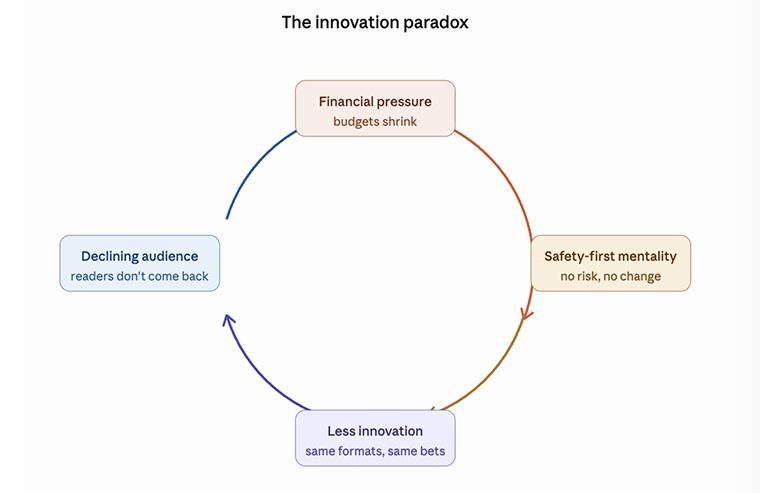
Financial pressure in our industry produces a safety-first mentality. A safety-first mentality produces less innovation. Less innovation produces declining audiences. Declining audiences produce financial pressure.
The cycle is self-reinforcing, and it is very hard to break from inside.
The colleague at that dinner wasn’t a victim of bad luck or a difficult manager. She was a victim of a system that says it wants change while quietly eliminating the people who actually embody it.
A wholesale shift
Over the past few weeks, a text has been making the rounds — shared, quoted, and debated across media LinkedIn. Deborah Turness, the former CEO of BBC News, gave a speech in London in May. It was framed as a dispatch from the front lines of a revolution reshaping journalism.
Turness spent months talking to independent journalists, talent managers, investors, and platform founders after leaving the BBC. Her conclusion: The shift we’re witnessing isn’t just about platforms. It’s about relationships. Audiences are moving from institutions to individuals, from brands to people.
“This is not just another technology-enabled stage in a story of media progress,” she said. “What we’re witnessing is the wholesale shift from one information ecosystem to another.”
She’s right. And the reason the speech resonated so widely is that she names something the industry has been dancing around: The established media’s fundamental problem is not distribution. It’s not format. It’s the relationship between the organisation and the people inside it.
Her prescription? Newsrooms need to liberate their talent. Give journalists the freedom to build direct relationships with audiences — on YouTube, on Substack, on their own terms. Strike a new deal, share the revenue. Or watch the best people leave.
Liberate the talent. Sounds great. But what does that actually mean?
Liberating talent doesn’t just mean giving journalists permission to build a YouTube channel. It means not being afraid of the people who actually want to change things.
That sounds almost too simple to say out loud. And yet, the conversation during my dinner speaks volumes.
My colleague wasn’t lacking ideas. She wasn’t lacking energy or vision or appetite for risk. What she was lacking was an organisation willing to see those qualities as an asset rather than a threat.
If we’re serious about reaching younger audiences, there’s another piece Turness doesn’t address: who gets to sit in the room where decisions are made.
Putting younger people — actual Millennials and Gen Z — into positions of real influence isn’t a diversity initiative but rather a strategic necessity. You cannot build for an audience you don’t understand, and you cannot understand an audience you’ve never been part of.
The same logic applies to professional development. Most industry conferences — and I say this with full awareness of my own position — are still dominated by C-suite attendance. Seen and be seen. Which is fine. But what about the innovative young people inside your organisation? Why aren’t they the ones being sent?
One of the most memorable voices for me at the INMA World Congress in Berlin last month was Siri Pallesen, head of social media at VG. She was also one of the very few Millennials in a leadership role who had made the trip to Berlin.
That’s not a coincidence; it’s a pattern. And it’s one worth breaking deliberately. If you’re looking for a place to start: INMA’s Media Innovation Week in Madrid in September is built around exactly this kind of next-generation leadership. The framing this year — innovators, disruptors, and creators pushing European news media forward — is not accidental.
So if you’re reading this and asking yourself whether you’re doing enough for your talent, that question is already the answer. Don’t send the same people to the same conferences. Don’t promote the safe choice into the role that needs a disruptor. And don’t wait for the most innovative person in your organisation to find a better offer somewhere else. By the time you notice they’re gone, they already decided to leave months ago.
And if you’re reading this thinking I’m onto something, forward it to your boss. Just a thought.
If you’d like to subscribe to my bi-weekly newsletter, INMA members can do so here.
Related Articles
-

Marketers should outsource tasks, not thinking
25 October 2026 -

5 lessons from the INMA Young Audiences Summit
28 September 2026 -

The 3 editorial pillars of Chile’s first streaming news channel
23 September 2026 -

AI’s effect on super user math
15 September 2026 -

What I told 40 CEOs (and won’t gatekeep from you)
30 August 2026 -

Indian Express builds a video-first future around trusted journ...
20 July 2026 -

Economist launches subscription tier targeting younger audience...
20 July 2026 -

Inside Denník N’s successful subscription strategy
15 July 2026
Upcoming Events
-

Subscriber Acquisition Master Class
10-17 November 2026
-

Media Advertising Summit
New York, United States
07-10 December 2026
-

AI-Native News Product Master Class
18-25 February 2027
-

Media Subscriptions Summit
Oslo, Norway
08-12 March 2027
-

World Congress of News Media
New York, United States
25-30 April 2027
-

Branded Content & Partnerships Master Class
20-27 May 2027
-

Subscriber Retention Master Class
17-24 June 2027
-

Conferencia Latinoamericana
15-16 July 2027
-

South Asia News Media Festival
New Delhi, India
19-22 July 2027
-

Asia/Pacific News Media Summit
19-20 August 2027
-

CEO Roundtable at Kilkenny
Kilkenny, Ireland
24-26 August 2027
-

Media Innovation Week
Amsterdam, The Netherlands
27 September - 01 October 2027








