

What happens when a news company’s star voice walks out the door?
Young Audiences Initiative Blog | 27 October 2026

Every few weeks, someone asks me the same question, usually with a slightly worried face: “What happens if we build up a creator and they walk away from us?”
Fair question. So what does happen? And what makes these voices leave in the first place? Two recent cases from Norway and Switzerland offer some surprisingly useful answers.
Fredrik Solvang hosted Debatten, NRK’s flagship political debate show, for years. He signed off in November 2025. This autumn he resurfaced in a small studio a stone’s throw from the Oslo courthouse, hosting Duellen for the Danish subscription audio platform Podimo.
From Debatten (The Debate) to Duellen (The Duel): The name alone tells you he hasn’t left his old show entirely behind. He has just narrowed the room down to two people. Solvang himself calls it a pure debate podcast, preferably with two people.
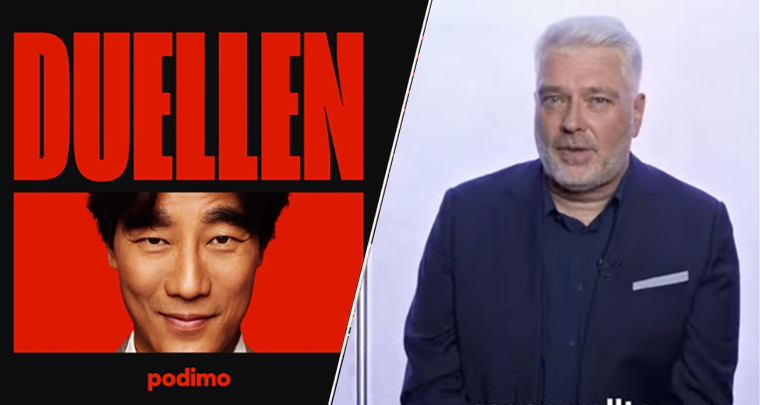
Sandro Brotz has hosted Arena, SRF’s equivalent and arguably the most important political TV format in Switzerland, since 2019. At the end of September, Ringier announced that he will leave SRF after 14 years and launch a video podcast for Blick in February, covering politics, business, and society several times a week. Just in time for the Swiss election year 2027.
Two well-known faces leaving the safest harbour in European journalism: national public television.
The fear we talk about vs. the thing that happened
When publishers worry about building talent, the nightmare scenario usually goes like this: We invest years in someone (young), they go independent, sign a few brand deals, and make a fortune on their own.
But look at what Solvang and Brotz actually did. Neither of them went solo. Neither launched a Substack, a YouTube channel, or a merch line. (And neither of them is — sorry — young). They were bought. One by a platform, one by a competing publisher. They swapped one institution for another.
That’s a much more uncomfortable mirror for media companies. The competition for your best voices isn’t the creator economy; it’s whoever offers them a better deal than you do. And as both cases show, the better deal isn’t necessarily about money.
So why did they go?
Asked whether he was simply fed up with cost cutting and reorganisations at SRF, Brotz pushed back in an interview with persoenlich.com. That was the wrong track, he said. What tipped the decision, according to SRF, was the chance to develop a format from scratch.
Solvang sounds similar. In Podimo’s announcement, he says podcasts allow for “different kinds of conversations and a different dynamic than TV.” On Facebook he promised a show he would want to listen to himself.
Read those lines again and you’ll notice something: Neither is talking about reach, salary, or freedom from editorial guidelines. They are talking about building and about owning a format instead of inheriting one.
And here’s the detail I find most telling: Solvang didn’t leave alone. His long-time colleague Sara Victoria Rygg left NRK after 22 years to keep working with him. The risk isn’t that one face walks out. It’s that a face walks out and takes the team that made the format work.
The real experiment: What’s a name without its show?
This is why I’ll be watching both launches closely. Solvang and Brotz became household names on linear TV, inside formats that were brands in their own right. Arena is an institution in Switzerland; Debatten is one in Norway.
Part of the trust audiences placed in these hosts may have belonged to the format, the time slot, and the public broadcaster behind them.
Now we get to find out how much of that trust is portable.
The two bets also look very different.
Podimo has put Duellen behind a paywall, with one free episode a month as a teaser. That’s a classic funnel, and Podimo knows the Nordic subscription game well: Its competitor PodMe, owned by Schibsted, has built more than 200,000 paying subscribers (listen here to my podcast episode with Kristin Ward Heimdahl ,who leads Podme).
Ringier, meanwhile, calls Brotz’s show a “premium video podcast” but hasn’t said yet where it will live or how it will make money. It’s also not Blick’s first go at video: Ringier shut down its daily Blick TV news shows in 2023. This time, the bet is on a person rather than a channel.
No listener numbers for Duellen have been published so far. (If you have any, I’m all ears!)
What this means for young audiences teams
As mentioned above, neither Solvang nor Brotz is a young creator, and neither show is built for Gen Z. But the lesson travels directly to every newsroom building its own voices on TikTok, YouTube, or in podcasts.
If you build someone up and they leave, that is not proof the strategy failed. It’s proof you built something worth buying. The question is whether you saw it first.
And if you want them to stay, the two cases are pretty clear about what matters: Give your best people something to build, not just something to host. Let them shape the format, choose their team, and own a piece of the result.
Brotz put his own stance plainly: “I prefer uncomfortable questions to a political stance.”
That’s a voice with a clear identity, and clear identities attract buyers.
The alternative is that someone else offers them a blank page — and Podimo and Ringier just did.
Or you hand them the blank page yourself
An announcement I only read this morning shows what an alternative can look like. Axel Springer has launched Axel Springer Creators, a model that lets journalists build their own formats inside the house, with more editorial and entrepreneurial freedom and a share in the financial success.
The first creator is Paul Ronzheimer, another political journalist and one of the best known in Germany. His podcast Ronzheimer ranked No. 1 across all genres in Germany in September, with more than 12 million views and streams across platforms, according to Axel Springer. Ronzheimer steps down as deputy editor-in-chief of Bild to focus on building it out, and his team stays with him.
What we’re seeing here is exactly the missing piece: an internal platform that gives talent room to grow. Everything Solvang and Brotz went looking for elsewhere — a format they own, a team they trust, a stake in the outcome — Axel Springer has now put on the table inside the company.
Axel Springer’s publishing board member Claudius Senst summed up the deal: “We give them the freedom to pursue their own ideas.”
It shouldn’t come as a complete surprise. At INMA’s Innovation Week in Madrid last month, Earl Wilkinson pointed out that trust is moving from the masthead to the individual and that Mathias Döpfner wants to turn Axel Springer into a creator platform within the next five years.
Today, we got the first concrete step.
One more thing, before this turns into a boys’ club
Three men, three political voices. So let me end with a woman who arguably outranks all of them. Christiane Amanpour announced she will leave CNN next June, after 43 years.
She says she’s looking forward to “interesting new projects down the line,” and she already has a foot outside the building: her podcast The Ex Files, which she hosts with her ex-husband Jamie Rubin, is produced by Global, not CNN.
Whether she’ll be the next one to be bought, build her own thing, or simply enjoy a well-earned break, we’ll see. But I’ll be watching. And I noticed one difference already: While Solvang and Brotz both insist they’ll keep their opinions to themselves, Amanpour signed off her statement with her own long-standing motto: Always be truthful, not neutral.
You gotta love Christiane.
If you’d like to subscribe to my bi-weekly newsletter, INMA members can do so here.
Banner photo: Adobe stock image by Midnight Studio.
Related Articles
-

5 lessons from the INMA Young Audiences Summit
28 September 2026 -

AI’s effect on super user math
15 September 2026 -

What I told 40 CEOs (and won’t gatekeep from you)
30 August 2026 -

The Guardian’s experimentation with video leads to new formats,...
26 August 2026 -

Nation Media Group focuses editorial strategy on stories that m...
4 August 2026 -

Economist launches subscription tier targeting younger audience...
20 July 2026 -

Grupo RBS builds social-first video operation to expand audienc...
20 July 2026 -

AI adoption in newsrooms should move from experiment to strateg...
12 July 2026
Upcoming Events
-

Subscriber Acquisition Master Class
10-17 November 2026
-

Media Advertising Summit
New York, United States
07-10 December 2026
-

AI-Native News Product Master Class
18-25 February 2027
-

Media Subscriptions Summit
Oslo, Norway
08-12 March 2027
-

World Congress of News Media
New York, United States
25-30 April 2027
-

Branded Content & Partnerships Master Class
20-27 May 2027
-

Subscriber Retention Master Class
17-24 June 2027
-

Conferencia Latinoamericana
15-16 July 2027
-

South Asia News Media Festival
New Delhi, India
19-22 July 2027
-

Asia/Pacific News Media Summit
19-20 August 2027
-

CEO Roundtable at Kilkenny
Kilkenny, Ireland
24-26 August 2027
-

Media Innovation Week
Amsterdam, The Netherlands
27 September - 01 October 2027








