

As AI passes the experimental phase, product and tech step into the spotlight
Product & Tech Initiative Blog | 12 May 2026

Just before INMA World Congress, we send a survey to participants to get a gauge on how their organisations — and, critically, their C-suites — are really thinking about where the industry is heading next.
We’ve been doing this since COVID so this year is year five, which starts showing some trends. This year brought clarity, particularly around AI. After 18 months of experimentation, uncertainty, and, at times, noise, there is now a much stronger sense of alignment across the industry.
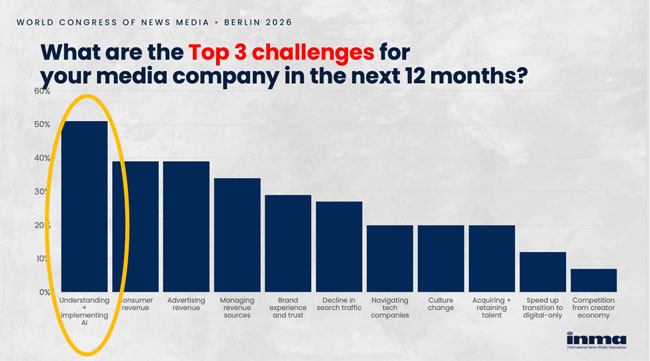
The biggest challenge highlighted over the next 12 months showed 51% of companies was understanding and implementing AI.
1. Product and tech have moved to the centre of the business
One of the clearest signals from the survey is the elevation of product and technology within organisations. This is not simply about increased investment or headcount. It is about where decisions are being made and where strategy is being shaped.
Product is no longer sitting adjacent to editorial and commercial teams, translating requirements into features. It is increasingly the place where these functions converge and where trade-offs are actively negotiated. Technology, in turn, is no longer just enabling delivery. It is shaping what is possible.
This shift has been building for some time. There is a growing recognition that the future of media companies will be defined not just by what they produce but by how those products are designed, distributed, and continuously adapted.
And in an AI context, that raises a more fundamental question: Are product teams still optimising interfaces, or are they being set up to design systems?
2. AI is now understood as a product transformation layer
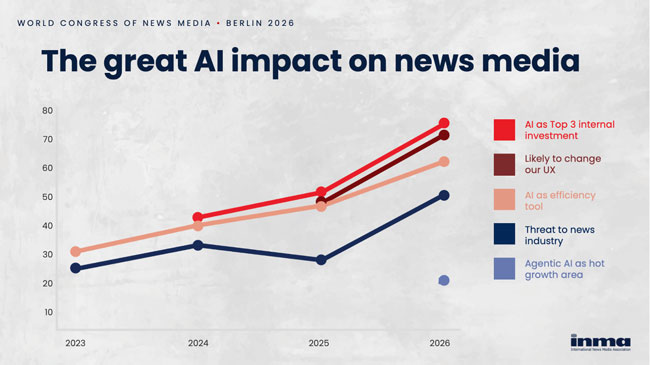
Perhaps the most telling data point in the survey is the shift in how leaders perceive AI’s impact on user experience and product.
In 2025, 48% of respondents believed AI would significantly change the UX and products they create. In 2026, that figure rises to 72%. This is not a marginal increase. It represents a step change in conviction.
Over the past year, much of the industry’s focus has been on use cases: summarisation, transcription, content generation, and workflow automation. These remain important but they are incremental changes, not a fundamental step change.
What is emerging instead is a broader understanding that AI is something that reshapes the product itself. It changes how content is created, how it is structured, how it is discovered, and increasingly how it is consumed.
In practical terms, this means product conversations are shifting. The question is no longer “where can we apply AI?” but “what does our product look like if AI is the starting point?”
3. Direct relationships are becoming more intentional
Another clear theme in the data is the continued emphasis on direct-to-consumer models — subscriptions, owned products, and events. This is not a new direction, but it is being approached with greater intentionality.
For many organisations, direct relationships have historically been framed as a revenue strategy — a way to reduce reliance on volatile advertising markets or platform distribution.
What is changing now is the underlying motivation.
As AI begins to intermediate more of the user experience, the predictability of distribution continues to erode. Referral traffic is less certain. Interfaces are increasingly controlled by third parties. And, increasingly, users are not even aware of the original source of the information they are consuming.
In that context, direct relationships take on a different role. They become a way of maintaining relevance and resilience in a more fragmented ecosystem. They are not just about monetisation, they are about connection, habit, and recognition.
4. Trust is shifting from narrative to infrastructure
Trust also emerges strongly in the survey responses, but the way it is being discussed is evolving. Historically, trust has been treated as a brand attribute — something earned over time through editorial standards, consistency, and reputation.
While that remains true, it is no longer sufficient.
In an AI-mediated environment, trust is increasingly determined by how content is structured, attributed, and surfaced within systems. It becomes a question not only of whether users trust a publisher but whether machines can reliably interpret and represent that publisher’s content.
This creates a new set of challenges. It requires thinking about metadata, provenance, and structure in ways that were previously secondary. It also shifts responsibility. Trust is no longer just an editorial concern; it becomes a product and technology consideration as well.
For many organisations, this is still an emerging area. But it is likely to become central very quickly.
5. Alignment is increasing, but the shift to journeys is still emerging
Taken together, these signals point to a significant level of alignment across the industry. There is broad agreement on the importance of AI, the centrality of product, the need for direct relationships, and the evolving nature of trust and monetisation.
However, there is still a noticeable gap between this alignment and how products are being designed.
Much of the thinking remains anchored in familiar constructs: apps, articles, and individual features. What is only just beginning to take shape is a shift toward designing for user journeys, for moments of need that span formats, devices, and increasingly, systems. This includes thinking about how text, audio, and agentic experiences come together, and how products can support users not just in consuming information, but in taking action.
This is where the next phase of work sits. And why we recently released the report AI first user journeys: a strategic framework for publishers (free for INMA members).
What the survey indicates
What the survey ultimately reveals is not a set of disconnected trends but a coherent direction of travel. The industry is moving toward a model where:
AI underpins how products are built and experienced.
Product functions act as the connective tissue across organisations.
Direct relationships provide stability in a shifting distribution landscape.
Trust is embedded into systems, not just communicated through brands.
Technology is deployed more strategically.
There is now far more clarity than there was a year ago. But clarity, on its own, does not create change.
The real challenge for media organisations is translating this alignment into execution. That means rethinking how teams are structured, how products are conceived, and how value is created in an environment where the rules are still evolving.
We have spent the past 18 months exploring what AI might mean for news media. The next phase is about building accordingly, and doing so with intent.
If you’d like to subscribe to my bi-weekly newsletter, INMA members can do so here.
Related Articles
-

Marketers should outsource tasks, not thinking
25 October 2026 -

5 questions shaping INMA’s Media Tech & AI Week
18 October 2026 -

The front door is gone — and Asia-Pacific publishers are rebuil...
26 August 2026 -

The news company tech stack is now geopolitical
19 August 2026 -

Here’s why I changed my mind about liquid content
18 August 2026 -

Bauer Media reimagines publishing for the age of AI
16 August 2026 -

Nation Media Group focuses editorial strategy on stories that m...
4 August 2026 -

The destination is dead — here’s what replaces it
8 July 2026
Upcoming Events
-

Subscriber Acquisition Master Class
10-17 November 2026
-

Media Advertising Summit
New York, United States
07-10 December 2026
-

AI-Native News Product Master Class
18-25 February 2027
-

Media Subscriptions Summit
Oslo, Norway
08-12 March 2027
-

World Congress of News Media
New York, United States
25-30 April 2027
-

Branded Content & Partnerships Master Class
20-27 May 2027
-

Subscriber Retention Master Class
17-24 June 2027
-

Conferencia Latinoamericana
15-16 July 2027
-

South Asia News Media Festival
New Delhi, India
19-22 July 2027
-

Asia/Pacific News Media Summit
19-20 August 2027
-

CEO Roundtable at Kilkenny
Kilkenny, Ireland
24-26 August 2027
-

Media Innovation Week
Amsterdam, The Netherlands
27 September - 01 October 2027








