

The news business is learning what it actually owns
The Distillation Blog | 02 October 2026

Three rooms, three continents, one sentence.
On Wednesday, INMA published a 45-page report by Pradeep Gairola, chief digital business officer at The Hindu Group, arguing that journalism is not “content” in the AI economy but infrastructure. Yesterday, 135 people from 14 African countries joined our Audience Development Summit and heard how Nation Media Group Uganda spent 37 days off air. A few days earlier, INMA released the Madrid-recorded Debrief from four of our Initiative Leads as the conference emptied out.
For two decades, the news business counted visits and called them an asset. They were not. The asset was always the thing behind the visit — original knowledge, a small core of people who come back, and trust that holds when a platform, an algorithm or a government switches you off.
This week was the inventory. It was uncomfortable, because it also showed how much of that asset we give away or let someone else price.
What AI cannot make
Pradeep’s report, “How AI’s Dependence on Journalism Could Reshape Publisher Economics,” turns the familiar fear inside out. A model can summarise, translate, and rewrite at near-zero cost — by late 2024, AI-generated articles on the Web already outnumbered human ones. It cannot attend the hearing, persuade the reluctant source, or witness the event. To stay useful, it needs three things it cannot manufacture from its own outputs: freshness, credibility and novelty.

He calls the slice of journalism that supplies them the Original News Production Layer, where reality is converted into verified knowledge for the first time. Everything else is derivative, and derivative is where machines compete best. The opportunity, he writes, “is not a journalism premium. It is a scarcity premium.”
The buyers already know the layer is worth money. Between July 2023 and March 2026, the six largest AI companies struck 109 licensing and data-access deals at an average of about US$24 million, and the Associated Press arrangement reportedly resets its terms if a rival later secures better ones. Epoch AI estimates the supply of high-quality human text for training runs out by 2032. For three decades, publishers negotiated with technology companies from a position of dependency; AI, Pradeep argues, introduces the possibility of mutual dependency.
Now the uncomfortable half. Nearly four in five leading Web sites in the United States and Europe block AI crawlers; roughly 70% of Indian news sites remain open, and exactly one Indian publisher has signed a licensing deal. “A decade of traffic obsession has quietly become a negotiating liability,” Pradeep writes; credible publishers and content farms “both left their doors unlocked.” His first instruction is not litigation but measurement: “You cannot negotiate the value of an asset if you do not know what you own.”
The week’s news industry headlines that INMA follows for members read like price discovery without the seller in the room. The Verge reported that Google’s invite-only pilot now pays about 100 publishers whose content “contributes significantly” to AI Overviews, AI Mode, and Gemini — some under US$1,000 over several months, one more than US$1 million a year, formula undisclosed. On Wednesday, a U.S. appeals court upheld Thomson Reuters’ win over Ross Intelligence, the first appellate rejection of fair use for training a commercial AI product, though confined to retrieval rather than generative systems. The same day, California’s governor signed a US$40 million-a-year law that values a journalist at US$20,000 in tax credits. In Louisiana, the owner of The Times-Picayune | New Orleans Advocate told The Lens that “AI licensing contracts will save journalism.”
The insight: A Search Console widget, a federal judge, and a state legislature each put a price on original journalism this week. Pradeep Gairola’s report is the manual for setting your own price first.
The 1% who pay for everything
At the INMA European News Media Conference in Madrid last week, our researcher-in-residence, Greg Piechota, broke a few hearts: “We don’t have a subscription ceiling. We have a Web site ceiling.” Some 82% of subscriptions are still sold through a checkout that began at a paywall — the one channel in structural decline. His analogy was an Apple store on Plaza de España, where only 15% of iPhones are sold. Protect the core, because that is where the money is made. Open more doors, because that is where the people are.
The core is smaller than you think and more valuable than you treat it. INMA benchmarks show 1% of users drive 27% of pageviews; one European national publisher takes 81% of revenue from 1% of its users. The same people carry both revenue lines, which is why the old war between advertising and subscriptions rests “on a wrong assumption.” Switching ads off for subscribers is “the most stupid thing we could do.”
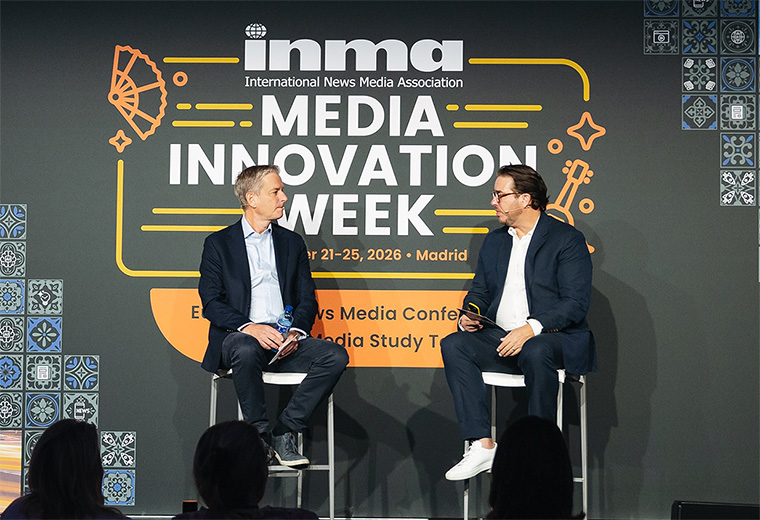
INMA Advertising Initiative Lead Gabriel Dorosz brought the buy side. In the old model, an impression on The New York Times is priced like one on an AI-slop site built for advertising, because the buyer is purchasing a demographic, not a context. That is why advertising “lives out in the shed,” and why he wants the business renamed: “We are in the business of brand partnerships.” The Times — fewer ad slots, no pop-ups — grew digital advertising 21% in the second quarter, its sixth straight double-digit quarter. At the TRB Audience Summit in New York, Will Lee of Adweek called events “a 60%-70% margin business,” and Kirk McDonald of Sundial described the reversal underneath it: “All of our stages become studios.”
Mike Reed of USA Today Co. did the arithmetic out loud at the same summit: 150 million uniques earning two or three dollars a year, 50 million of them from search, against 100 million known people earning six. “I don’t need 150 million. I’m fine with the 100.” Digital-only ARPU hit a record US$10.47, up 34.4%, while digital advertising fell 9.2%. Advance Local, which had no digital subscribers in 2018, now has 250,000. And A Media Operator found Google search traffic to publishers down 40.2% in a year while total pageviews “barely moved.”
Then the catch. A median publisher sees a reader three times a month for three minutes — nine minutes out of 43,200. The Times’ chief data officer has proved the link between TikTok views and subscriptions and still “doesn’t have a dashboard” for it. “If I close my eyes,” Greg said, “you are still there.”
The insight: The audience on your dashboard is the smaller asset. The 1% you can see pays the bills; the behaviour you cannot see is where the next 1% comes from.
The trust that survived 37 days
Africa never had the luxury of mistaking traffic for the asset.
On June 28, Nation Media Group Uganda was shut down — Daily Monitor, NTV, Spark TV, and its radio stations, with military personnel at its premises. It was back in the studio on August 6. Hadija Batuka, its head of marketing, told the INMA Africa Development Summit yesterday what the silence revealed: Audiences went on X to ask the government where NMG was, and that pressure hastened the reopening. The comeback was phased — listen, acknowledge, announce — then staff sold newspapers on the roadside, presenters worked their own social accounts and journalists told the story from behind the scenes. Trust built since 1992 survived 37 days of absence. Doreen Mbaya’s distillation: Brand strength is measured in a crisis.

Maggie Ireri of TIFA Research, whose surveys cover up to 38 countries, dismantled the assumptions we export to Africa. Digital is not replacing traditional media: Weekly news use runs 59% radio, 53% television, and 50% social. And audiences don’t come direct: About half of Kenyans first meet a story on TikTok, YouTube, or an individual creator — and visit the publisher to verify it. Where discovery runs through platforms, the publisher is the verification layer. “Audiences do not need more content,” Ireri said. “They need content that is worth their attention.”
INMA Newsroom Innovation Initiative Lead Sonali Verma hears the same question from Singapore to Toronto — Mediacorp’s Alvin Chong puts it as “After every click, did we give the user a reason to choose us again?” — and on The Debrief she described the strategy that follows: distinctive over commodity, because “why would someone come just to me?”
Tarun Gangwani of WordPress VIP supplied the machine side of the ledger: One AI crawler took 71,000 pages for every reader it sent back in a week, and more than half of Web traffic is now non-human. Yet 86% of consumers at least sometimes check the original source after an AI summary. Sonali’s report this week for the Lenfest Institute shows the division of labour: The Philadelphia Inquirer’s Scrape tool reads council agendas, school calendars, and Facebook pages for six hyper-local newsletters, replacing 12 hours a week one editor spent sifting — the machine sifts, the journalist knows.

At Sowetan, Nwabisa Makunga found a top search query was “Where do I buy an illegal gun in South Africa?” The newsroom turned it into a brief on keeping communities safe; trust, she said, now means relatability as much as credibility. of the Kenya Editors’ Guild closed the day: “Trust is easy to earn, but loyalty is hard to keep.”
The insight: An audience asked its government where the newspaper had gone. No analytics suite will show you that asset — until the day it is the only one you have.
Faces, logos and who owns which
Madrid’s most repeated line was that faces matter more than logos, and the evidence is specific. De Telegraaf relaunched newsletters under journalists’ names: 70% opens for its crime reporter, 85% for a 26-year-old tech reporter, against a Dutch benchmark near 40%. At the Kyiv Independent, a fundraising e-mail written by a frontline journalist converted three times better than polished creative.
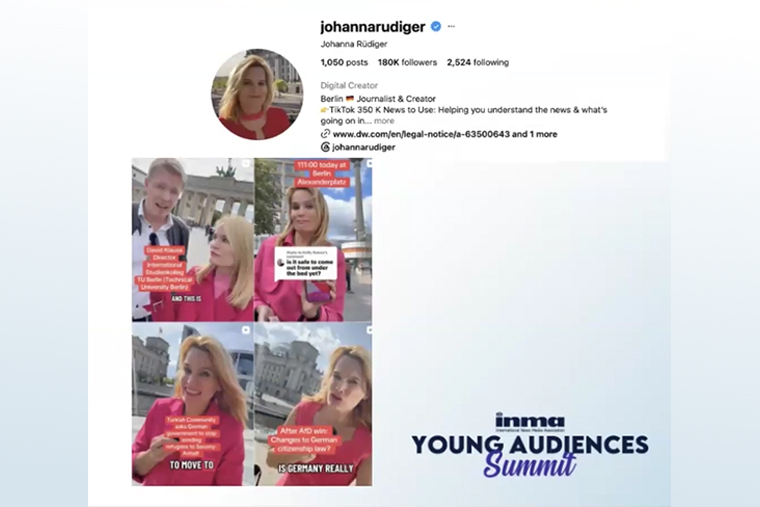
The inventory question follows: Who owns that asset? Kamran Ullah of De Telegraaf admits his stars may one day decide they don’t need the brand; his answer is to invest in them anyway. Mediahuis’ Spilnews — 16 staff, 60 pieces a week, 37 million views this year — chose the opposite: “We will not build our brand around faces,” said Birgit Coenen, who expects her young journalists to leave and hand credibility back to the house. The Washington Post built its creator network deliberately outside the newsroom, and a free newsletter from one former political reporter reached 30,000 subscribers in months. DMG Media grew its social creative team from 20 to 100 on the principle that “brands shouldn’t be scared of creators becoming bigger.” Deutsche Welle’s Johanna Rüdiger is recognised by her wardrobe: “People don’t know my name. They say the lady in the red coat.”
Kerstin Hasse’s five lessons from her recent Young Audiences Summit carry the same accounting. Some 70% of publishers fear creators are stealing attention; among people who use creators for news, creators outscore news brands on every attribute measured, trust included. Her question is the inventory in one line: “Why does someone choose you over the 11 other places they could get the same headline?” The format question is settled. 20 Minuten’s in-app shorts now equal its standard video views: “Vertical video is not a trend; it’s a habit.” Her plea on The Debrief was aimed at the c-suite: Download the apps and look at what people are doing there.
Brand, the oldest asset of all, produced the week’s most honest moment. Members of the INMA European Board asked the room in Madrid where it would put its entire 2027 budget: Brand won with 39%. Asked who actually plans to invest in brand next year, one hand went up. Nieuwsblad invited Flemish schools to compete for a greener playground: 663 schools entered, 160,000 people voted in its app, 45,000 downloaded it, and the regional minister found €3 million for playgrounds. El País marked its 50th anniversary with a free three-day festival that drew 40,000 people. Anders Braso of Monocle: “Nobody needs Chanel.” People still desire it.
The insight: The person is the point of contact; the brand is the stamp of trust. You keep the second only by funding the first.
The next owner of the relationship
INMA Product & Tech Initiative Lead Jodie Hopperton spent the week on the asset nobody in media is counting yet: personal context. As intelligence becomes cheap, four things stay scarce — context, trust, permission, and relationships. “Models can catch up. Context is sticky. And permission makes it stickier still.” She downloaded Meta’s new Muse over the weekend; within days it had written her the prompt to import her history from a rival chatbot. Google and Apple are racing for the same position: the one agent that knows you.
If the agent, not the app, becomes the interface, she asks, “How do you show up inside someone else’s?” Her answer is not despair. An agent that knows you subscribe to the Financial Times can bring FT journalism into your day, unlock what non-subscribers cannot see and take you deeper when you want — “a very different media product.” The Guardian’s 2031 plan already forecasts more traffic from agents than from people; Ofcom finds 21% of U.K. adults use AI apps as a news source, 37% of 25- to 34-year-olds. In Argentina, two 23-year-olds built a free AI audio briefing that scans dozens of national news sources; 80% of users return daily, and it is now the country’s No. 1 news app. Somebody is building the interface on that layer. It isn’t the people who produce it.
The insight: The agent will know what you own before you do. Jodie Hopperton’s line belongs above the strategy deck: The challenge isn’t preserving the interface; it’s preserving the relationship when somebody else owns it.
Three lines on the balance sheet
The inventory has three lines:
- Original knowledge: The layer AI cannot make and already pays US$24 million a deal for — where the door is locked.
- Super users: The 1% who carry 27% of pageviews and both revenue lines, and whose lives you mostly cannot see.
- Trust: The asset that survived 37 days of silence in Uganda, and that advertisers are now willing to price as quality.
Pradeep Gairola’s caution covers all three: “Scarcity creates economic value. Dependency creates negotiating leverage. But neither automatically creates revenue.” You still have to organise, protect and negotiate what you hold. It is the same instruction I gave in Madrid — automate the commodity, invest in the person — with a deadline attached. He puts the window at 2026 to 2032. Marc Isler of Tamedia was blunter: Publishers don’t have five years.
So here is the exercise for your next leadership meeting. Write down the three assets. Beside each, write who currently sets its price. Any row where the answer is not you is the agenda.
Related Articles
-

Marketers should outsource tasks, not thinking
25 October 2026 -

Building is cheap now, but choosing what to build is the real j...
15 October 2026 -

AI’s effect on super user math
15 September 2026 -

INMA unveils 2026 “30 Under 30” Award recipients
7 September 2026 -

The front door is gone — and Asia-Pacific publishers are rebuil...
26 August 2026 -

At Mediacorp’s CNA, loyalty means giving audiences a reason to ...
20 August 2026 -

Tribun Network turns print “dots” into AI-powered insight
20 August 2026 -

Nation Media Group focuses editorial strategy on stories that m...
4 August 2026
Upcoming Events
-

Subscriber Acquisition Master Class
10-17 November 2026
-

Media Advertising Summit
New York, United States
07-10 December 2026
-

AI-Native News Product Master Class
18-25 February 2027
-

Media Subscriptions Summit
Oslo, Norway
08-12 March 2027
-

World Congress of News Media
New York, United States
25-30 April 2027
-

Branded Content & Partnerships Master Class
20-27 May 2027
-

Subscriber Retention Master Class
17-24 June 2027
-

Conferencia Latinoamericana
15-16 July 2027
-

South Asia News Media Festival
New Delhi, India
19-22 July 2027
-

Asia/Pacific News Media Summit
19-20 August 2027
-

CEO Roundtable at Kilkenny
Kilkenny, Ireland
24-26 August 2027
-

Media Innovation Week
Amsterdam, The Netherlands
27 September - 01 October 2027








