

Building is cheap now, but choosing what to build is the real job
The Distillation Blog | 16 October 2026

Gina Chua put it in one sentence to the 126 people from 80 companies in 36 countries who joined the second module of INMA’s Newsroom and AI Master Class on Tuesday: “The question isn’t, can you build? The question is, what should you build?”
She is executive editor of Semafor, a 40-person newsroom where tools built part-time by a reporter and an audience staffer read every reader e-mail, interrogate the news budget from Slack, and cluster 300 CEO interview transcripts by claim.
But the sentence described the whole week of the INMA conversation.
The economics of building have collapsed. When anything can be built, the scarce asset shifts from engineering capacity to judgment: what to build, what to stop building, and what to let someone else build for you.
That is this week’s storyline. It runs from Politico’s Friday hackathons to The Times’ decision to publish 80 fewer stories a day, from Gabriel Dorosz’s advertising playbook to Jodie Hopperton’s question about what makes an AI choose you.
Your 2027 plan is a list of building decisions.
The builders are already in your newsroom
Matilde Baggio, newsroom strategy editor at Politico, started with a birthday list. The DC Playbook reporter spent 20 to 30 minutes a day making sure nobody on the newsletter’s birthday roll had died. In one Friday session with a newsroom engineer, he built an agent that checks every name. It halved the job, and other Playbook teams copied it.
That is the Politico model: three-hour Friday hackathons, three to 12 journalists, each paired with an engineer who unblocks but does not build. Since May, one in four Politico journalists has built an AI tool; 23 prototypes are in use.
“Your best tool builders are already in your newsroom,” Baggio said. “Your job is just to give them the space and the technical coaches.”
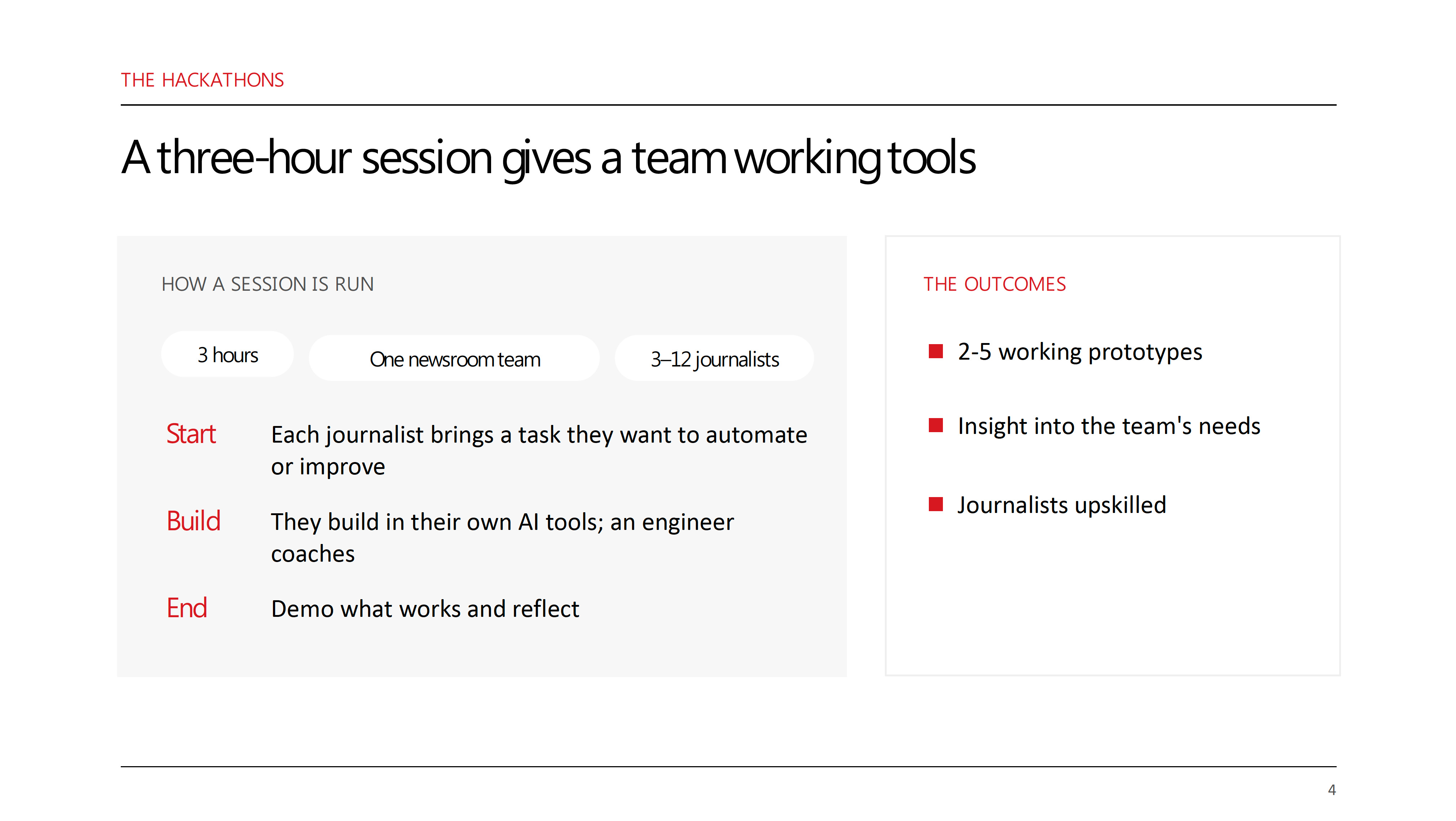
In June, Politico created an Innovation Hub under its product chief to decide which prototypes stay on one desk, which go into a skills marketplace, and which are rebuilt into the CMS.
“Building isn’t the hardest part anymore,” she said. “Scaling and deciding what to scale is hard.”
Reuters made the same choice at 2,500 journalists in 200 locations. Arlyn Gajilan, global editor for AI development and integration, described a “let a thousand flowers bloom” policy with a one-page form: When a personal experiment proves useful to others, a front-line review committee checks the code; anything that touches the CMS or the audience goes to a governance committee chaired by editor-in-chief Alessandra Galloni. Her case against bans: “You cannot govern what you cannot see.”
Her proof of payoff: Publishing a story on Reuters.com took a producer three to five minutes; with AI leaning on wire metadata it takes about 35 seconds, 400 times a day. The team’s attrition problem left with the rote work.
At Sanoma in Finland, Heidi Iivonen asked journalists what made their work difficult rather than how AI could help, collected 74 bottlenecks, and scaled the fixes with three AI coaches, three developers, and three hours of side-by-side coaching for every journalist.
“We did it one person at a time,” she said recently at INMA Innovation Week in Madrid.
The insight: The constraint on newsroom AI is no longer the tool or the engineer. It is whether you have built the review step that decides what deserves to spread. Politico’s hub, Reuters’ one-page form, and Sanoma’s coaches are the same answer in three accents.
Start by building less
Anna Sbuttoni, deputy head of digital at The Times and The Sunday Times, opened the final module on of the Newsroom and AI Master Class on Thursday with a growth story that begins with a cut.
Three years ago, The Times found one-fifth of its articles were barely read and that it could drop a quarter of its stories and keep 95% of its page views. It did. Output fell from 200 to 250 stories a day to about 170, and traffic rose on every desk that made the cut.
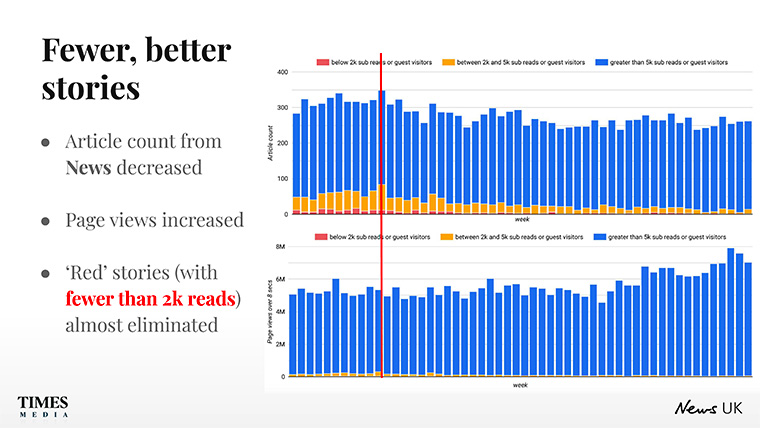
The numbers behind “fewer, better”: 84% of The Times’ subscribers are digital-only, approaching 700,000. More than 70% of subscriber visits are to the app, where readers spend more than nine hours a month. Four straight months of record audience growth.
“More people open and read the daily briefing newsletter than buy the print paper,” Sbuttoni said.
Visual-led pieces earn four-and-a-half times the engagement of a standard story, and people who watched The Times’ journalist-fronted videos were 5% more likely to consider subscribing, a Meta study found. The north star for every team in the business is now a daily return rate; the editorial dashboard ranks stories by subscriber engaged minutes, not views.
Chieu Luu, director of video at the South China Morning Post, made the same call with fewer people.
“We’re not CNN,” he said, so SCMP does not compete on volume. It publishes about 400 videos a quarter on what people come to it for — Hong Kong, China, Asia — and TikTok, which SCMP cannot even see from Hong Kong, is run by a producer overseas and grew about 400% in six months. Video is free, text is paywalled: Video is the front door.
Chua gave the reason this works. Machines, she said, “are actually pretty good at narratives.” Humans should move to the two ends — deciding which questions to ask and engagement. “Be ruthless about what you think humans actually bring to the table. Don’t hang on to things for nostalgic reasons.”
The insight: Cutting output is a building decision, and the cheapest one you will make this year. The Times bought its visual journalism, its live blogs, and its app habit with the 80 stories a day it stopped writing.
Build the business the audience already is
Greg Piechota’s presentation at the Newsroom & AI Master Class reframed the subscription-first newsroom as an audience-first newsroom. He opened with a Helsingin Sanomat job advertisement for a culture journalist that asked for “evidence of generating willingness to pay.” His answer is to define value three ways — craft, engagement, impact — and make the effort visible.
Svenska Dagbladet grew digital subscribers by one-third in 2025 to 130,000 because Editor-in-Chief Lisa Irenius measures for an “aha moment” — new insight, deeper understanding, curiosity.

There is no subscription ceiling, Greg argues; there is a Web site ceiling — a point he has made in recent presentations and his blog.
The median brand sells digital subscriptions to about 2% of households in its market, the top decile 7%, Estonia’s Delfi 25%. Yet four in five subscriptions are still sold at a Web checkout. His build, buy, or borrow grid, crossed with awareness, visit, identity, and payment, maps the doors.
Build is slow; borrow can be fast. Die Zeit sold 50,000 podcast-only subscriptions on Spotify and Apple at €10 a month, and 80% of those buyers had never read Die Zeit. When CNN took All Access to Britain and Canada this week, Greg gave Digiday in an interview the INMA numbers: Across 318 benchmarked brands, monthly users fell 14% from 2024 while heavy users held. “Those heavy users are now the business.”
Público in Lisbon put a door in the wall between newsroom and commerce, then knocked half the wall down. Greg’s three conditions for making the change stick: evidence, routines, and decision owners with authority.
Kerstin Hasse supplied the audience most publishers have not built for: 52% of 18- to 24-year-olds now name social video or AI as their main news source, per the Digital News Report.
Her three moves: show up where they are (Mediahuis’ Spilnews, a creator newsroom built deliberately “breakable” beside the legacy brands), build the product for them (20 Minuten’s in-app vertical video feed), and price for them (The Economist’s US$15 tier of games, podcasts, audio, and short video).
“It’s not them,” she said. “It’s us.”
In her blog this week she went further: For young people the side door “is often not the entrance. It’s the destination.” Build for super fans, not super readers.
The insight: Most publishers have one door and a sales operation behind it. The grid is a budgeting tool: Decide which doors you build, which you buy, and which you borrow — and give one person the authority to say no to the rest.
Advertising has to be built in, not bolted on
Gabriel Dorosz’s Webinar on October 14 was the commercial version of the same argument: “The business that is built on the idea of traffic is dead,” he said.
Ad spend on news is down 33% since 2019 while global advertising keeps growing. The 1% of super users who generate 60% to 81% of a publisher’s subscription and advertising revenue are the very people we switch the ads off for — “and so we built the business this way.”
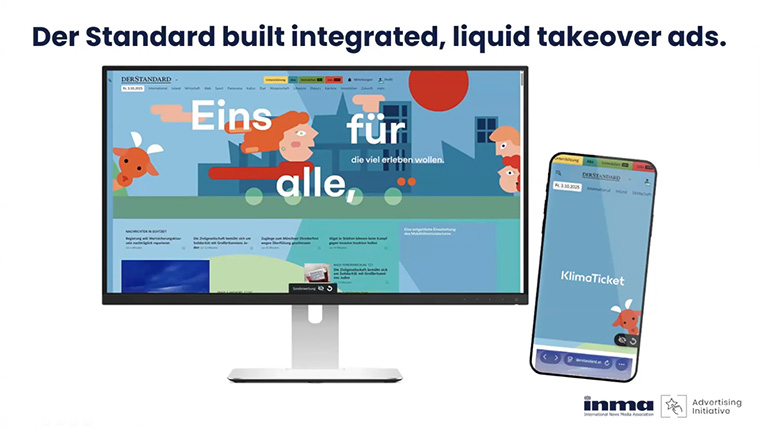
His playbook is a list of what to build: Der Standard’s “liquid takeover” and Russmedia’s vibe-coded micro-apps instead of banners; Mediahuis’ In-Market and The New York Times’ Brand Match selling outcomes instead of reach.
Bake advertising into product development because adding it afterwards is “a big reason why we end up with interruptive formats, awkward placements, and bad experiences.”
“Make the ads worthy of the journalism,” he said.
The old business is ad inventory; the new one is brand partnerships. Protect the old as long as you can, “but it is not the future.”
Spain showed him the transition mid-stride. AS grew ad revenue this year while traffic fell by doubling social branded content, and La Voz de Galicia’s Tomás García Morán borrowed Webedia’s line for the mobile ad experience: “Michelin star restaurants with the rubbish in the middle of the restaurant.”
Gabe’s summary: “Nobody apologises about a sponsored festival; almost everyone apologises for the programmatic.”
His four advertising lessons from INMA Madrid make the same list. I opened that conference with the line I borrowed from our CEO Roundtable in Vail — you build businesses around things that are scarce — and Eimear Moran of The Irish Times closed it: “Scarcity makes a premium. Scarcity is like selling diamonds.”
De Telegraaf’s Kamran Ullah sends newsletters under journalists’ names rather than the masthead and opens 70% to 85% of them against a Dutch benchmark of 40%. Amedia grew video advertising 54% in a year by putting audience before ads.
The thing not to build yet is agentic advertising. Gabe came back from Advertising Week in New York this week with a market of US$30 million to US$50 million and one open question: “Nobody wants agents to rebuild the ad tech tax; whether they will is still an open question.”
The insight: Advertising designed after the product is the definition of a bolt-on. If 2027 brings one new product, put the commercial team in the room on day one and sell the partnership, not the impression.
Build for the machine that chooses
Jodie Hopperton’s two blogs this week moved the question up a level, from the audience to the agent acting for the audience.
She is sceptical of AI licensing as strategy: “Take the money. But don’t confuse a revenue stream with a strategy.”
Her alternative is authentication: You prove your Wall Street Journal subscription to your personal AI, and the AI brings Journal reporting into your answer, by name. “Licensing may be tactical. Authentication feels structural,” she said.
The competition shifts from attention to intention: “What makes an AI choose you?”
The money is real. Mather’s Benji Stalvey cites 94 announced AI licensing deals by July, The New York Times’ Amazon agreement reportedly worth more than US$20 million a year.
So is the reason: When a Google AI summary appears, Pew finds users click a result 8% of the time instead of 15%, and a source cited inside the summary 1% of the time. Licensing, he argues, now deserves the attention given to advertising and subscriptions, starting with an audit of what you own the rights to sell.
Two master class speakers showed what gets built there. Kevin Delaney, editor-in-chief of The San Francisco Standard, took a US$150,000 Lenfest grant on January 20 and had an AI-native app live for subscribers by early April: an LLM profile for every reader (“burritos in the Mission District” is a valid interest), AI-generated briefings, polls, and a map of stories, with editors approving polls and AI barred from writing about murders.
“You can now write a prompt that effectively creates any feature in your app.”
Next: reporters filing the notes and quotes that never make an article into the same corpus, for the day they matter.

Francesco Marconi of AppliedXL closed the master class by calling journalism “delta science” — knowing what changed and why it matters.
His team codifies each beat as an event atlas and an ontology of actors, then lets agents watch for consequential change, he said: “News is not really new; it’s the reoccurrence of a pattern.”
His advice was to shift 80% of resources to news gathering because “even reporters will become editors.”
The insight: Licensing pays for this year. Authentication, permissioned access, and proprietary observation are what you build to still be chosen in 2030.
What the week says about your company
Some of what you have built is not yours to keep. Ben Whitelaw of FT Strategies warns new subscription laws in Canada, Colorado, Maryland, Europe, and the United Kingdom will make cancelling easy — and expose how much retention was inertia rather than value.
His audit list: low-engagement segments, failed cancellation attempts, triallists who never formed a habit. Retention you did not earn is a product you did not build.
And some of what matters most needs almost no budget. Dagblad van het Noorden built a true-crime podcast with four people and no outside help: two million downloads in four months, hundreds of listener tips that changed the reporting, and more than 250 voluntary donations.
“Innovation doesn’t have to start with a big strategy,” Bergens Tidende’s Hanne Louise Akernes said in Madrid. “Sometimes you just have to start.”
Two guest pieces from Harare and Milan agreed: The Future Newsrooms Study finds the greatest threat is not technology but “the inability of news organisations to adapt their culture, structures, and skills.” Meanwhile, trust in U.S. media sits at 28% — trust being the one thing nobody can vibe-code.
So the question for your 2027 budget is no longer whether you can afford to build. You can build almost anything, in weeks, with the people you already employ.
The question Gina Chua left with the master class is the one I would put to every leadership team: Of everything you could build now, what would your audience miss if you didn’t — and what are you still building that nobody would?
Related Articles
-

Marketers should outsource tasks, not thinking
25 October 2026 -

AI’s effect on super user math
15 September 2026 -

INMA unveils 2026 “30 Under 30” Award recipients
7 September 2026 -

At Mediacorp’s CNA, loyalty means giving audiences a reason to ...
20 August 2026 -

Tribun Network turns print “dots” into AI-powered insight
20 August 2026 -

Nation Media Group focuses editorial strategy on stories that m...
4 August 2026 -

Briefly News empowers journalists with AI tool suite Nova
4 August 2026 -

AI adoption in newsrooms should move from experiment to strateg...
12 July 2026
Upcoming Events
-

Subscriber Acquisition Master Class
10-17 November 2026
-

Media Advertising Summit
New York, United States
07-10 December 2026
-

AI-Native News Product Master Class
18-25 February 2027
-

Media Subscriptions Summit
Oslo, Norway
08-12 March 2027
-

World Congress of News Media
New York, United States
25-30 April 2027
-

Branded Content & Partnerships Master Class
20-27 May 2027
-

Subscriber Retention Master Class
17-24 June 2027
-

Conferencia Latinoamericana
15-16 July 2027
-

South Asia News Media Festival
New Delhi, India
19-22 July 2027
-

Asia/Pacific News Media Summit
19-20 August 2027
-

CEO Roundtable at Kilkenny
Kilkenny, Ireland
24-26 August 2027
-

Media Innovation Week
Amsterdam, The Netherlands
27 September - 01 October 2027








