

The visit is no longer the unit of the news business
The Distillation Blog | 28 August 2026

This is the first edition of The Distillation, so one sentence on what it is: Every week INMA produces more than any media professional can read (the “INMA conversation”), and The Distillation finds the one storyline in the pile — what mattered, why, and what it means for your company.
One thesis, not a roundup.
The lead to the story
The news business is moving out of the house it built.
For two decades, search sent people to a front door, the door opened onto a Web site, and the Web site was the business. This week, from four directions inside INMA, the industry conceded the visit is no longer the unit of the business.
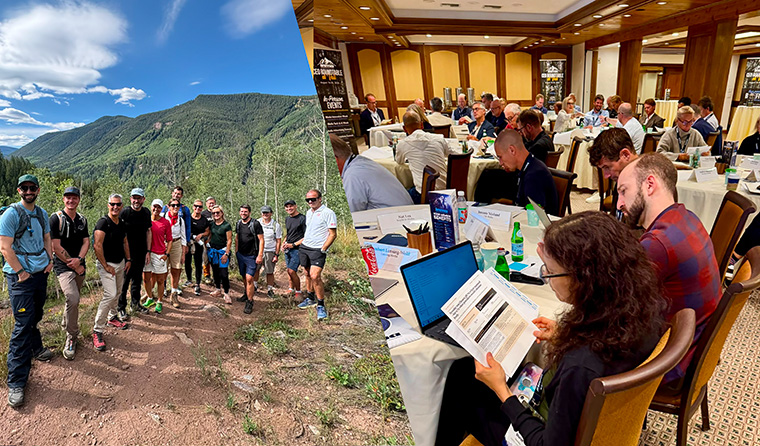
- INMA CEO Roundtable at Vail: Forty CEOs concluded that what we sell — trust, judgement, provenance, presence — has to travel with the customer rather than wait for one.
- Wednesday’s INMA Webinar: The Guardian and Frankfurter Allgemeine Zeitung (FAZ) explained why they are hiring for YouTube, TikTok, and Instagram — real estate they will never own.
- INMA Asia-Pacific News Media Summit: Publishers from nine markets reported the front door is gone, and habit is what replaces it.
- INMA’s newsroom blogs: USA Today, WSJ Japan, and El Vocero moving AI from the cost line into the delivery layer.
Underneath everything sits the same unresolved problem: We know what we are selling, and we have yet to prove what it is worth. That was the finding of Vail. It turns out to be the finding of the week.
The insight: Once the visit stops being the unit of the business, every KPI built on it — pageviews, sessions, CPMs — becomes a lagging indicator. Your dashboards are measuring a building that is emptying.
The numbers behind the exodus
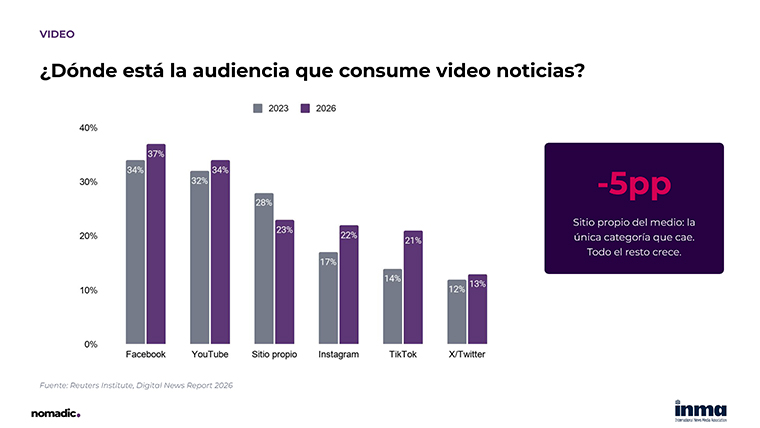
Nomadic’s Ignacio Zaccagnino gave INMA members in Latin America the new traffic map in a Webinar last week: Google organic traffic to publishers down 33% in a year — 22% for large publishers, 47% for medium, up to 60% for small — and 68% of searches ending without a click. Referrals from AI chatbots remain below 1%.
His framing is the useful one. Audiences have not disappeared. They have been redistributed — to Discover, now roughly half video; to YouTube, the second-largest search engine on Earth; to chatbots that send back almost nothing.
Glide’s Richard Fairbairn, comparing his London peer event with INMA’s summer, reached the same diagnosis on the Content Strategies blog: relationship over volume, the archive as the moat, and a “rule of three” — a new reader who returns three times in a week is retained long-term in 78% of cases. The UK Association of Online Publishers expects referrals to halve again by late 2027.
Press Gazette’s U.S. audit confirms it from outside: The top 50 news sites have lost 37% of their visits in two years, and the brands that held are the ones with a direct habit. Brands that built habits held. Brands that rented an audience from a referrer did not.
The insight: The people didn’t stop wanting news. They stopped coming to get it. If your 2027 budget still assumes search recovers, it is not a budget. It is a hope.
What Vail agreed — and could not do
The official report of the Vail Roundtable went to the 40 participating CEOs this week and, under Chatham House rules, stays with them. The argument of the room is ours to share, and I gave the first account of it on Monday.
Across nine sessions, every INMA faculty member reached the same answer to what a news company sells in an AI economy: trust, relationships, judgement, provenance, presence. AI has collapsed the marginal cost of the article. What remains scarce is expensive to build and hard to measure.
Then Greg Piechota asked two questions. Who knows who their super users are? Five hands out of 40. Who can put a currency figure on them? Essentially nobody.
Gabe Dorosz named the gap: We have spent a year calling trust our moat, and a moat is a cost centre until somebody builds a toll on it. Platforms get paid because they prove what they deliver. We will be paid the same way, or not at all.
Six sessions in six vocabularies converged on one instruction: Build products that travel with the customer — the journalism, the brand and, if Jodie Hopperton and Kerstin Hasse get their way, the subscription itself, unlocked inside TikTok or Instagram.
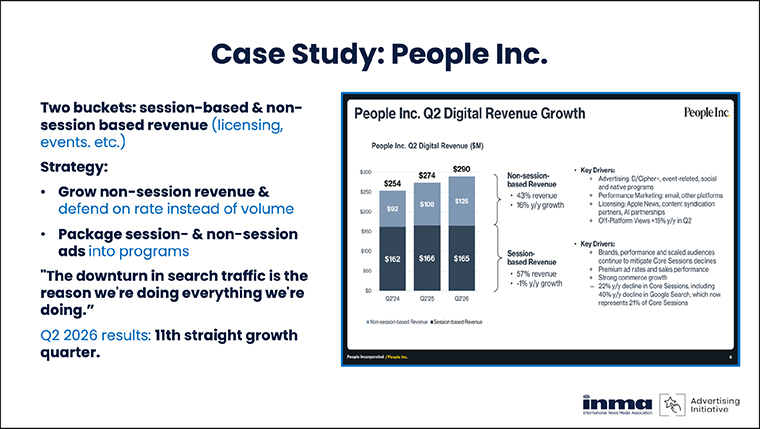
The case study that stopped conversation was People Inc.: sessions down 22%, rates up 27%, and non-session revenue — licensing, events, everything independent of a visit — now 43% of digital revenue.
The clock the room set itself: Within six to 24 months, publishers are either paid suppliers or free raw material.
The insight: Forty CEOs from six continents agreed on the product and not one could price it. That is not a strategy gap. It is a measurement gap, and measurement is a budget line with an owner’s name on it.
Two newsrooms that packed their bags
Wednesday’s INMA Webinar was Vail’s practical companion.
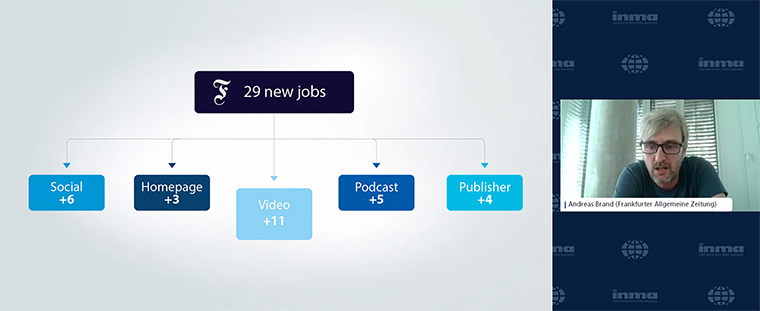
Sonali Verma polled the 160+ members on the Webinar about their biggest challenge in scaling video. Money won. “Proving the ROI is the most difficult,” said FAZ’s Andreas Brand, “because it’s almost not in our hands.” Both speakers are investing anyway.
Frankfurter Allgemeine Zeitung (FAZ): On April 23, every editor in the house was summoned to Frankfurt’s largest conference room, where Publisher Carsten Knop announced 29 new positions — six in social, five in podcasts, 11 in video — while most German media companies are cutting.
“The central question is not only what we publish and how good we are,” Brand said. “It is how we remain part of the conversation.”
FAZ learned the craft producing an economics explainer for funk, the public broadcasters’ youth platform — 27,000 views a video in season one, half a million by season three — and now wants the same under its own name on YouTube, with specialist editors as creators.
The aim is not to turn every journalist into an influencer. It is to make expertise visible where people already are.”
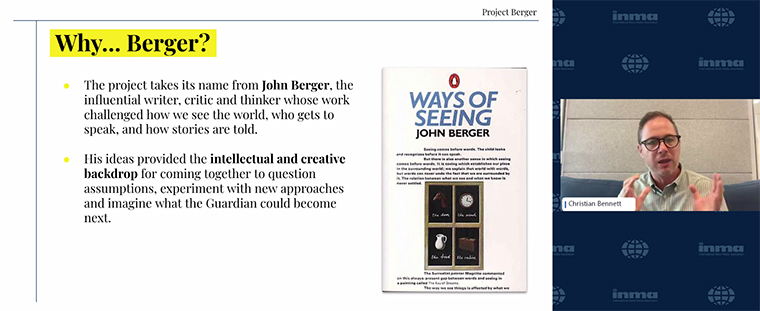
The Guardian: Christian Bennett runs Project Berger, named for the critic whose television series Ways of Seeing became a book — a text-centric message to a text-centric organisation. His opening statistic: The Guardian publishes two novels’ worth of text a day and, when the project began, one Instagram video.
Beating your traditional competitors proves nothing, Bennett said, because “this could be a race that everyone loses.” So The Guardian is doing the unglamorous work: an engaged-time metric across text, audio, and video, on and off platform, and a brutally honest daily playback on every show.
One line for the wall: “It’s going to be more expensive than you think, and you’d better be piloting longer than you think.”
The insight: Two of Europe’s most text-bound institutions decided the ROI question can only be answered after the investment, not before. If you are waiting for proof before funding video, you are waiting for a number your competitors are generating without you.
Asia-Pacific got there first
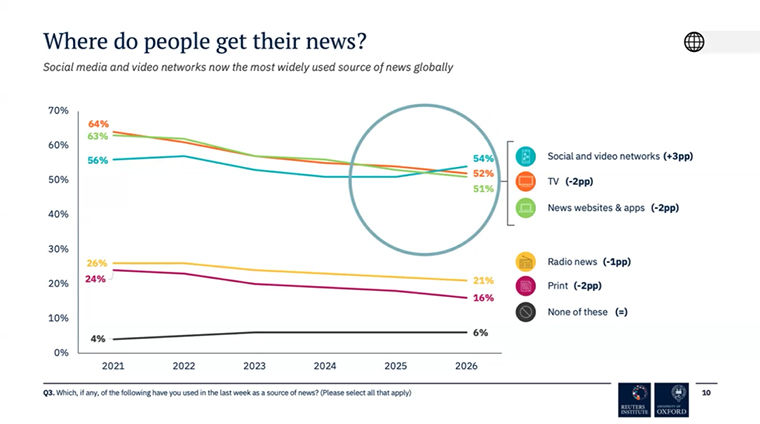
INMA Senior Editor Dawn McMullan’s synthesis of the recent INMA Asia-Pacific News Media Summit carries a headline that could serve the whole edition:The front door is gone. In Indonesia, Malaysia, and the Philippines, social and video overtook television and news Web sites years ago.
What replaced the funnel was not a better funnel. It was habit.
- Mediacorp’s CNA runs a daily product with a 27% daily return rate. Alvin Chong’s test after every click: “Did we give them a reason to choose us again?”
- The Philippine Daily Inquirer windows its journalism around the moments of a reader’s day. Arlene Burgos: “A platform referral is rented attention.”
- Maekyung Media Group turned a 10-million-article archive into a cited knowledge engine and grew subscribers 213% in 30 months.
- Universal McCann Malaysia’s Sue-Anne Lim, from the buy side: 200,000 organic shares are worth more than 20 million paid impressions. Sell the community, not the leftover inventory.
Kerstin Hasse’s line on young audiences is the sharpest of the week: More than half of 18- to 24-year-olds have never engaged with news through a newspaper or news Web site. “This is not a churn. This is a generation that’s never walked through your front door.”
The insight: The markets that lost the front door first did not die. They rebuilt around daily jobs to be done. Your retention problem may be a habit problem wearing a paywall’s clothes.
The newsroom moves upstream
Other INMA blogs from the week tell the same story from inside the building.
At USA Today Network, Jessica Davis asked whether a human is really needed in every loop. Reviewing every AI output, she argues, “puts a cap on how fast our industry can innovate at scale.” Her answer is editorial evals — measurable definitions of success, with humans brought in where judgement matters most. Accuracy on a public-records bot reached the high 90s; deployment went from months to days.
At WSJ Japan, George Nishihama found AI translation is “not a one-and-done deal”: glossaries, proofreading agents, and sampling never stop, and translators have become system orchestrators.
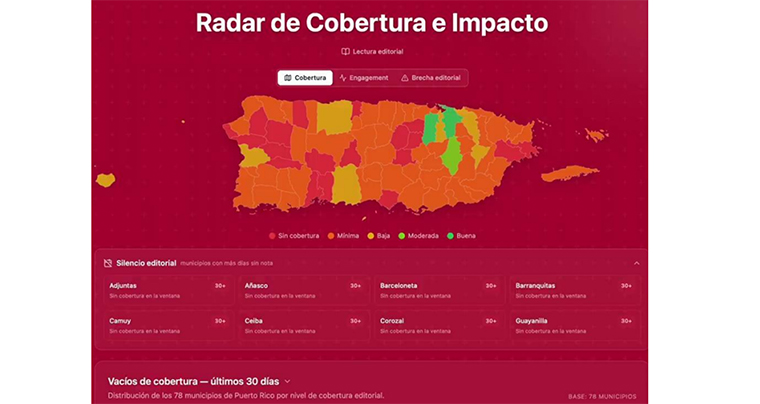
At El Vocero in Puerto Rico, agents found the 12 of 78 municipalities the newspaper did not cover at all last month — AI applied to what is missing, not to producing more.
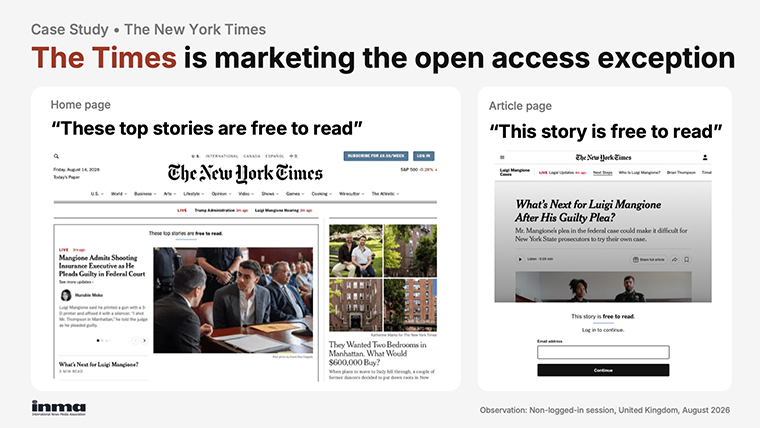
Meanwhile, USA Today Co. is rebuilding its pages so AI systems can read and cite them, and The New York Times is testing AI summaries in its own site search. Closer to home, Greg Piechota caught The Times promoting “free to read” stories on its homepage — managing what he calls the shadow of the paywall, the one readers build in their heads, which “may be suppressing more demand than the real one stops.”
This is the third audience Jodie Hopperton described in Vail: humans, agents acting for humans, and the AI systems themselves. Vail’s AI visibility audit found that when an AI could choose any source, only one in four citations went to the participating brands. AI cannot recommend what it does not understand.
The insight: Journalistic artefacts are becoming commodities whilst journalistic processes — verification, judgement, accountability — gain value. The machine-readable layer is being built now by publishers who intend to be paid suppliers, and standards will harden around whoever shows up first.
What it means for your company
Distil the week, and you get three sentences.
- The visit is no longer the unit of the business.
- The brands that held have a direct habit — a newsletter, an app, a podcast, a games franchise, a login.
- Everyone else is discovering the referral was rented.
What travels is the journalism, the brand, and possibly the subscription itself. FAZ and The Guardian are not chasing views. They are moving expertise to where the audience already is, in its format, with their names on it. That is a product decision, not a distribution tactic. And the habitat is being re-zoned beneath it: Australia’s new platform levy, Meta’s settlement capping teenagers at two hours a day.
And the thing that travels has to be priced. Gabe’s three ways to monetise trust — attention, influence, intent — all require proof. Chartbeat’s Kiran Paranjpe put it well on INMA’s Digital Strategies blog: We spent 20 years optimising how advertising is bought and forgot to optimise how it is sold. Same toll booth, still unbuilt.
Vail left three decisions with dates on them:
- Settle your crawler policy — lock, license, or pool collectively — with a named owner before Cloudflare’s September 15 default.
- Re-forecast the P&L assuming a 50% cut in search traffic.
- Name an owner for super users with a 90-day mandate: who they are, what they are worth, how to grow them whilst protecting reach.
I said in Vail that we agree on what we are selling and have yet to prove what it is worth. A week later I would sharpen it. We have left the building. We have not yet sent the invoice.
Which leaves one question for your executive team: When the AI buyer says it will pay only for what is unique and unobtainable free — what, precisely, would you hand it?
The Distillation is INMA’s weekly read on where the news business is going based on our content. Available as a blog, a newsletter, and a podcast.
Related Articles
-

Readers’ agents are becoming customers, and most publishers can...
28 October 2026 -

Why publishers are blocking bots by default to starve the black...
28 October 2026 -

What makes an AI choose your news brand?
14 October 2026 -

Licensing won’t save media, but authentication might
13 October 2026 -

AI is now media’s operating environment
28 September 2026 -

5 lessons from the INMA Young Audiences Summit
28 September 2026 -

Agents, liquid content, vibe coding raise questions for news me...
9 September 2026 -

What I told 40 CEOs (and won’t gatekeep from you)
30 August 2026
Upcoming Events
-

Subscriber Acquisition Master Class
10-17 November 2026
-

Media Advertising Summit
New York, United States
07-10 December 2026
-

AI-Native News Product Master Class
18-25 February 2027
-

Media Subscriptions Summit
Oslo, Norway
08-12 March 2027
-

World Congress of News Media
New York, United States
25-30 April 2027
-

Branded Content & Partnerships Master Class
20-27 May 2027
-

Subscriber Retention Master Class
17-24 June 2027
-

Conferencia Latinoamericana
15-16 July 2027
-

South Asia News Media Festival
New Delhi, India
19-22 July 2027
-

Asia/Pacific News Media Summit
19-20 August 2027
-

CEO Roundtable at Kilkenny
Kilkenny, Ireland
24-26 August 2027
-

Media Innovation Week
Amsterdam, The Netherlands
27 September - 01 October 2027








